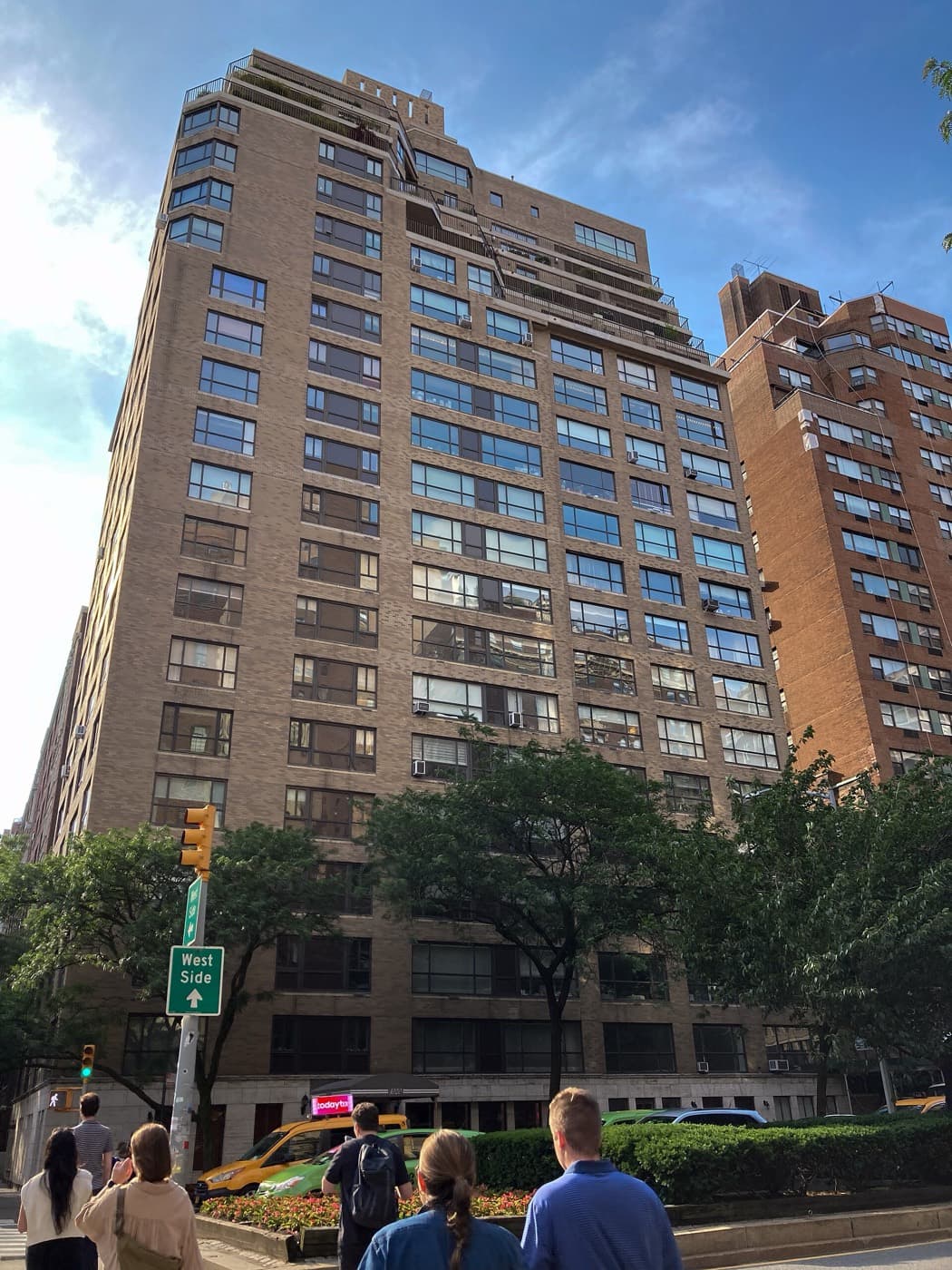
1020 Park Avenue
1020 Park Avenue, New York, NY 10028
Upper East Side
BBL 1014970034 · BIN 1046833
- Year built
- 1962
- Type
- Cooperative
- Units
- 52
- Floors
- 21
- Landmark
- Designated
- Flip tax
- 2% of the gross sale price, paid by the purchaser (in effect for contracts dated on/after January 1, 2016; immediate-family transfers exempt).
- Financing
- Up to 50% financeable (50% minimum down) — materially more restrictive than typical trophy-co-op norms.
- Subletting
- Owner-occupancy required — title must be taken in the name of the occupant; the house rules provide no general subletting allowance (effectively not permitted).
- Pied-à-terre
- Permitted, subject to board approval.
- Washer / dryer
- Permitted under House Rule 7A with conditions — high-efficiency machine, drip pan with flood-stopper, and restricted dryer venting on the landmark Park Avenue façade.
- Pets
- Permitted — a pet-friendly building.
- Smoking
- Non-smoking building, including inside apartments, since January 1, 2019.
- Alterations
- Require prior written Board approval, a security deposit, and licensed contractors; new shareholders must replace the original windows within six months of closing.
Compiled by The Roebling Research Desk from the building’s offering plan, amendments, and related building documents (primary source dated 2021). Board policies can change by amendment — confirm at the offer stage.
Every recorded sale at this building, 2002–2026
Bedroom-by-bedroom medians, the full transfer record, and how units trade against ask.
- 3BR median
- $2.8M
- Recent range
- $2.2M – $3.1M
- Listing discount
- 10.1%
- Recorded transfers
- 44
Own an apartment here? See what it would sell for.
A Private Pricing Opinion — what your apartment at 1020 Park Avenue would likely sell for today, what it costs to sell, and what you’d walk away with — reviewed personally against condition, exposures, renovation quality, and the competition actually on the market.
1020 Park Avenue is one of the most architecturally consequential mid-century modernist cooperatives on the Carnegie Hill / Lenox Hill seam of Park Avenue. The building was completed in 1962 by Lipman-Spitzer Company under the architectural direction of Wechsler & Schimenti — the New York firm whose body of late-1950s through 1980s work includes 200 Central Park South (the firm's most architecturally consequential commission), 60 Riverside Drive, and (in collaboration with Der Scutt) The Corinthian.
The building's architectural identity is structurally distinct from the surrounding pre-war Carnegie Hill cooperative tradition. Where 1040 Park (Delano and Aldrich 1925) three doors north, 1075 Park (Blum brothers 1929), 1133 Park (Schwartz & Gross 1928), 1175 Park (Emery Roth 1925), and the broader Carnegie Hill pre-war Park Avenue inventory deploy the classical Renaissance Revival and pre-war modernist vocabularies of the 1920s building cycle, 1020 Park is executed in the mid-century white-brick idiom that Wechsler & Schimenti and a small group of peer firms (notably Sylvan Bien, Emery Roth & Sons in his post-war work, and Philip Birnbaum) developed in the 1955-1975 building cycle along Park Avenue. The travertine marble base, the chamfered upper-story massing with bay windows, the asymmetrical setbacks producing private terraces on the upper floors, and the modest entry canopy together define the building's distinctive mid-century identity within the broader Carnegie Hill streetscape.
The architectural significance is recognized institutionally. The Park Avenue Historic District — designated by the New York City Landmarks Preservation Commission on April 29, 2014 (LP-2547) — covers Park Avenue from East 79th Street to East 91st Street and includes 1020 Park as a contributing structure. The Historic Districts Council's "Six to Celebrate" program, which identifies the city's most architecturally consequential preservation-priority districts, explicitly recognized 1020 Park (along with 1036 Park and 1065 Park) as among the architecturally significant post-war buildings on the corridor.
The cooperative's institutional structure places it among the earliest Park Avenue cooperatives of the post-war construction cycle. The cooperative corporation 1020 Park Ave., Inc. was incorporated on August 21, 1961 — predating construction by approximately one year, in a corporate structure common to early-1960s Park Avenue development where the entity was formed to acquire the land and undertake construction in a single integrated vehicle. The building was completed in 1962 and converted to cooperative ownership in 1966, placing 1020 Park among the earliest Carnegie Hill Park Avenue cooperative conversions of the post-war era — well before the broader 1970s-1980s cooperative-conversion wave that produced most of today's Park Avenue cooperative inventory.
The 52-residence scale places 1020 Park among the smaller-to-mid-size Carnegie Hill Park Avenue cooperatives — meaningfully larger than the tightest pre-war Candela peers (740 Park: 33; 778 Park: 18; 720 Park: 31) but smaller than the larger Carnegie Hill pre-war peers (1040 Park approximately 100; 1199 Park approximately 60-70). The combination of 52 residential apartments plus 5 ground-floor professional office spaces produces both a manageable institutional density and a structurally meaningful supplementary revenue stream from the commercial tenants.
The professional-space rental income is one of the building's structurally distinctive financial attributes. Per the cooperative's 2019 audited financials, the 5 ground-floor offices generated approximately $412,000 in annual commercial rent to the cooperative corporation — equivalent to roughly 12 percent of total cooperative revenue and a structural cash-flow cushion that materially offsets shareholder maintenance pressure. This is uncommon among peer Park Avenue cooperatives and represents one of the building's most meaningful structural financial advantages.
For buyers, 1020 Park represents a particular position in the Carnegie Hill / Lenox Hill market: Wechsler & Schimenti architectural pedigree at the firm's broader mid-century white-brick body of work; the structurally distinctive 52-residence scale; the prestigious Park Avenue and East 85th-86th Street geographic position immediately south of the corridor's most consequential intersection; the architecturally protected Park Avenue Historic District designation; and the structurally meaningful commercial rental income that produces a more stable cooperative-financial profile than most peer Park Avenue cooperatives.
Architecture and unit composition
The 52 residential apartments distribute across the building's 21 stories in configurations consistent with the 1962-vintage mid-century cooperative idiom. Wechsler & Schimenti's interior architectural vocabulary produced apartments with the substantial ceiling heights, formal layout discipline, and architectural fabric characteristic of the early-1960s Park Avenue cooperative tradition. Apartment configurations include classic-six and classic-seven layouts on the standard floors (with the A-line typically configured as the larger corner residence on each floor), 2-bedroom and 3-bedroom standard configurations across the broader apartment inventory, and combined-unit configurations on select floors (15AB as one documented example).
The defining architectural feature for the upper floors is the asymmetrical setback massing with bay windows and private terraces — apartments on the upper setback floors (approximately the top six floors) carry private outdoor space that materially distinguishes them from the standard-floor inventory below. The 21A combination, for example, includes an approximately 45-foot setback terrace with four exposures.
Apartment interiors carry the mid-century architectural vocabulary characteristic of 1962-vintage Park Avenue cooperative construction. Cumulative building improvements over the cooperative's six-decade history have been substantial: per the 2019 balance sheet, $6.34 million in capitalized improvements relative to the $1.95 million original 1961 cost basis — indicating sustained reinvestment in lobby renovations, elevator upgrades, mechanical systems, and the substantive Local Law 11 façade restoration work undertaken in the 2020 cycle.
Park Avenue-facing apartments (east exposure) look across the Park Avenue median plantings. 85th Street-side exposures look across the cross-street to neighboring buildings.
Building operations
1020 Park Avenue operates as a full-service white-glove cooperative under the corporate entity 1020 Park Ave., Inc. Building services are provided by SEIU Local 32BJ-represented employees under the multi-employer Building Service 32BJ Pension Fund collective bargaining structure.
A meaningful union note: Per the 2019 audited financial statements, the 32BJ Pension Fund was in "red zone" funding status (less than 65 percent funded) as of July 2019, with critical-status designation and a rehabilitation plan in effect. The red-zone status creates a small but real withdrawal-liability exposure for the cooperative corporation if it were ever to leave the plan. Most Park Avenue cooperatives with 32BJ labor face similar exposure; the structural feature is common to the corridor but warrants explicit acknowledgment.
Financial profile (FY 2019, per the audited financial statements)
| Line Item | 2019 |
|---|---|
| Total revenue | $3,541,202 |
| Maintenance charges (shareholders) | $2,838,225 |
| Operating assessment | $270,908 (~$8.81/share) |
| Professional space rents (5 tenants) | $411,790 |
| Total wages + union + payroll + workers' comp | $1,266,301 |
| Real estate taxes (NYC) | $1,455,515 |
| Mortgage interest | $98,430 |
| Net income | $186,159 |
| Reserve fund balance (end of 2019) | $485,492 |
The 2019 net income of $186,000 represented a positive operating year following 2018's near-breakeven $1,464 net result.
Mortgage structure (per the 2019 reporting)
| Attribute | Detail |
|---|---|
| Lender | Investors Bank |
| Original principal | $2,895,000 |
| Interest rate | 3.40 percent per annum |
| Payment structure | Interest-only |
| Monthly payment | $8,203 |
| Initial maturity | February 1, 2027 |
| Extension option | 10-year extension to February 1, 2037 at the greater of 4.00 percent or 10-year UST plus 2.00 percent |
| Revolving line of credit | $1,000,000 unsecured (undrawn as of 2019) |
| Prepayment | Declining-scale penalty; 10 percent per year prepayable without penalty; last 12 months of each term prepayable without penalty |
The February 2027 mortgage maturity is structurally material. Buyers should understand that the building faces a refinancing event in early 2027. The current 3.40 percent rate is meaningfully below 2026 market rates; refinancing at maturity may result in higher debt service and corresponding maintenance pressure. The extension option provides a structural fallback (10-year extension at the greater of 4.00 percent or 10-year UST plus 2.00 percent) and is exercisable at the cooperative's election. Confirm current refinancing posture with management during due diligence.
Capital project pipeline
The cooperative was budgeting approximately $1.47 million for the Local Law 11 façade restoration project anticipated to begin in 2020. The project funding mix included reserve fund draws, line-of-credit availability, capital assessments, and operating cash. The 2019 capital assessments alone raised $599,625 ($19.50 per share, billed in two waves of $8.25 per share and $11.25 per share). Current LL11 status and any additional capital project pipeline through 2026 should be confirmed with management during due diligence.
Real estate tax history
| Fiscal Year | Tax Rate | Annual Tax |
|---|---|---|
| 2016/17 | 12.892% | $1,234,818 |
| 2017/18 | 12.719% | $1,329,010 |
| 2018/19 | 12.612% | $1,430,259 |
| 2019/20 | 12.473% | $1,480,771 |
Tax rates have moderated modestly while assessed valuations have grown. The cooperative routinely protests assessed valuations.
Operational policy framework (per the Sample Alteration Agreement dated October 25, 2018 and verified public sources)
- Pet policy: pets allowed upon board approval
- Pied-à-terre: case-by-case (board approval required)
- Secondary residence: case-by-case (board approval required)
- Subletting: not permitted
- Corporate / diplomat purchases: not permitted
- Short-term rentals / Airbnb: not permitted
- In-unit washer/dryer: permitted
- Guarantors: case-by-case
- Maximum financing: 50 percent of purchase price or appraised value
- Flip tax / transfer fee: 2 percent of gross sale price, payable by purchaser at closing (in effect for contracts entered after January 1, 2016; exempt if purchaser is a current shareholder)
- Window replacement: original windows must be replaced; 50 percent deposit due at closing
- Tax deductibility on maintenance: approximately 39 percent
- Open houses: by appointment
- Board interviews: virtual allowed
- Move-in / move-out deposits: $5,000 each (refundable, less $1 per share)
Structural alterations require a board-approved Alteration Agreement (most recently updated October 25, 2018) and compliance with its terms. The 2 percent flip tax is on the gross sale price — a meaningful transaction-cost line item that buyers and sellers should factor into all carrying-cost and net-proceeds calculations.
Local Law 97
- 2024–2029 annual penalty
- $0 (under cap)
- 2030–2034 annual penalty
- $1,891/yr
- Per unit / month range
- $0 – $3
Source: NYC LL84 benchmarking and PLUTO · The Roebling Research Library. City record last verified September 2026.
See full Local Law 97 analysis — emissions history, scenarios, methodology →Facade safety — Local Law 11
The latest available FISP filing classified the facade as Safe — no repairs were required at that inspection. Facade inspections run on a fixed five-year cycle; future inspection, repair, and any assessment decisions remain building-specific.
How to read this, and where it comes from
QEWI = Qualified Exterior Wall Inspector — the licensed engineer the city requires to sign the report (the independent expert, not the managing agent).
Source: NYC DOB facade filings (FISP) · The Roebling Research Library. City record last verified September 2026.
Management & transfer contacts
- Flip tax
- 2% of gross sales price (paid by Buyer; effective contracts after 1/1/2016; exempt if buyer is current shareholder)
- Sublet policy
- Not Allowed
- Pied-à-terre
- Allowed, case by case
- Notable fees
- Managing Agent's Fee $900 (individual)/$1000 (estate); Move-in/out deposits $5,000 each ($1/share deducted); windows replacement 50% deposit at closing
Recent sales
Recent transfers at this building, curated by The Roebling Team research desk. Prices are the transfer amounts recorded with the NYC Department of Finance; apartment-level detail is checked against the building’s own file in The Roebling Research Library before publishing.
| Date | Unit | Apartment | Price | PPSF | vs. Ask |
|---|---|---|---|---|---|
| Jul 8, 2026 | 21A | 2 BR · 2 BA | $2,495,000 | +0.0% | |
| Aug 15, 2025 | 2A | 3 BR · 3.5 BA · 650 sf | $2,716,250 | $4,179/sf | -1.2% |
| Nov 13, 2023 | 18A | 3 BR · 2.5 BA | $3,100,000 | -10.1% | |
| Sep 19, 2023 | 11A | 3 BR · 4.5 BA | $2,235,000 | -17.2% | |
| Jun 13, 2023 | 16A | 3 BR · 4.5 BA | $2,825,000 | -16.9% | |
| Sep 7, 2022 | 15D | 2 BR · 2 BA | $1,800,000 | -4.0% | |
| Aug 26, 2022 | 2 | 2 BR · 2.5 BA | $1,950,000 | +18.2% | |
| Feb 8, 2022 | 6 | 2 BR · 2.5 BA | $2,335,000 | -2.5% |
Market read. $/sf is measured on the latest sales with reliable square footage (2025): a median $4,179/sf across 1 sale. The building has traded as recently as 2026. Median listing discount 4.8% from the last ask — a recurring negotiation gap worth pricing into any offer or listing strategy.
The retrade record
Lines that have traded more than once in the public record — the building’s appreciation arc, apartment by apartment.
Other recent transfers
| Date | Unit | Price |
|---|---|---|
| Apr 13, 2006 | 2C | $1,400,000 |
| Mar 21, 2005 | 15D | $695,000 |
Full closing history with price-per-square-foot over time, the complete retrade record, and every line that has traded.
Sales sourced from NYC Department of Finance recorded transfers (BBL 1-01497-0034) and verified listing data. Apartment-level facts (line, condition, asking-price context) curated and cross-verified by The Roebling Team research desk. Not all transactions cross-verify with ACRIS records — sponsor and LLC purchases sometimes record at stipulated values rather than market price; square footage on co-ops is not officially recorded, figures shown are approximate.
Buying here? Co-op closing costs typically run 2 to 3% of the price. See NYC co-op and condo closing costs, line by line.
Keep up with 1020 Park Avenue and its market
The Roebling Report, monthly: Manhattan sales data and analysis, including buildings like1020 Park Avenue. Unsubscribe anytime.
We’ll use your email for The Roebling Report and note your interest in this building. See our privacy policy.
What to know if you’re buying
The architectural attribution is mid-century, not pre-war. Wechsler & Schimenti white-brick post-war cooperative — distinct from the surrounding Carnegie Hill pre-war tradition. The Park Avenue Historic District designation (LP-2547, 2014) treats 1020 Park as a contributing structure within the district, and the Historic Districts Council has explicitly recognized the building's architectural significance.
The professional space rental income reduces shareholder maintenance burden. Approximately $412,000 in annual commercial rental income from 5 professional tenants provides a stable supplementary cash flow that materially offsets shareholder maintenance obligations. This is uncommon and structurally valuable on Park Avenue.
The 2 percent flip tax is meaningful at closing. Buyers should expect 2 percent of the gross sale price as a transfer fee at closing.
The February 2027 mortgage maturity is structurally material. The current 3.40 percent rate is materially below 2026 market rates; refinancing will produce higher debt service and may produce maintenance pressure. Confirm current refinancing strategy with management during due diligence.
The setback-terrace upper-floor inventory is structurally distinctive. Apartments on the upper setback floors (approximately the top six floors) carry private outdoor space — 21A's approximately 45-foot terrace with four exposures is the canonical example.
Maximum financing is 50 percent. Materially more restrictive than typical Manhattan trophy cooperative norms (most peer buildings permit 60-75 percent); buyers should plan for the 50 percent down requirement.
Subletting is not permitted. The building's policy framework supports primary-residence use; buyers anticipating pied-à-terre or investment use should confirm specific case-by-case allowances with the board.
The Local Law 11 façade project is recent. The 2020-era $1.47 million LL11 façade restoration was a major capital project. Current building condition and any subsequent capital assessments should be confirmed with management during due diligence.
Board approval follows tier-one Carnegie Hill / Lenox Hill border norms. Strong financial profile, primary-residence intent, professional accomplishment, and the established Park Avenue board package requirements. Plan for 6-10 weeks from contract through approval to closing.
What to know if you’re selling
The financial position is a marketing asset. Listing copy can reference the supplementary commercial income (~$412,000 annual), the meaningful reserve fund position, and the disciplined capital expenditure framework. Positive 2019 net income ($186,000) is evidence of operational health.
The architectural pedigree should be positioned correctly. Wechsler & Schimenti mid-century white-brick cooperative — NOT pre-war classical. Historic Districts Council "Six to Celebrate" recognition and Park Avenue Historic District contributing-structure status are real institutional credentials.
Pricing requires apartment-level comparable analysis. A-line versus B-line versus C-line versus D-line all produce meaningful pricing variation; setback-terrace upper-floor inventory commands substantial premium.
Recent transaction volume has been moderate. 2-4 sales per year is meaningful context for pricing strategy; comparable analysis depends on small samples.
The 2 percent flip tax is buyer-paid. This is meaningful in net-proceeds modeling — sellers retain the full sale price (less standard closing costs and commission); the flip tax burden does not reduce seller net proceeds.
Closing timelines are cooperative-standard. 6-10 weeks from contract through approval to closing.
Comparable buildings
If you're considering 1020 Park Avenue, also evaluate:
- 1036 Park Avenue — immediate neighbor north; another HDC-recognized post-war Park Avenue cooperative
- 1065 Park Avenue — third HDC "Six to Celebrate" post-war Park Avenue cooperative
- 1040 Park Avenue — Delano and Aldrich 1925; three doors north at the Park / 86th corner; full-service approximately 100-unit pre-war (architecturally distinct register)
- 1050 Park Avenue — Carnegie Hill peer
- 1060 Park Avenue — Carnegie Hill peer
- 1075 Park Avenue — Blum brothers 1929; Carnegie Hill pre-war peer
- 1133 Park Avenue — Schwartz & Gross 1928; nearby Carnegie Hill pre-war peer
- 1185 Park Avenue — Schwartz & Gross 1928-29; Park Avenue courtyard pre-war peer
- 1199 Park Avenue — northern Carnegie Hill peer
- 200 Central Park South — Wechsler & Schimenti peer (the firm's most architecturally consequential commission for direct architectural comparison)
More Park Avenue buildings
- 1000 Park Avenue — 1916 co-op by Emery Roth
- 1001 Park Avenue — 1928 co-op
- 1010 Park Avenue — 2018 condominium by Beyer Blinder Belle
- 1021 Park Avenue — 1929 co-op by Rosario Candela
- 1025 Park Avenue (The DeKoven House) — 1911 co-op
- 1035 Park Avenue — 1926 co-op
The neighborhood
For the full corridor — architecture, transit, and pricing across Park Avenue — read The Roebling Team Guide to Park Avenue.
The full playbook — what goes in the package, how boards read your financials, the interview, and the timeline — plus sample cover, reference, and personal letters you can adapt.
How to read the facts on this page. Items attributed to an offering plan describe the building as it was offered at that filing — unit mix, square footage, the amenity program as planned. They are not a statement about how the building operates today. Tax and compliance figures are sourced separately to current City records and carry their own dates. House rules, staffing and fee policy can change by board resolution without any public filing: treat every policy line here as a starting point for diligence and confirm it with the managing agent. Where this page compares one building or neighborhood to another, that is our analysis of the recorded record — it names the measure, the period and the sample it rests on, and it is an observation about medians rather than a prediction about any particular apartment.
Considering a move at 1020 Park Avenue?
Request a private building brief with the relevant comparable sales, current and off-market availability, and an apartment-specific view of value.