
Bought. Then Sold.
- Sold
- $4,995,000
- Listed
- $5,200,000
- vs. ask
- −3.9%
- Closed
- May 12, 2023
The brief
This is the buy-side at 285 Lafayette Street — a substantial NoLita cast-iron loft conversion on Lafayette Street at the Houston / Prince Street corridor — closed on May 12, 2023 at $4,995,000 against a $5,200,000 ask (−3.9% to ask).
It is also one half of a two-deal arc with the same client. Three months after the 285 Lafayette close, we ran the connected sell-side at 3 West 13th Street #8 — the buyer's prior Greenwich Village home — which closed at $1,910,000 in 29 days on market.
The strategic shape of the engagement was buy-first, sell-later: securing the new home at 285 Lafayette before listing the existing Greenwich Village apartment. The strategic logic is straightforward: in a competitive Manhattan loft cohort at the $5M tier, the right apartment surfaces irregularly and the buyer who can move first wins. Securing the new home before listing the prior residence eliminates the contingent-contract structural risk that often prices a buyer out of the best inventory.
About the apartment
285 Lafayette Street is a NoLita cast-iron loft conversion — the architectural register of substantial tall-ceiling open-loft proportions, cast-iron columns visible as architectural anchors in the public rooms, four large industrial-style windows delivering substantial natural light across the apartment's main living space, hardwood flooring, and the beamed-ceiling industrial register that defines the corridor's contemporary luxury loft inventory.
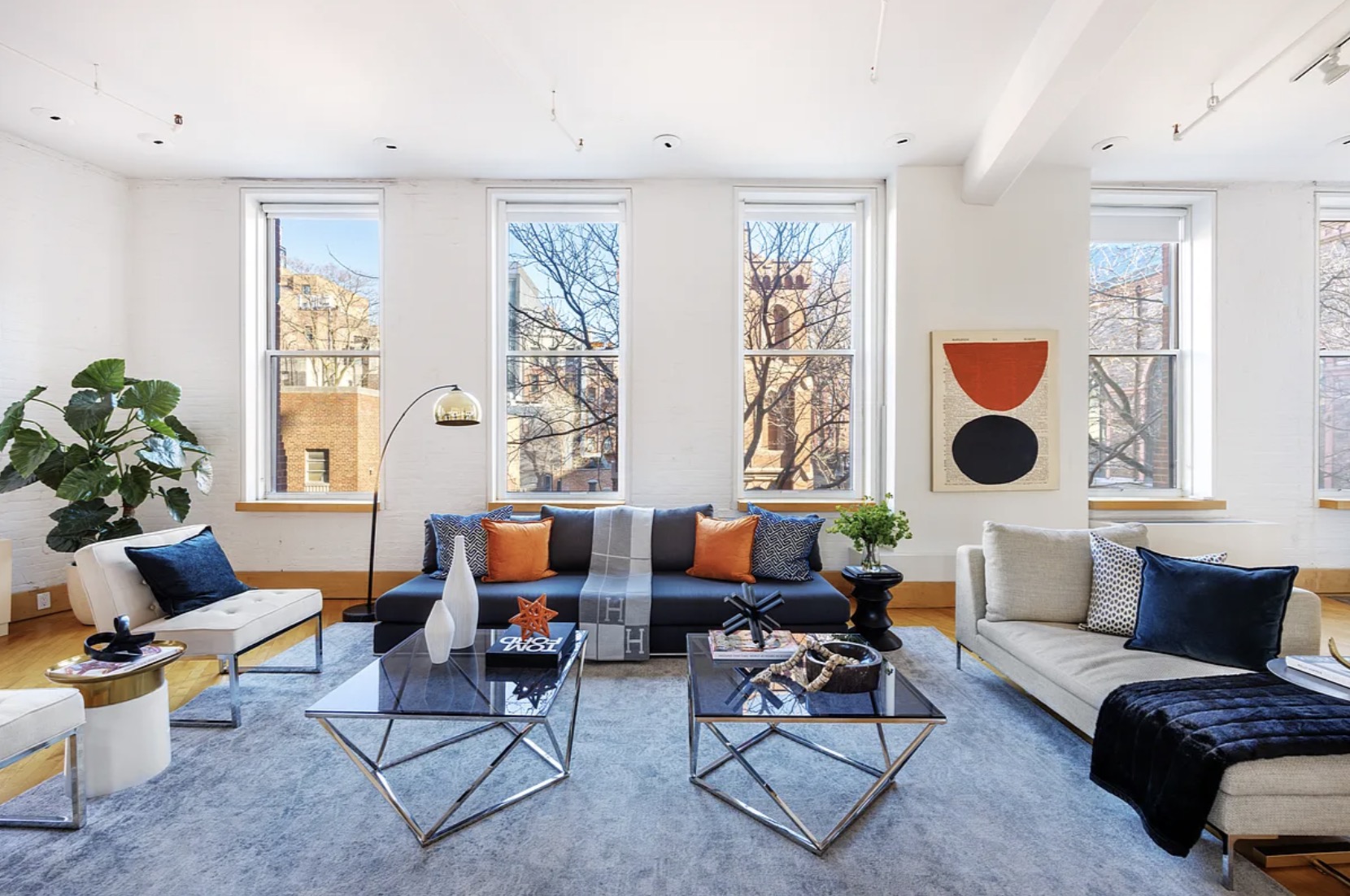
The living-and-dining footprint reads at substantial scale — open-plan with a clear flow between the living, dining, and reading-area configurations. The cast-iron columns are not architectural decoration; they are the structural anchors that define the apartment's specific spatial register against the broader Manhattan loft cohort. Substantial natural light through the four-window exposure carries through the entire main living space.

The dining program sits within the same open envelope, with the architectural cast-iron column providing both structural anchor and visual punctuation against the open-plan flow.

The primary bedroom carries the same tall-ceiling industrial register — exposed structural detailing, substantial windows delivering the same natural-light advantage as the public rooms, and the open-plan proportions that distinguish the apartment from the standard 2BR Manhattan inventory at the corridor's broader price tier.

A secondary sitting area / reading-room configuration delivers additional flexible-use space within the apartment's broader footprint — supporting either daily-living function (home-office, library, reading room) or expanded entertaining-room overflow.

The buy-side strategy
Buying at the $5M Manhattan loft tier requires a specific framework: the inventory surfaces irregularly, the qualified-buyer pool is competitive, and the apartment-specific feature set varies meaningfully across the corridor's broader inventory. The right apartment is not the apartment that fits the buyer's budget; it is the apartment whose architectural register, location, and feature set actually delivers what the buyer is buying for.
For this engagement, the right apartment was 285 Lafayette. The cast-iron loft conversion delivered the architectural specificity the buyer wanted, the NoLita / SoHo position carried the corridor adjacency the buyer wanted, the apartment-specific four-window exposure and tall-ceiling proportions delivered the natural-light and spatial register the buyer wanted. The buyer-strategy work was finding the right apartment — and then negotiating into it at a clearing price that the seller would accept.
The negotiation framework moved from the $5,200,000 ask to a $4,995,000 clearing — a $205,000 negotiated discount, 3.9% to ask. The clearing reflected a meaningful negotiation position rather than a market-discount-to-ask outcome: the seller had a specific clearing-price expectation, and our negotiation work moved them into a position where $4,995,000 was the cleanest outcome for both sides.
The connected sell-side, three months later
With the 285 Lafayette purchase secured and the buyer transitioning to the new home, the connected sell-side at the buyer's prior Greenwich Village home — #8 at 3 West 13th Street, a contemporary two-bedroom floor-through with an enclosed corner balcony / sunroom — was the natural next step.
We ran that sell-side three months after the 285 Lafayette close. The 3 W 13 #8 transaction closed at $1,910,000 in 29 days on market in a 2023 mid-summer rate-sensitive market environment that materially shaped the marketing-and-pricing strategy.
For the full pricing-and-marketing arc of the 3 West 13th #8 sell-side, see the #8 case study.
The strategic frame across both deals
The buy-first, sell-later structure was the right shape for this engagement, and it is the shape we recommend for clients whose buy-side cohort is structurally competitive (where the qualified-buyer pool for the next apartment outnumbers the inventory) and whose existing residence sits at a price tier where a clean sale is achievable within a defensible window after the new purchase.
The structural risks the buy-first approach absorbs are: the carrying-cost overlap window between owning both properties; the financing structure required to bridge that overlap; and the timing-and-marketing risk on the subsequent sell-side. Against those risks, the buy-first approach removes: the contingent-contract competitive disadvantage on the buy-side; the timing risk that the right apartment will be unavailable when the buyer's sale clears; and the conditional-sale dependency that often weakens the buy-side negotiation position when the seller knows the buyer is waiting on a separate closing.
For this client, the structural risks were manageable and the upside captured was the specific apartment they wanted in the NoLita corridor at a meaningful negotiated discount to ask. The connected sell-side three months later cleared cleanly within the defensible window.
Considering a buy-first / sell-later transaction — or buying in the NoLita / SoHo loft cohort?
The two-deal framework applied across the 285 Lafayette buy and the 3 West 13th sell — buy-side strategy tied to the specific architectural register the buyer wanted, sell-side strategy calibrated to the rate-sensitive 2023 mid-summer market window, both anchored to the same client's broader life-transition timeline — is repeatable across the NoLita / SoHo / Greenwich Village luxury inventory and across the broader Manhattan cooperative and condominium market.
If you're considering a buy-side engagement (including a buy-first / sell-later structured arc) or a sell-side at comparable contemporary loft / condominium inventory, a 30-minute consultation is the right starting point. We'll work through the specific apartment, the specific building, the specific corridor, and the specific market dynamics your transaction will run inside.
The presentation set.
Selling at 285 Lafayette Street — or comparable inventory?
A 30-minute pricing-and-strategy review is the right starting point. We bring the building-level analytics, the recent comp record, and the marketing-and-board calibration your situation requires.
