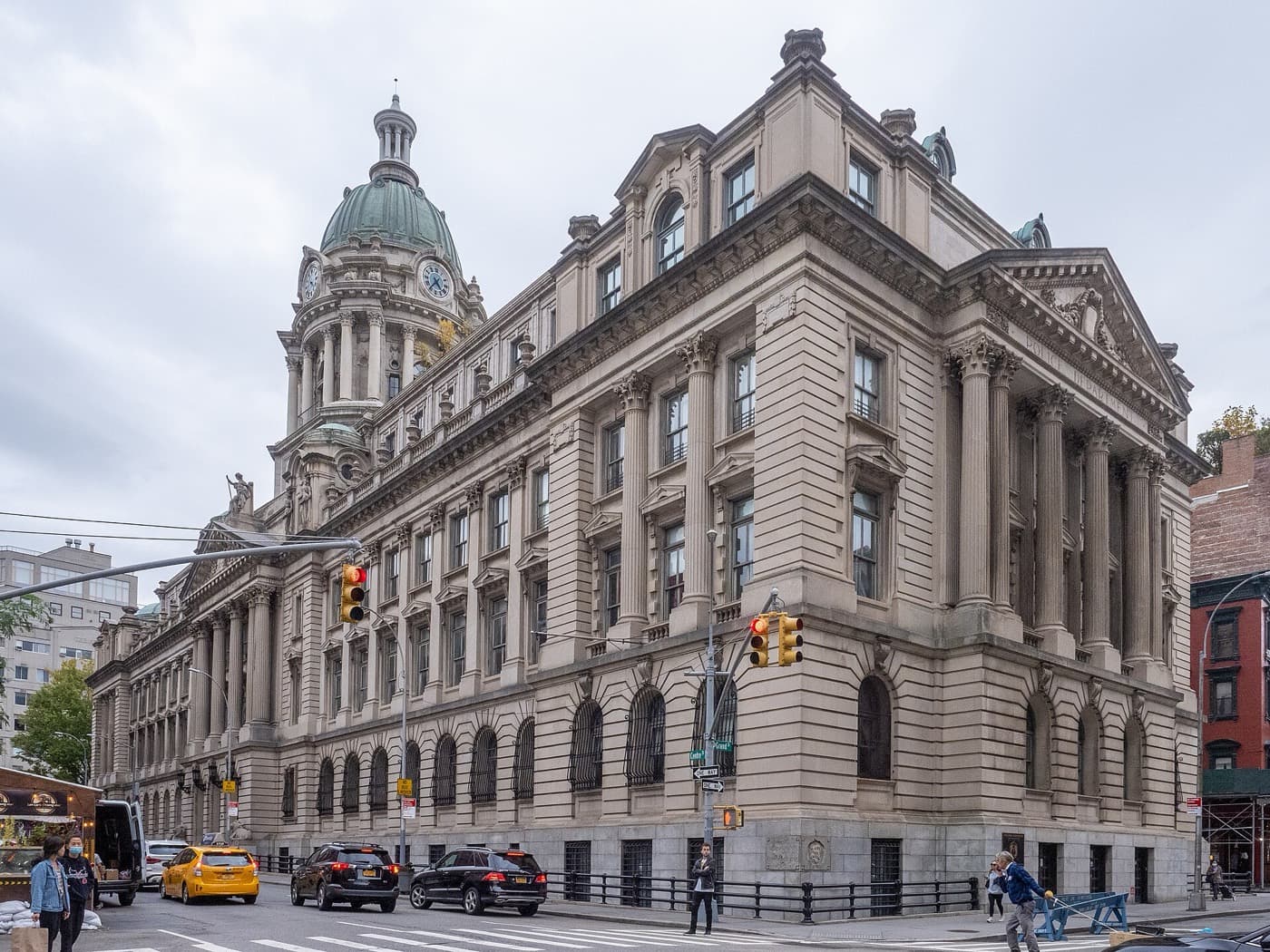
The Police Building
240 Centre Street, New York, NY 10013
SoHo
BBL 1004727501 · BIN 1075959
- Year built
- 1909
- Type
- Condominium
- Landmark
- Designated
Every recorded sale at this building, 2005–2026
Price-per-square-foot over time, the line- and floor-premium curves, and every recorded sale.
- Median $/sf
- $1,558
- Listing discount
- 3.1%
- Recorded sales
- 52
- On record
- 2005–2026
Own an apartment here? See what it would sell for.
A Private Pricing Opinion — what your apartment at The Police Building would likely sell for today, what it costs to sell, and what you’d walk away with — reviewed personally against condition, exposures, renovation quality, and the competition actually on the market.
There is no other residential address in New York quite like 240 Centre Street. Built in 1909 by Hoppin & Koen as the headquarters of the New York City Police Department, it is a full-block Beaux-Arts monument — limestone and granite, ornamented in a mix of Baroque and Renaissance Revival detail, and crowned by a copper dome that still reads as a landmark from across SoHo and Little Italy. The NYPD occupied it until 1973; in the late 1980s it was converted into one of downtown's most distinctive condominiums, the Police Building Apartments.
The conversion preserved the civic grandeur that makes the building famous. Homes were carved out of the old headquarters' monumental rooms, and the most coveted residences incorporate the original architecture directly — soaring columns, arched openings, and, at the very top, spaces beneath the dome itself. The building is a designated New York City landmark and is listed on the National Register of Historic Places, which protects the exterior and the silhouette that anchors the neighborhood.
For buyers, the appeal is twofold: the unrepeatable character of living inside a landmark, and the practical advantages of condominium ownership — flexible financing, a lighter approval process, and the privacy and security the building has been known for since it was the most secure address in the city.
Architecture and unit composition
The exterior is the building's permanent signature: a richly modeled Beaux-Arts pile in limestone and granite, wrapping the irregular block where Centre, Grand, and Broome converge, and topped by the copper dome that gives it its skyline presence. As a designated landmark, that envelope is preserved.
Inside, the 54 residences vary widely because they were fitted into a monumental civic structure rather than a purpose-built apartment house. Layouts range from intimate homes to expansive lofts, and the most sought-after units retain dramatic original elements — full-height columns, arched windows, and the curved spaces under the dome. Ceiling heights, light, and architectural character differ markedly from unit to unit; this is a building where each home is genuinely distinct, and the trophy residences are unlike anything in conventional inventory.
Building operations
The Police Building runs as a full-service condominium with a 24-hour doorman, concierge service, and a live-in resident manager — a level of privacy and security that has long been part of the building's identity. Shared facilities include a fitness room and private storage, with the building's architecture itself serving as its defining amenity.
As a condominium, ownership is flexible: financing is straightforward, purchases clear through a right-of-first-refusal rather than a co-op board package, and pied-à-terre, LLC, trust, and investor purchases are customary at this tier. Common charges and real estate taxes are billed separately. The location is among downtown's best for walking — at the meeting point of Nolita, Little Italy, and SoHo, with the neighborhood's restaurants, galleries, and boutiques at the door and broad subway access a block or two away.
Local Law 97
- 2024–2029 annual penalty
- $0 (under cap)
- 2030–2034 annual penalty
- $36,590/yr
- Per unit / month range
- $0 – $56
Source: NYC LL84 benchmarking and PLUTO · The Roebling Research Library. City record last verified September 2026.
See full Local Law 97 analysis — emissions history, scenarios, methodology →Management & transfer contacts
- Flip tax
- 2% of purchase price
- Sublet policy
- Allowed (board approval)
- Pied-à-terre
- Allowed
- Notable fees
- Corporate sublet fee = 1 month maintenance; closing fee $800 ($850 no broker) + $0.05/share
Recent sales
Recent closings at this building, curated by The Roebling Team research desk. Prices are the transfer amounts recorded with the NYC Department of Finance; apartment-level detail is checked against the building’s own file in The Roebling Research Library before publishing.
| Date | Unit | Apartment | Price | PPSF | vs. Ask |
|---|---|---|---|---|---|
| Apr 9, 2026 | 3J | 2 BR · 2 BA · 1,500 sf | $2,325,000 | $1,550/sf | -3.1% |
| Apr 30, 2025 | 2M | 2 BR · 2.5 BA · 1,300 sf | $2,229,500 | $1,715/sf | -31.4% |
| Dec 18, 2024 | 2J | 2 BR · 2 BA | $2,475,000 | -0.8% | |
| May 10, 2023 | 2D | 1 BR · 2 BA | $1,900,000 | +0.0% | |
| Oct 26, 2022 | 4B | 2 BR · 2.5 BA | $4,100,000 | -6.7% | |
| Sep 1, 2022 | 3A | 2 BR · 2.5 BA | $2,900,000 | -3.2% | |
| Aug 30, 2022 | 2A | 2 BR · 2.5 BA | $3,100,000 | -11.4% | |
| May 13, 2022 | 3G | 3 BR · 3 BA · 2,500 sf | $3,850,000 | $1,540/sf | -9.4% |
Market read. Most recent trades (2026) cleared a median $1,558/sf across 1 sale. Median listing discount 3.1% from the last ask — a recurring negotiation gap worth pricing into any offer or listing strategy.
The retrade record
Lines that have traded more than once in the public record — the building’s appreciation arc, apartment by apartment.
Full closing history with price-per-square-foot over time, the complete retrade record, and every line that has traded.
Sales sourced from NYC Department of Finance recorded transfers (BBL 1-00472-7501) and verified listing data. Apartment-level facts (line, condition, asking-price context) curated and cross-verified by The Roebling Team research desk. Not all transactions cross-verify with ACRIS records — sponsor and LLC purchases sometimes record at stipulated values rather than market price; square footage from recorded condo declarations and offering plans.
What to know if you’re buying
This is a landmark conversion, so no two homes are alike — diligence is unusually unit-specific. Pay close attention to the home's ceiling height, light, and whether it incorporates original architectural elements, which materially affect both livability and value. Because the building is landmarked, exterior changes are constrained; interior renovations should be evaluated against the board's rules and the building's structure. The condominium structure favors buyers — flexible financing, a right-of-first-refusal rather than a board interview, and customary pied-à-terre and investor ownership. Review the building's financials; a small, full-service landmark carries real operating and maintenance costs. The location, at the convergence of three of downtown's most desirable neighborhoods, is a durable value anchor.
What to know if you’re selling
You are selling something genuinely unrepeatable — a home inside a domed Beaux-Arts landmark that was once the headquarters of the NYPD. Lead with the architecture and the provenance, and if the home incorporates original columns, arches, or dome spaces, make those the centerpiece, because they have no direct comparables. Benchmark to the building's own distinctive trades and to top-tier SoHo–Nolita condominiums rather than to conventional inventory. A resale clears through a right-of-first-refusal on a faster, more predictable timeline than a co-op, and the building's landmark status and privacy are themselves selling points to the buyer this address attracts.
Comparable buildings
If you're considering The Police Building, also evaluate these downtown landmark and loft condominium peers:
- 270 Broadway — pre-war lower-Manhattan condominium
- 261 Broadway — Tribeca pre-war condominium opposite City Hall
- 233 Broadway — the Woolworth Tower Residences
- 25 North Moore Street — The Atalanta, a Tribeca warehouse loft conversion
How to read the facts on this page. Items attributed to an offering plan describe the building as it was offered at that filing — unit mix, square footage, the amenity program as planned. They are not a statement about how the building operates today. Tax and compliance figures are sourced separately to current City records and carry their own dates. House rules, staffing and fee policy can change by board resolution without any public filing: treat every policy line here as a starting point for diligence and confirm it with the managing agent. Where this page compares one building or neighborhood to another, that is our analysis of the recorded record — it names the measure, the period and the sample it rests on, and it is an observation about medians rather than a prediction about any particular apartment.
Considering a move at The Police Building?
Request a private building brief with the relevant comparable sales, current and off-market availability, and an apartment-specific view of value.