
Hunted. Sourced. Bought.
- Sold
- $2,740,000
- Listed
- $2,950,000
- vs. ask
- −7.1% ($210,000 under last published ask)
- Closed
- May 25, 2021
The brief
The buy-side at 181 Richards Street — a 2013 Ben Bischoff / MADE Build/Design luxury townhouse in Red Hook, Brooklyn featured in Dwell and in Rizzoli's New York Living: Reinventing Home — closed on May 25, 2021 at $2,740,000, $210,000 under the seller's last published asking price of $2,950,000 (−7.1%).
The headline structure has two distinct value drivers:
-
An off-market acquisition that did not exist as an available transaction at the moment we identified it. The home was not actively listed at the time we engaged the seller. The seller had previously brought the home to market through a listing record arc; the listing had expired without clearing; and at the moment our client's brief crystallized around an architecturally significant Red Hook townhouse, the property was not on any active inventory feed. We surfaced it through an outbound cold-messaging campaign and built the transaction from scratch — direct buyer-seller, no competing offers, no auction-style price escalation.
-
A $210,000 reduction off the seller's last published ask. Off-market sourcing is not, by itself, a price-negotiation framework — many off-market transactions clear above what the prior public-listing arc supported because the seller has more leverage in a one-buyer conversation. The pricing outcome on this engagement reflected a substantive defensible underwriting argument from the buyer side: the prior listing arc's failure to clear at $2,950,000 was itself the comp-record evidence that supported the negotiated $2,740,000 clearing.
The substantive value the engagement delivered was the outbound sourcing framework that created the transaction. The dollar negotiation flowed from it.
The outbound sourcing framework
The client's brief was specific: a 3,000+ square-foot architecturally significant residence with substantial private outdoor space in a Brooklyn neighborhood with distinct cultural-and-creative-community character, at a price point that supported the long-term family-residence horizon the acquisition was anchored to. We mapped the broader Brooklyn inventory — Carroll Gardens, Cobble Hill, Boerum Hill, Park Slope, Brooklyn Heights, Williamsburg, Greenpoint, the Red Hook waterfront — and toured more than twenty homes across the active public listing inventory before the right cohort came into focus: architecturally distinctive newer construction or substantively renovated townhouses in the Red Hook / Carroll Gardens waterfront-adjacent corridor.
The active public-listing inventory did not contain the apartment. At that point most buy-side engagements either compromise on the brief or pause for inventory to come back to market. Neither was the right call here.
Instead, we ran an outbound sourcing campaign:
- Cold-messaging to off-market sellers — direct outreach to owners of architecturally distinctive Red Hook / Carroll Gardens / Cobble Hill townhouse inventory whose properties were not actively listed, framing a substantive qualified-buyer conversation that respected the seller's not-on-the-market posture
- Expired-listing follow-up — direct outreach to sellers whose prior listing arcs had expired without clearing, on the read that a defensibly-priced buyer engagement could re-open the transaction without re-listing the property
- Architect and design-community network outreach — direct outreach to the architecture-and-design community in the Red Hook corridor (the residents and the design professionals who knew the inventory inside the corridor's small architecturally-significant cohort), framing the buyer's specific brief and asking for introductions to owners considering a transaction without a public marketing arc
181 Richards Street surfaced through this outbound work. The property's prior public-listing arc had expired without clearing. The owner — a creative-professional household with the architectural sensibility the residence's design vocabulary documents — was open to a defensibly-priced buyer conversation without re-listing the property publicly. Our outreach landed at the right moment in the seller's decision arc.
The residence
181 Richards is a 2013-built 4-bedroom, 2.5-bath, 3-story luxury townhouse designed by Ben Bischoff of MADE Build/Design. The architectural register has been documented in Dwell and in Rizzoli's New York Living: Reinventing Home. The interior carries the materials palette the design is anchored to — extensive poplar wood detail through the millwork, headboard walls, room dividers, and the triple-story bookcase staircase that the architectural design centers on; polished radiant-heated concrete flooring throughout the principal living levels; floor-to-ceiling glass doors opening from the public-room program to the substantial private outdoor space; and a rubbed-aluminum exterior that signals the home's architectural register at the street.
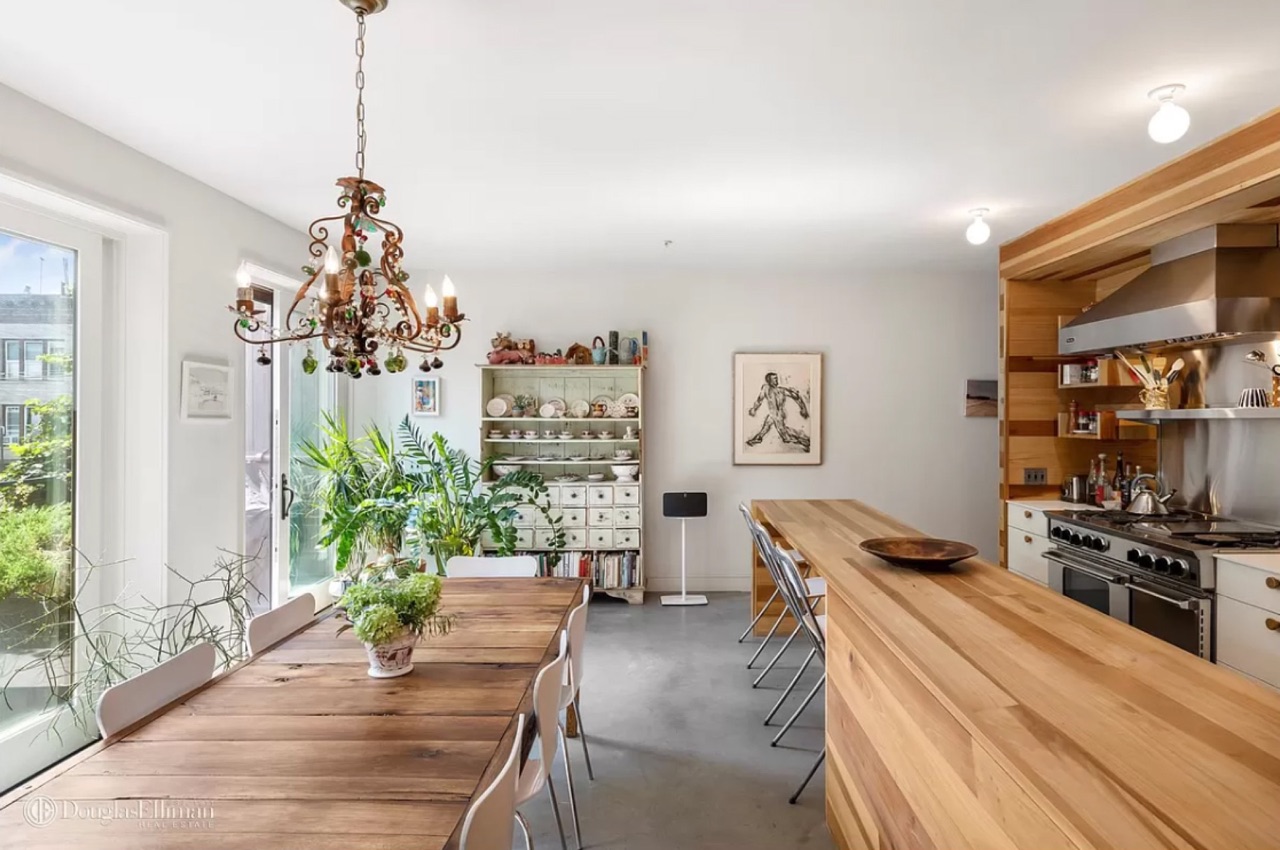
The kitchen-and-dining program runs as an integrated open flow. The chef's kitchen carries the wood-clad architectural register with a long counter island and bar seating, stainless professional range and hood, and the materials continuity that the design's poplar-and-concrete palette is built on. The dining program opens through floor-to-ceiling glass doors to the deck and the substantial 1,700+ square-foot private outdoor program beyond.
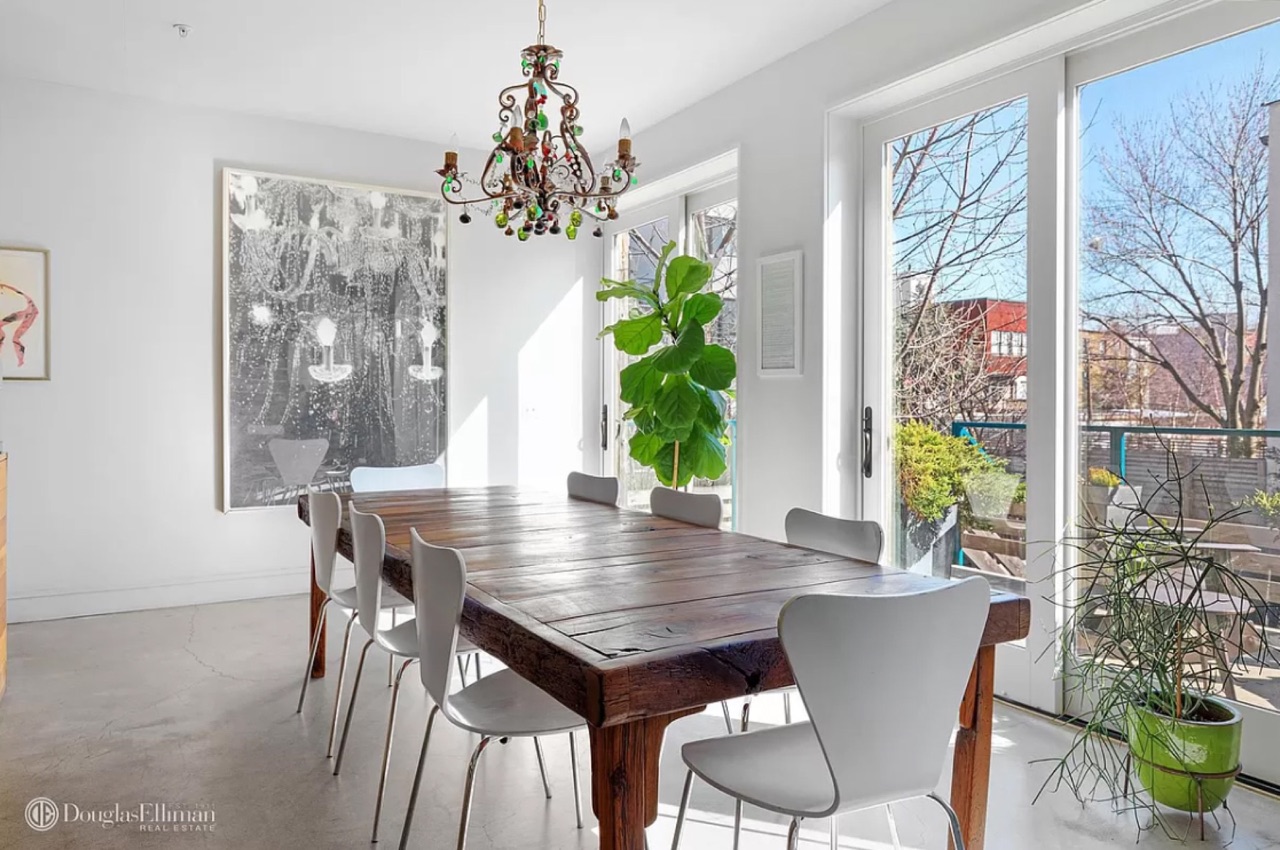
The dining room at the front of the kitchen-and-dining flow carries the apartment's editorial register clearly — large-scale abstract canvas, antique-style chandelier with glass-fruit pendants, the live-edge wood table at scale for an eight-to-ten-person dinner, and the floor-to-ceiling glass-door wall opening to the outdoor program.
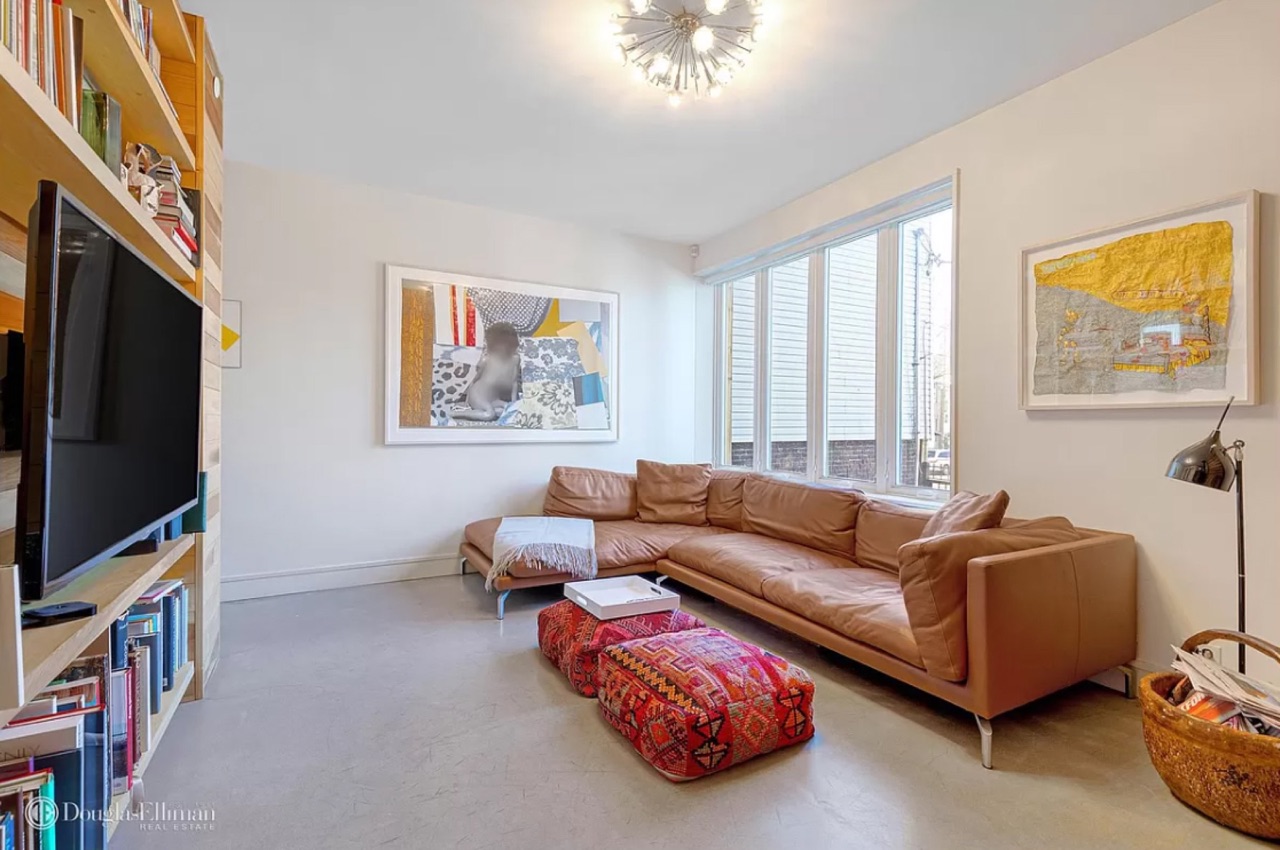
The living room sits adjacent to the kitchen-and-dining program and anchors the principal entertaining program. The wood-clad bookshelf wall on the left carries the apartment's signature poplar-detail vocabulary, the picture window delivers light to the seating program, and the mid-century sectional anchors the room's design register. The modern shaker wood-burning fireplace that the listing brief documents sits at the other end of the room.
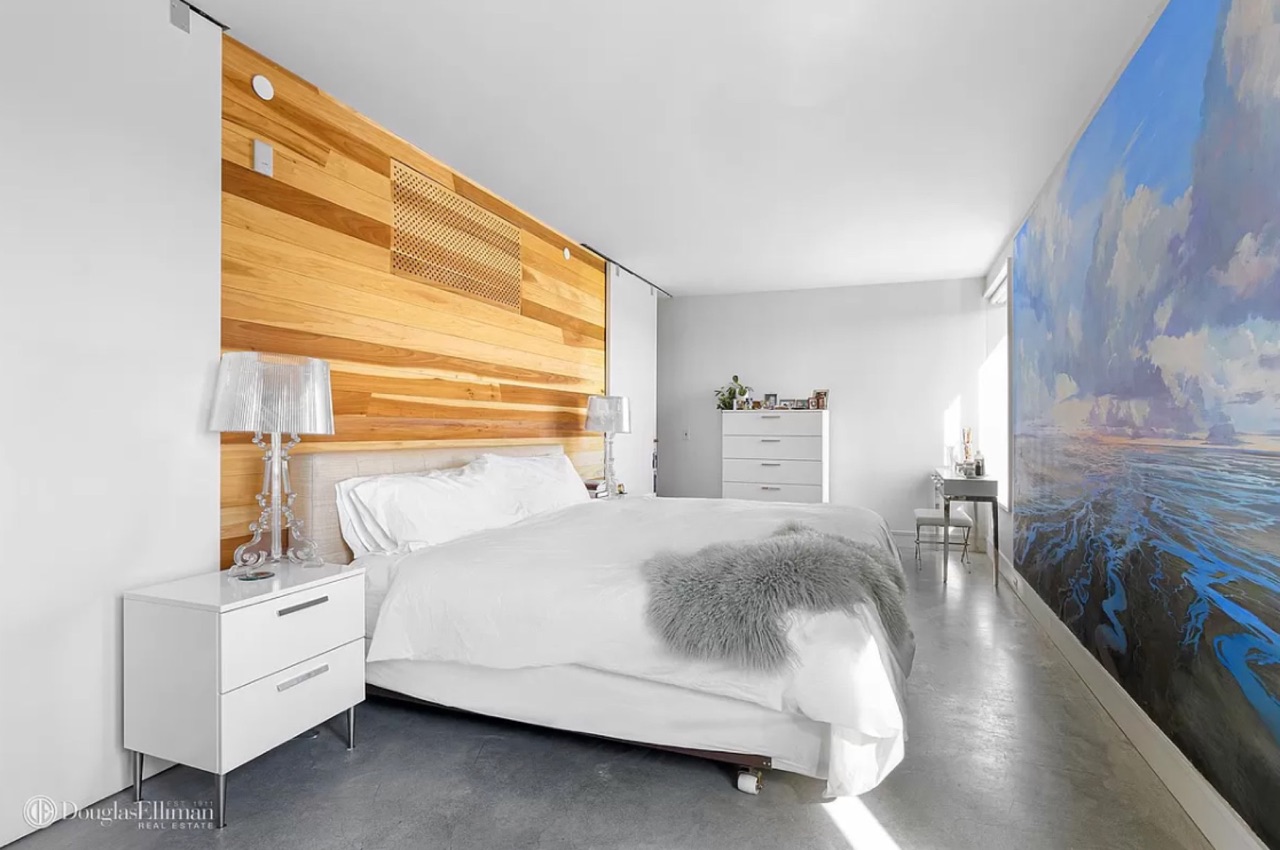
The primary bedroom suite on the third floor — what the prior listing copy described as "reserved for the master suite with a deluxe custom-finished spa bath and adjoining private gym or office area" — anchors the apartment's residence-scale program. The poplar wood headboard wall is the room's architectural focal point, the large-scale mural artwork carries the apartment's editorial register through the private rooms, and the polished concrete flooring continues from the principal living levels.
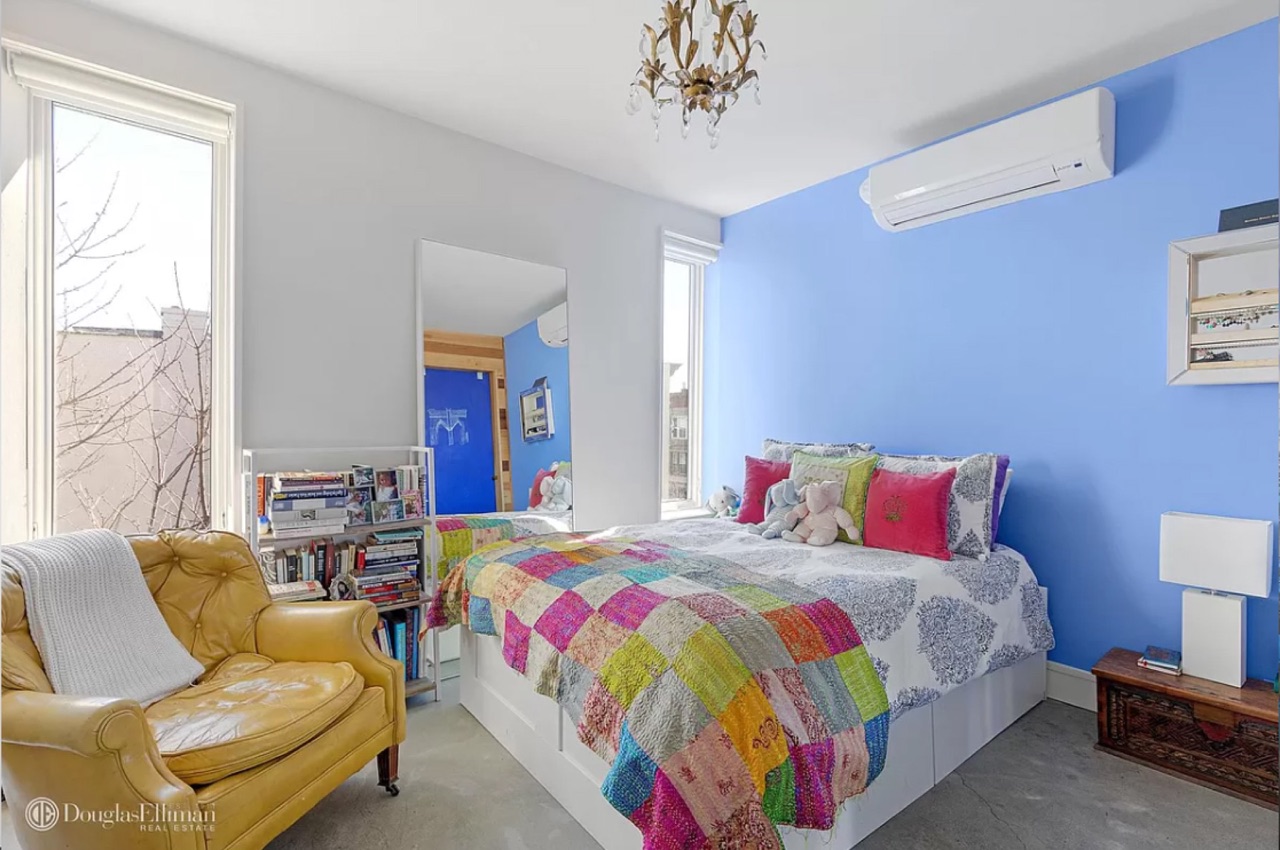
The second-floor bedroom program runs two bedrooms with substantial walk-in-closet infrastructure and the dedicated family-room and laundry program the floor supports. The configuration carries the apartment's family-residence brief cleanly — full-scale rooms, contemporary finish register, the natural light the home's window-and-glass-door program delivers through the residence.
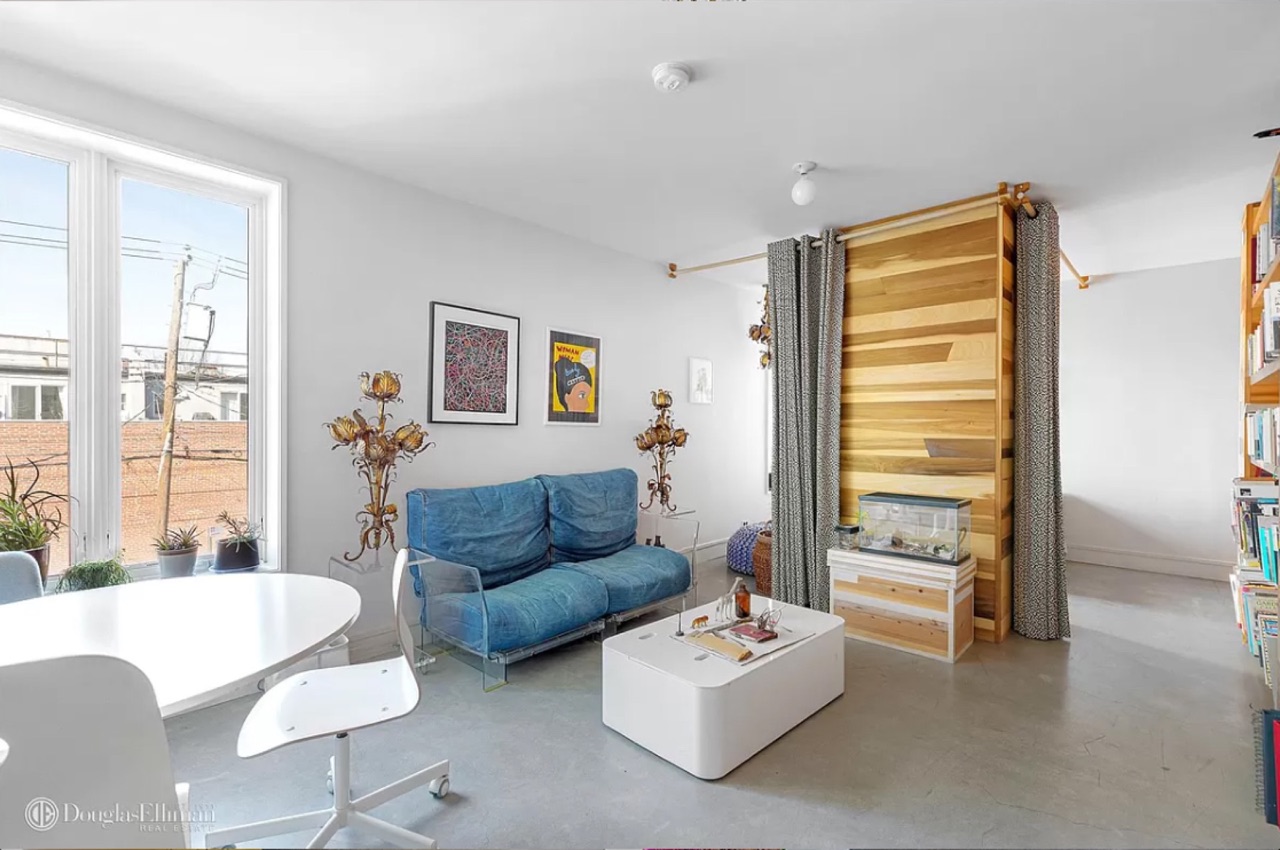
The office-and-study program on the upper levels carries the home's design-forward register — wood-clad room divider with grommet-curtain panels supporting a flexible-use partition, contemporary art at scale, modern furniture in conversation with the antique-light fixtures, the kind of layered interior the home's broader design vocabulary supports.
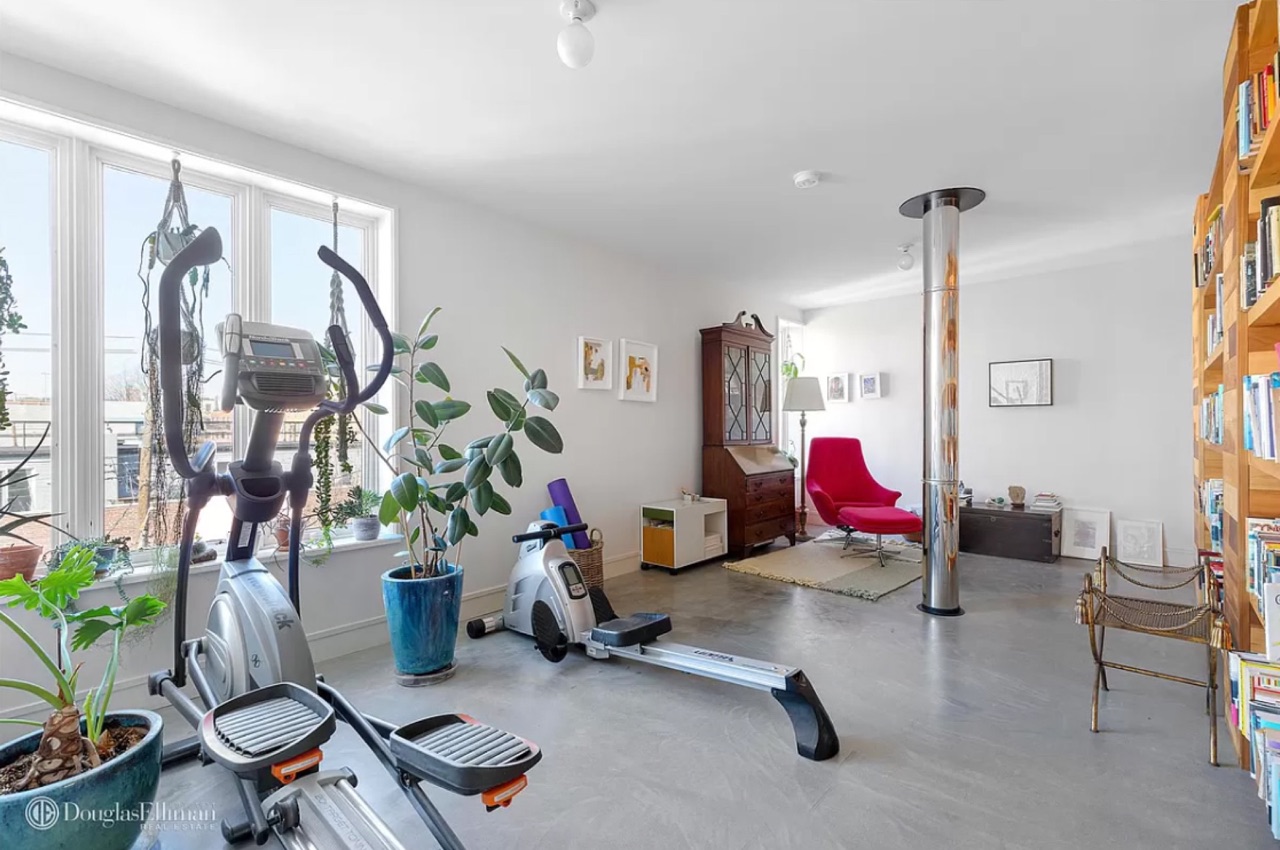
The upper-level multi-use program — gym, study, secondary office — opens to the roof deck that crowns the residence's substantial outdoor program. The roof deck delivers the views the listing brief documents: Downtown Manhattan, the Statue of Liberty, and the Verrazzano-Narrows Bridge, a view program that few Brooklyn townhouse residences anywhere in the borough support.
The architecture
181 Richards is a documented work of architectural significance. The design is by Ben Bischoff of MADE Build/Design — the architecture-and-build firm that has produced a meaningful body of contemporary residential work across New York and that has carried the home through Dwell magazine coverage and inclusion in Rizzoli's New York Living: Reinventing Home monograph. For buyers whose criteria include architectural-press recognition, design-community provenance, and the resale-and-prestige register that an architecturally documented residence carries, 181 Richards delivers the substantive credential.
The design signatures: the rubbed aluminum exterior that signals the residence at the street, the 6-foot lift above ground that creates the storage program for bicycles, sports equipment, and vehicle accommodation underneath the first floor, the curb cut with parking for 2 additional vehicles at the front of the home, the triple-story bookcase open staircase that the design's vertical-circulation program is built around, the extensive poplar wood detail through the millwork and the room dividers, the polished radiant-heated concrete floors throughout the principal living levels, the 2 skylights and oversized windows delivering the natural light that the design's open-floorplate program is calibrated to receive, and the 1,700+ square-foot private outdoor program — deck plus the substantial lush rear garden — that the architecture frames as an extension of the interior.
The location
Red Hook is one of Brooklyn's most distinct corridors. Waterfront access three blocks south of the residence; the NYC ferry to Wall Street at a 15-minute crossing; the substantive retail-and-grocery anchor at Fairway Market and the broader Red Hook food-and-beverage corridor including Steve's Authentic Key Lime Pies, the cultural-anchor visual-arts community at Pioneer Works, and the substantive small-craft and design-community presence that has defined the neighborhood's contemporary creative identity. The block-level character at 181 Richards is substantively residential with the cultural-and-creative-community register that Red Hook carries — quieter than the active Carroll Gardens commercial spine, less heavily-trafficked than the broader DUMBO and Williamsburg waterfront corridors, with the specific community feel that the brief was anchored to.
The result
$2,740,000 closed on May 25, 2021 — $210,000 under the seller's last published asking price of $2,950,000 (−7.1%), executed as a direct buyer-seller transaction without a competing-bid pricing arc and without re-introducing the property to the public listing market.
The substantive outcomes:
- The right home was acquired — an architecturally significant 2013 Ben Bischoff residence with the press recognition (Dwell, Rizzoli), the design provenance, the Red Hook waterfront-corridor positioning, the 3,000+ square-foot residence-scale interior, the 1,700+ square-foot private outdoor program, the 4-bedroom family-residence configuration, and the roof-deck Manhattan-and-Verrazzano view program the brief was anchored to
- The transaction was sourced where the public-listing market did not contain it — through the outbound cold-messaging-to-off-market-and-expired-listings campaign that surfaced the seller's willingness to transact without re-listing publicly
- The negotiated outcome captured the spread between the prior listing's failed clearing price and the home's actual defensible underwriting — $210,000 net negotiated value at the apartment-level
For a buyer whose specific criteria — architectural significance, Red Hook waterfront positioning, residence-scale interior with substantial outdoor program, family-residence configuration with the design-press recognition that a multi-decade hold horizon would benefit from — would otherwise have required compromise against the public-listing inventory or extended waiting for new inventory to surface, the outbound sourcing framework produced the home the brief actually required.
The strategic frame
The 181 Richards engagement validates a thesis that defines the differentiated Roebling Team buy-side practice: the right home is not always on the public listing market at the moment the buyer's brief crystallizes. The active inventory feed represents only the subset of qualifying transactions that sellers have chosen to expose publicly. The full inventory — including expired-listing inventory, off-market inventory, and the inventory whose sellers are open to a defensibly-priced direct buyer conversation but have not committed to a public re-listing arc — is materially larger than the active feed represents.
The buy-side framework that surfaces the full inventory is outbound sourcing: cold-messaging to off-market sellers, follow-up on expired listings, network outreach to architects / interior designers / building managers / community-network nodes who know the inventory inside specific corridors, and the patient relationship work that produces direct buyer-seller introductions at the right moment in each seller's decision arc.
This framework is calibrated apartment-by-apartment and corridor-by-corridor. It does not produce instant inventory; it produces the inventory the brief actually requires when the active feed does not contain it.
Considering an architecturally significant residence — an off-market Brooklyn or Manhattan acquisition — or a buy-side engagement that requires sourcing the inventory the public market does not contain?
The buy-side framework we ran at 181 Richards Street is the framework we apply on every architecturally-significant, off-market, or otherwise public-listing-constrained buy-side engagement: map the brief precisely, exhaust the active public-listing cohort, and if the right home is not there, source it directly through outbound work to off-market sellers, expired-listing owners, and the design-community network nodes that know the corridor's small architecturally-significant cohort.
If you're considering a Brooklyn or Manhattan townhouse, an architecturally significant residence, an off-market acquisition, or any buy-side engagement where the active public-listing inventory does not contain the home the brief actually requires, a 30-minute consultation is the right starting point. We'll work through the specific brief, the corridors and cohorts that qualify, the outbound sourcing framework the engagement requires, and the negotiation discipline that produces the right outcome at the right window.
The presentation set.
Selling at 181 Richards Street — or comparable inventory?
A 30-minute pricing-and-strategy review is the right starting point. We bring the building-level analytics, the recent comp record, and the marketing-and-board calibration your situation requires.
