
Searched. Compared. Bought.
- Sold
- $2,300,000
- Listed
- $2,350,000
- vs. ask
- −2.13%
- Closed
- March 1, 2022
The brief
The buy-side at Residence 21C at The Grand Beekman (400 East 51st Street) — a high-floor East River-view two-bedroom condominium in the Beekman corridor of Midtown East — closed on March 1, 2022 at $2,300,000 against a $2,350,000 ask (−2.13%). The headline price arc is the cleanest possible buy-side outcome; the headline strategic outcome was the corridor-and-cohort search framework that led the buyer to this specific apartment.
The client engaged us with a specific brief: a pied-à-terre acquisition with waterfront views as the non-negotiable criterion. The search ran two distinct legs in sequence:
-
Leg one — Sutton Place cooperative cohort. The natural first cohort for a waterfront-adjacent Midtown East pied-à-terre. We mapped the inventory across the Sutton Place, Beekman Place, and adjacent East 50s cooperative spine; we identified the high-floor East River-facing lines that supported the waterfront-view brief; we walked the relevant board policy frameworks against the client's specific pied-à-terre use case.
-
Leg two — the Beekman condominium cohort. The Sutton Place cooperative review surfaced the policy-framework constraint that defines the cohort for pied-à-terre buyers — boards in the Sutton Place co-op cohort range from case-by-case-with-extensive-disclosure at the more permissive end to outright pied-à-terre prohibitions at the more restrictive end, with financing caps, post-closing liquidity requirements, and subletting limitations that compound against the client's flexibility brief. The Beekman corridor's contemporary condominium inventory — and specifically The Grand Beekman — supported the same waterfront-view criterion with a materially more permissive policy framework: pied-à-terre purchases are standard, financing is not gated by board cap, subletting and corporate ownership are within the building's published rules, and the apartment itself supports the full flexibility profile a pied-à-terre acquisition typically requires.
We pivoted from the co-op cohort to the condominium cohort, identified Residence 21C as the apartment that satisfied both the waterfront-view criterion and the flexibility brief, and ran a focused negotiation to clear at $2,300,000 against the $2,350,000 ask.
The $50,000 reduction from ask is not the headline of this engagement. The headline is the search-and-comparison framework that mapped two distinct cohorts (co-op vs. condominium) against a specific client brief (pied-à-terre + waterfront view), surfaced the policy-framework constraint that disqualified the first cohort, and identified the right apartment in the right cohort to satisfy both criteria. That framework is the buy-side value the engagement delivered.
The apartment
Residence 21C at The Grand Beekman is a high-floor two-bedroom condominium with the apartment's defining feature — a bay-windowed living room facing east across the East River — anchoring the principal entertaining space.

The bay-window living room is the apartment's signature feature. Three faceted floor-to-ceiling window banks open east across the East River and the Long Island City skyline, with the curved-sectional sitting program oriented to the view rather than to the room. High-floor exposure delivers the substantive natural light the bay configuration was designed for, and the prewar-style architectural register (crown molding, hardwood parquet flooring, generous ceiling heights) carries through the public-room program.
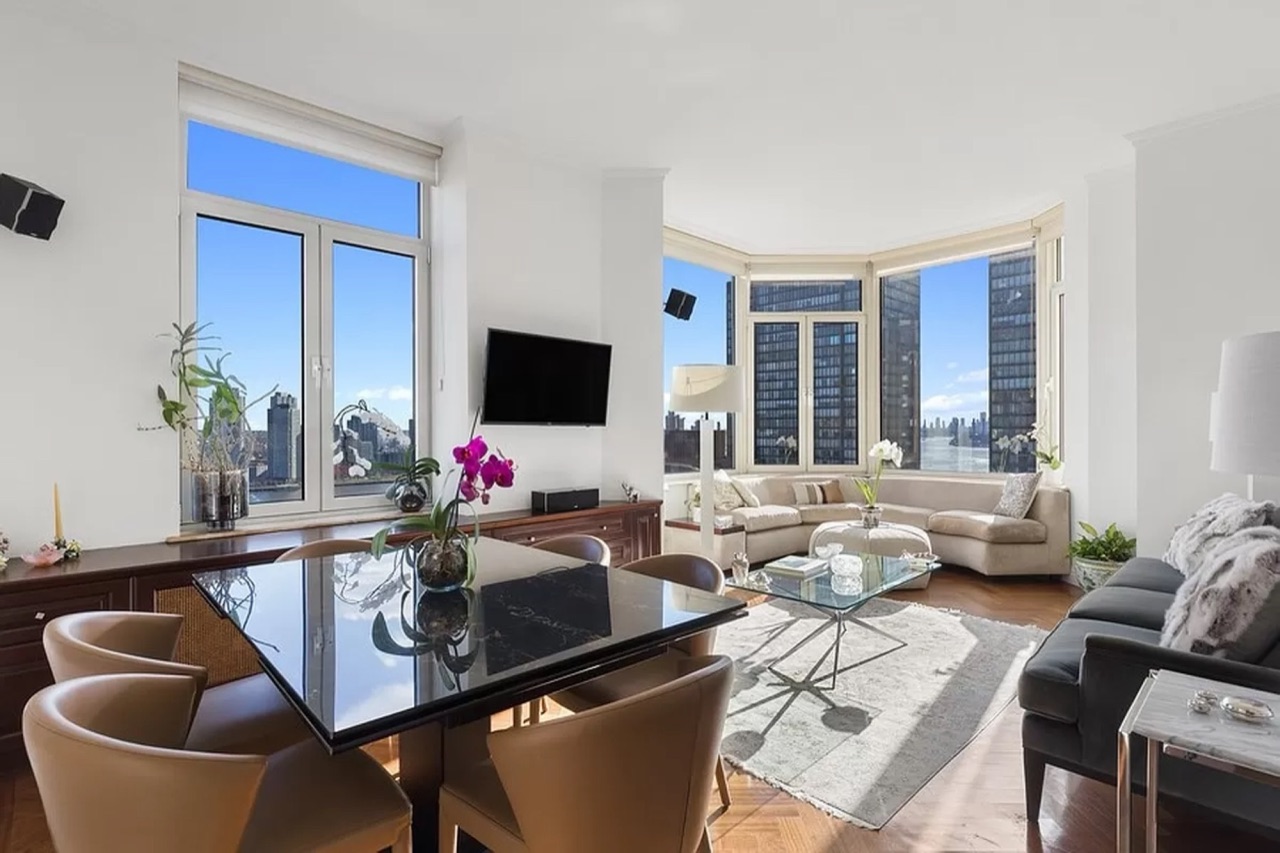
The open-plan dining-and-living configuration supports the apartment's pied-à-terre program — a daily-use entertaining-and-dining flow that scales from a working weekday breakfast to a six-to-eight-person dinner without reconfiguring the room. The dual exposure (south-facing through the side windows, east-facing through the bay) delivers light through the principal living program from midday through sunset.
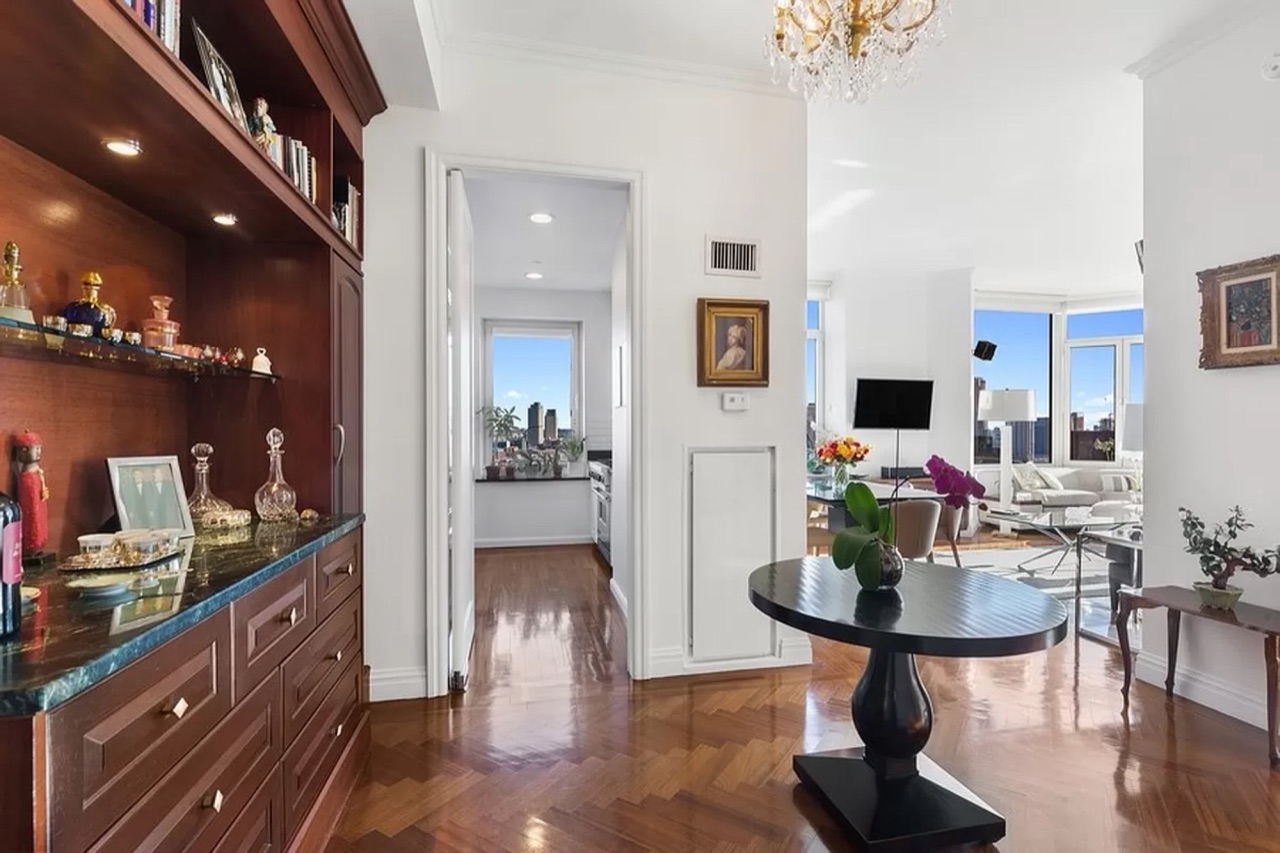
The formal entry foyer carries the apartment's pre-war-vocabulary detail. Built-in mahogany breakfront cabinetry with green-marble counter supports the foyer's serving-and-display program; the crystal chandelier overhead anchors the apartment's editorial register; sightlines from the foyer flow through to the kitchen on the left and the living room on the right, framing the apartment's public-room program at the moment of arrival.

The galley kitchen carries the apartment's contemporary working-program — white shaker cabinetry with stainless professional appliances (Wolf range visible), stone countertops, and a city-view window at the work counter. The galley configuration is calibrated for the pied-à-terre use case: a kitchen that supports daily-use cooking without committing the floor plate to a sprawling chef's-kitchen program that the pied-à-terre buyer would not actually deploy.

And the apartment's defining asset: the view. Across the East River to the Queensboro Bridge (visible at left), Roosevelt Island in the middle distance, and the Long Island City skyline rising across the river to the east. This is the waterfront view the pied-à-terre brief was anchored to — and the specific reason the C-line at The Grand Beekman cleared the search.
The corridor-and-cohort search framework
The buy-side framework we ran for this pied-à-terre client is the framework we apply on every multi-cohort buyer engagement — particularly for buyers whose criteria suggest more than one corridor or product-type can satisfy the brief. The mechanics:
Step one — surface the non-negotiable criterion
The client's non-negotiable was waterfront views. The waterfront-view criterion materially narrows the qualifying Manhattan inventory — to high-floor East River-facing inventory in the Sutton Place / Beekman / Midtown East corridor, high-floor Hudson River-facing inventory in Battery Park City and the West Side waterfront, and a handful of specific buildings along the rivers at other latitudes (UN Plaza, Riverhouse, Trump World Tower, etc.). The first leg of the search is mapping the inventory that actually clears the criterion.
Step two — map the secondary criteria against each cohort
For this client, the secondary criteria were pied-à-terre use (which compounds against any cooperative whose board framework restricts or prohibits non-primary occupancy), financial flexibility (which compounds against post-closing liquidity requirements and financing caps), and flexibility on future use (which makes corporate-ownership permissibility and subletting policy material).
These secondary criteria are disqualifying conditions on co-op cohort inventory more often than they are limiting on condominium inventory. The Sutton Place cooperative cohort — while substantively desirable on the waterfront-view criterion — runs into all four secondary-criterion compressions at varying severities across the boards. The Beekman corridor's contemporary condominium inventory carries materially less policy friction against the same secondary criteria.
Step three — run the first cohort with full diligence
We did not pivot to condominiums on theory; we ran the Sutton Place cooperative cohort with the same rigor we would have applied if it were the destination. We walked the inventory, mapped the boards, surfaced the specific friction points each board would carry against the client's specific use case, and produced the assessment that drove the decision to pivot.
The cooperative cohort review is not wasted work in this framework — it is the disqualification evidence that grounds the pivot to the second cohort. A buyer who explores only the condominium cohort cannot defensibly say the co-op alternative was rejected on substantive criteria; the buyer who explores both can.
Step four — execute on the qualifying cohort
The Beekman condominium cohort surfaced a small set of buildings supporting the waterfront-view criterion with the policy-framework flexibility the pied-à-terre brief required. The Grand Beekman — with its high-floor C-line bay-window configuration facing east across the river — surfaced as the right apartment in the right cohort. We engaged, ran the negotiation, and closed at $2,300,000 against the $2,350,000 ask.
The Grand Beekman
The Grand Beekman is a contemporary condominium at the corner of First Avenue and East 51st Street in the Beekman corridor of Midtown East. The building's policy framework is the structural alternative to the Sutton Place cooperative cohort for buyers whose secondary criteria (pied-à-terre, financial flexibility, future-use flexibility) compress against the co-op product type:
- Pied-à-terre acquisitions are standard — the condominium structure does not impose the case-by-case board review the co-op cohort does, and the building's policy framework is calibrated to a buyer pool that includes non-primary-residence users
- Financing is not gated by a board cap — the condominium structure allows the buyer to finance to the level the lender and the buyer's underwriting support, rather than to the level the cooperative board permits
- Subletting policy is materially more permissive — supporting the future-use-flexibility brief without the rolling-board-review framework cooperative subletting typically requires
- The C-line specifically supports the waterfront-view criterion at the high-floor tier — the bay-window configuration is the architectural anchor of the C-line, and the C-line on the upper floors delivers the East River + Queensboro Bridge + Long Island City exposure the buy-side brief was anchored to
For the building's full dossier — architectural register, financial profile, amenity stack, and the broader Beekman corridor comp record — see The Grand Beekman (400 East 51st Street).
The strategic frame
The Grand Beekman #21C buy-side validates a framework we apply on every multi-cohort buyer engagement: the right apartment is not always in the cohort the brief points to first. A pied-à-terre buyer with waterfront-view criteria will be initially drawn to the Sutton Place cooperative cohort — that is where the waterfront-view inventory clusters on the Midtown East side of the river, and that is where the prestige register the buyer is attracted to lives. The cohort that actually clears the brief, once secondary criteria are surfaced and mapped, is often a different one.
The framework — surface the non-negotiable, map the secondary criteria against each candidate cohort, run the first cohort with full diligence as the disqualification basis for the pivot, and execute on the qualifying cohort — is the buy-side value a pied-à-terre engagement (or any multi-cohort buy-side engagement) requires. The dollar negotiation that follows — $50,000 off ask on a $2,350,000 apartment, in this case — is the smaller of the two value drivers. The cohort selection is the larger.
Considering a pied-à-terre, waterfront-view, or multi-cohort Manhattan purchase?
The buy-side framework we ran for this Grand Beekman acquisition is the framework we apply on every multi-cohort engagement — pied-à-terre buyers evaluating co-op vs. condominium, waterfront-view buyers mapping the East River vs. Hudson River corridors, primary-residence buyers comparing pre-war cooperative against contemporary condominium, secondary-home buyers mapping flexibility-on-future-use across building cohorts.
If you're considering a pied-à-terre acquisition, a waterfront-view purchase, or any Manhattan purchase where the candidate inventory spans more than one corridor or product-type cohort, a 30-minute consultation is the right starting point. We'll work through your specific brief, the non-negotiable and secondary criteria the search will be calibrated against, the cohorts the brief actually qualifies, and the apartment-level execution framework that gets the right deal done at the right outcome.
For the building's full dossier, see The Grand Beekman (400 East 51st Street).
The presentation set.
Selling at The Grand Beekman — or comparable inventory?
A 30-minute pricing-and-strategy review is the right starting point. We bring the building-level analytics, the recent comp record, and the marketing-and-board calibration your situation requires.
