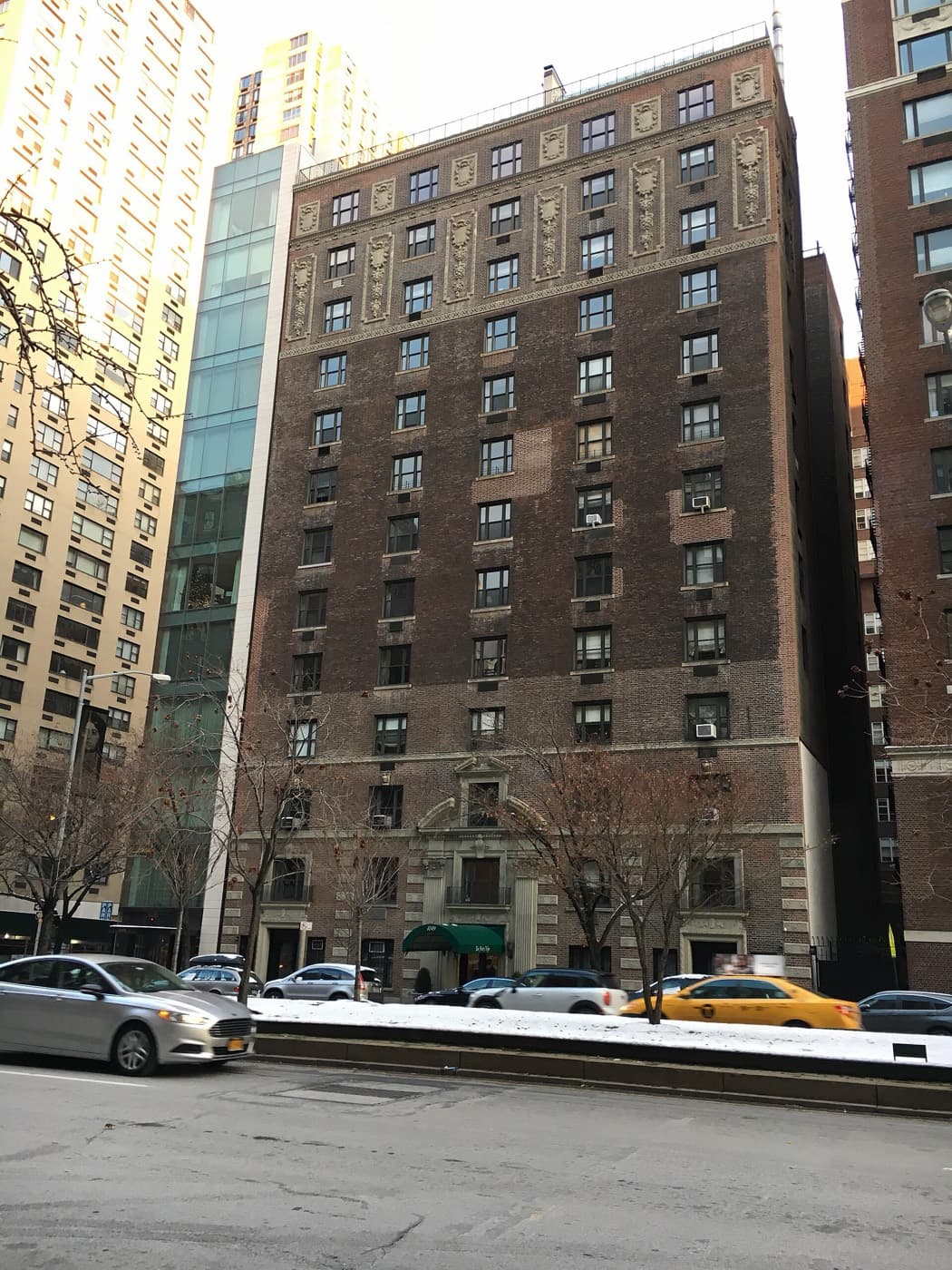
1049 Park Avenue
1049 Park Avenue, New York, NY 10028
Carnegie Hill, Upper East Side
BBL 1015150070 · BIN 1047971
- Year built
- 1919
- Type
- Cooperative
- Landmark
- No
Every recorded sale at this building, 2003–2026
Bedroom-by-bedroom medians, the full transfer record, and how units trade against ask.
- 3BR median
- $2.9M
- Recent range
- $1.3M – $5M
- Listing discount
- 0.0%
- Recorded transfers
- 46
Own an apartment here? See what it would sell for.
A Private Pricing Opinion — what your apartment at 1049 Park Avenue would likely sell for today, what it costs to sell, and what you’d walk away with — reviewed personally against condition, exposures, renovation quality, and the competition actually on the market.
1049 Park Avenue is a small, architecturally important prewar cooperative — one of the first apartment houses completed on Park Avenue after World War I, designed in 1919 by William Lawrence Bottomley, the architect whose later firm would produce River House. It earned a Gold Medal from the American Institute of Architects in 1922 for the best-designed apartment building erected in the preceding three years, and a century on it remains a connoisseur's address in Carnegie Hill: brown brick, elegant detailing, and a famously low-density floor plan.
The case for 1049 is intimacy and architecture. With just 36 residences across 14 floors — three apartments per floor — it offers the privacy of a boutique building with the bones of a Bottomley original: wood-burning fireplaces, nine-and-a-half-foot ceilings, and the kind of considered detail that does not get built anymore. For buyers who prize design pedigree and a quiet, small-building feel over amenity sprawl, 1049 is exactly the building.
Architecture and unit composition
Bottomley's facade is the building's signature: a brown-brick front with decorative quoins on the lower two floors, cartouches and garlands set between the windows on the top three floors, and an elaborate three-story entrance surround crowned by a broken pediment with composite capitals. It is a scholarly, beautifully proportioned design — the work that won the AIA Gold Medal and still reads as one of the more refined apartment-house entrances in Carnegie Hill.
Inside, the layout is deliberately low-density: 36 apartments, three to a floor, which yields large, light-filled homes with cross-exposures and real privacy. Common features include wood-burning fireplaces and nine-and-a-half-foot ceilings, with the gracious foyers, formal dining rooms, and well-scaled rooms of a top prewar building. Many residences convey with a private storage unit.
Building operations
1049 Park is a full-service cooperative scaled to a boutique building. A 24-hour doorman staffs a recently renovated lobby, and a live-in superintendent runs the building with porter support. The shared amenities are quietly excellent for a 36-unit house: a landscaped common courtyard — a genuine rarity on Park Avenue — plus a central laundry, bike storage, and individual storage units.
On policy, the building balances prewar standards with practical accessibility. Financing is permitted up to 66% of the purchase price, a 2% flip tax is collected on resale and is paid by the buyer, and one pet per apartment is allowed. That financing latitude — among the more generous on prewar Park Avenue — meaningfully widens the buyer pool relative to the cash-heavy houses nearby, while the board maintains the standards a building of this pedigree expects.
Local Law 97
- 2024–2029 annual penalty
- $0 (under cap)
- 2030–2034 annual penalty
- $21,310/yr
- Per unit / month range
- $0 – $49
Source: NYC LL84 benchmarking and PLUTO · The Roebling Research Library. City record last verified September 2026.
See full Local Law 97 analysis — emissions history, scenarios, methodology →Facade safety — Local Law 11
The latest available FISP filing classified the facade as Safe — no repairs were required at that inspection. Facade inspections run on a fixed five-year cycle; future inspection, repair, and any assessment decisions remain building-specific.
How to read this, and where it comes from
QEWI = Qualified Exterior Wall Inspector — the licensed engineer the city requires to sign the report (the independent expert, not the managing agent).
Penalties shown are amounts DOB assessed against filings on record across 2005–10 to 2025–30. The FISP dataset does not record whether they were paid, contested or remain open, so treat the figure as history rather than a current balance and confirm the building’s standing with the managing agent.
Source: NYC DOB facade filings (FISP) · The Roebling Research Library. City record last verified September 2026.
Recent sales
Recent transfers at this building, curated by The Roebling Team research desk. Prices are the transfer amounts recorded with the NYC Department of Finance; apartment-level detail is checked against the building’s own file in The Roebling Research Library before publishing.
| Date | Unit | Apartment | Price | PPSF | vs. Ask |
|---|---|---|---|---|---|
| Jan 15, 2026 | 9A | 3 BR · 3 BA | $3,200,000 | +0.0% | |
| Nov 3, 2025 | 7A | 3 BR · 3 BA | $2,940,000 | +3.2% | |
| Sep 3, 2025 | 6B | 3 BR · 2 BA · 1,550 sf | $1,250,000 | $806/sf | +0.0% |
| Aug 25, 2025 | 9C | 2 BR · 2 BA | $1,695,000 | -5.6% | |
| May 1, 2025 | 3C | 3 BR · 2 BA | $1,825,000 | +1.7% | |
| Feb 28, 2024 | 10A | 3 BR · 2.5 BA · 2,018 sf | $2,125,000 | $1,053/sf | -39.3% |
| Jan 25, 2023 | 4A | 3 BR · 2.5 BA | $2,850,000 | -10.9% | |
| Oct 26, 2022 | 2B | 3 BR · 2 BA · 1,550 sf | $1,500,000 | $968/sf | +0.3% |
Market read. $/sf is measured on the latest sales with reliable square footage (2025): a median $814/sf across 1 sale. The building has traded as recently as 2026. Median listing discount 1.4% from the last ask — a recurring negotiation gap worth pricing into any offer or listing strategy.
The retrade record
Lines that have traded more than once in the public record — the building’s appreciation arc, apartment by apartment.
Other recent transfers
| Date | Unit | Price |
|---|---|---|
| Apr 13, 2006 | 6A | $2,475,000 |
| Jul 30, 2003 | 2A | $2,245,000 |
Full closing history with price-per-square-foot over time, the complete retrade record, and every line that has traded.
Sales sourced from NYC Department of Finance recorded transfers (BBL 1-01515-0070) and verified listing data. Apartment-level facts (line, condition, asking-price context) curated and cross-verified by The Roebling Team research desk. Not all transactions cross-verify with ACRIS records — sponsor and LLC purchases sometimes record at stipulated values rather than market price; square footage on co-ops is not officially recorded, figures shown are approximate.
What to know if you’re buying
The board process is real — a full package, financials, references, and an interview — but the terms are accommodating for prewar Park Avenue: up to 66% financing means you need not arrive all-cash, one pet is permitted, and the 2% buyer-paid flip tax is a known, budgetable cost. Evaluate apartments for light and exposure, the condition and working status of the wood-burning fireplace, and whether a storage unit conveys. The address itself — a Bottomley original on a quiet Carnegie Hill block, steps from Central Park, the Met, the 4/5/6 at 86th Street, and the Second Avenue subway — anchors the long-run value.
What to know if you’re selling
1049 sells on what cannot be replicated: a Bottomley facade, an AIA Gold Medal pedigree, a three-per-floor density, and wood-burning fireplaces — combined with financing terms that broaden the buyer pool. Original prewar detail, working fireplaces, high floor, and a renovated kitchen and baths are the differentiators that set a strong price within the building. Because turnover is so thin, price to the building's own most recent comparable and to the small set of peer boutique prewar co-ops in Carnegie Hill rather than the broader market. We position each listing to the design-literate buyer this building attracts.
Comparable buildings
If you're considering 1049 Park Avenue, these nearby Carnegie Hill prewar cooperatives are the natural comparison set:
- 1045 Park Avenue — prewar Park Avenue co-op next door
- 1050 Park Avenue — full-service prewar co-op across the avenue
- 1140 Fifth Avenue — Fred F. French Carnegie Hill prewar co-op on the Park
- The Girard (125 East 84th Street) — Carnegie Hill prewar co-op on a side street
- 11 East 86th Street — full-service prewar co-op nearby
The neighborhood
For the full corridor — architecture, schools, transit, and pricing across Park Avenue — read The Roebling Team Guide to Park Avenue.
The full playbook — what goes in the package, how boards read your financials, the interview, and the timeline — plus sample cover, reference, and personal letters you can adapt.
How to read the facts on this page. Items attributed to an offering plan describe the building as it was offered at that filing — unit mix, square footage, the amenity program as planned. They are not a statement about how the building operates today. Tax and compliance figures are sourced separately to current City records and carry their own dates. House rules, staffing and fee policy can change by board resolution without any public filing: treat every policy line here as a starting point for diligence and confirm it with the managing agent. Where this page compares one building or neighborhood to another, that is our analysis of the recorded record — it names the measure, the period and the sample it rests on, and it is an observation about medians rather than a prediction about any particular apartment.
Considering a move at 1049 Park Avenue?
Request a private building brief with the relevant comparable sales, current and off-market availability, and an apartment-specific view of value.