- Year built
- 1869
- Type
- Cooperative
- Landmark
- Designated
Every recorded sale at this building, 2004–2024
Price-per-square-foot over time, the line- and floor-premium curves, and every recorded sale.
- Median $/sf
- $1,188
- Listing discount
- 4.8%
- Recorded sales
- 37
- On record
- 2004–2024
Own an apartment here? See what it would sell for.
A Private Pricing Opinion — what your apartment at Gilsey House would likely sell for today, what it costs to sell, and what you’d walk away with — reviewed personally against condition, exposures, renovation quality, and the competition actually on the market.
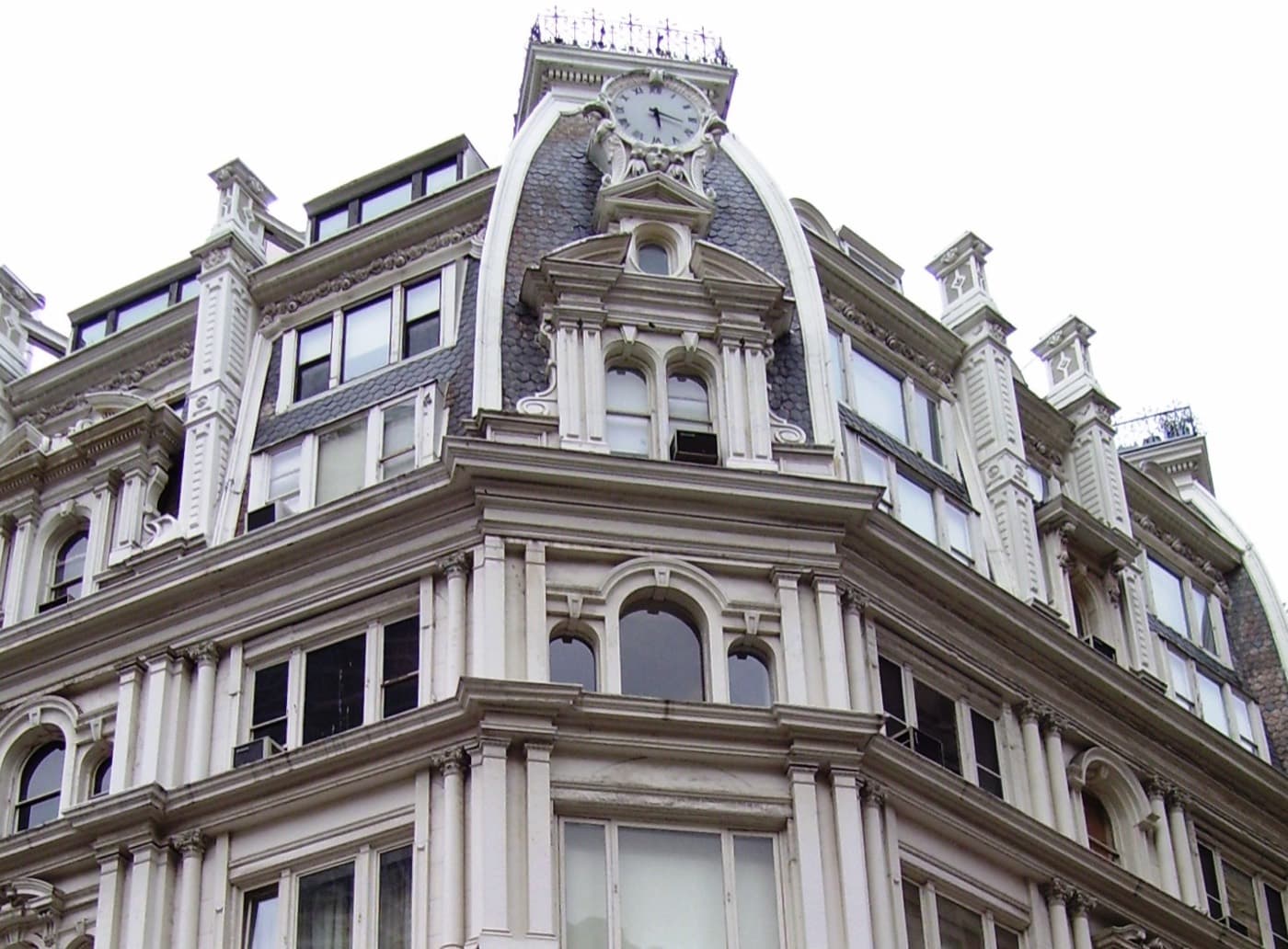
Gilsey House is one of the great survivors of nineteenth-century New York. Built between 1869 and 1871 by Peter Gilsey to a design by Stephen Decatur Hatch, it opened as one of the city's most opulent hotels — a Second Empire pile of cast iron, marble, and gilt at a time when Broadway above 23rd Street was the height of fashion. The cast-iron façade, with its tiers of columns, projecting cornices, and crowning mansard roof, is among the finest in the city, and the building is both a New York City individual landmark and a listing on the National Register of Historic Places.
The hotel closed in 1904, the building spent the twentieth century as loft and commercial space as the area became the garment and flower district, and in 1980 it was converted into a residential cooperative of roughly 40 loft homes. That conversion is the key fact for buyers: Gilsey House offers the chance to own inside a genuine architectural landmark, in lofts carved from the proportions of a Gilded Age hotel, in a neighborhood — NoMad — that has since become one of Manhattan's most fashionable.
The building's character is the entire point. There is no comparable address: a cast-iron landmark, a keyed elevator opening into loft homes, ceiling heights and window scale impossible to build today, and board policies — pets, pied-à-terre, live/work, and 80% financing — that are accommodating for a building of this stature.
Architecture and unit composition
Hatch's design is a textbook of Second Empire cast iron: an eight-story façade organized into ornamented tiers, with paired columns, deep cornices, and a mansard roof that crowns the corner of Broadway and 29th. Cast iron allowed exactly this kind of elaborate, repeated ornament at a scale that masonry could not, and Gilsey House is one of the most complete and celebrated survivors of the technique in New York.
Inside, the roughly 40 residences are lofts — the legacy of the building's hotel-then-commercial life, reconfigured for residential use in the 1980 conversion. Expect the hallmarks of a landmark loft conversion: dramatic ceiling heights, oversized windows, deep floor plates, and the architectural quirks of a building that predates the modern apartment by a century. The keyed elevator opens directly into many homes, and the building carries central air conditioning and a freight elevator — practical infrastructure layered onto the historic shell. No two lofts are identical; layouts, light, and finish levels vary considerably from line to line.
Building operations
Gilsey House runs as a self-managed cooperative with a resident superintendent, a keyed elevator, central laundry, private storage, and a freight elevator. The scale is intimate — roughly 40 households in a landmark building — which gives the cooperative the character of a closely held community rather than an anonymous tower.
The board's policies are notably flexible for a landmark co-op. Cats and dogs are permitted; pied-à-terre ownership, live/work use, and co-purchasing are all allowed; and the building permits financing up to 80% of the purchase price, with a 20% minimum down payment. A transfer fee, or flip tax, applies on resale. As a self-managed building inside a designated landmark, exterior work and any alterations affecting the historic fabric proceed under Landmarks Preservation Commission oversight — a responsibility shareholders share, and a guarantee that the cast-iron façade endures.
Local Law 97
- 2024–2029 annual penalty
- $0 (under cap)
- 2030–2034 annual penalty
- $13,243/yr
- Per unit / month range
- $0 – $28
Source: NYC LL84 benchmarking and PLUTO · The Roebling Research Library. City record last verified September 2026.
See full Local Law 97 analysis — emissions history, scenarios, methodology →Facade safety — Local Law 11
The latest available FISP filing classified the facade as Safe — no repairs were required at that inspection. Facade inspections run on a fixed five-year cycle; future inspection, repair, and any assessment decisions remain building-specific.
How to read this, and where it comes from
QEWI = Qualified Exterior Wall Inspector — the licensed engineer the city requires to sign the report (the independent expert, not the managing agent).
Penalties shown are amounts DOB assessed against filings on record across 2005–10 to 2020–25. The FISP dataset does not record whether they were paid, contested or remain open, so treat the figure as history rather than a current balance and confirm the building’s standing with the managing agent.
Source: NYC DOB facade filings (FISP) · The Roebling Research Library. City record last verified September 2026.
Recent sales
Recent transfers at this building, curated by The Roebling Team research desk. Prices are the transfer amounts recorded with the NYC Department of Finance; apartment-level detail is checked against the building’s own file in The Roebling Research Library before publishing.
| Date | Unit | Apartment | Price | PPSF | vs. Ask |
|---|---|---|---|---|---|
| Aug 19, 2024 | 6AB | 5 BR · 3.5 BA · 4,241 sf | $4,585,000 | $1,081/sf | -4.4% |
| Nov 21, 2022 | 7A | 2 BR · 2 BA · 2,071 sf | $2,000,000 | $966/sf | -4.8% |
| Feb 16, 2022 | 4D | 2 BR · 2 BA · 2,067 sf | $2,095,000 | $1,014/sf | +0.0% |
| Feb 14, 2022 | PHG | 2 BR · 1 BA · 2,000 sf | $2,353,879 | $1,177/sf | -11.2% |
| Apr 30, 2021 | PHE | 3 BR · 2 BA | $2,425,000 | -4.9% | |
| Oct 3, 2018 | 5F | 2 BR · 2,600 sf | $2,000,000 | $769/sf | -14.7% |
| Jul 2, 2018 | 4B | 2 BR · 2,000 sf | $2,550,000 | $1,275/sf | -7.3% |
| Jun 14, 2018 | 6E | 4 BR · 2 BA · 2,933 sf | $2,933,000 | $1,000/sf | -15.0% |
Market read. Most recent trades (2024) cleared a median $1,188/sf across 1 sale. Median listing discount 4.8% from the last ask — a recurring negotiation gap worth pricing into any offer or listing strategy.
The retrade record
Lines that have traded more than once in the public record — the building’s appreciation arc, apartment by apartment.
Full closing history with price-per-square-foot over time, the complete retrade record, and every line that has traded.
Sales sourced from NYC Department of Finance recorded transfers (BBL 1-00831-0020) and verified listing data. Apartment-level facts (line, condition, asking-price context) curated and cross-verified by The Roebling Team research desk. Not all transactions cross-verify with ACRIS records — sponsor and LLC purchases sometimes record at stipulated values rather than market price; square footage on co-ops is not officially recorded, figures shown are approximate.
What to know if you’re buying
Buy it for the building. Owning inside a cast-iron landmark, in a loft with ceiling heights and window scale that cannot be reproduced, is the entire proposition — this is a character purchase first and a square-footage purchase second. The board's flexibility is a genuine advantage: 80% financing, pets, pied-à-terre, live/work, and co-purchasing make the building accessible to a far wider pool than most landmark co-ops, including financed buyers and part-time New Yorkers.
Underwrite the loft itself carefully. Because every home is different, focus on the specific layout, light, ceiling height, and condition rather than building averages, and assess any renovation work for landmark and co-op approval requirements. Plan for a board package, and budget the transfer fee into your closing costs. Review the self-managed cooperative's financials and reserve picture as part of your diligence — a landmark building carries façade and infrastructure obligations that shareholders ultimately fund.
What to know if you’re selling
Lead with the architecture and the address. A residence inside a New York City individual landmark, a cast-iron Second Empire masterpiece in the heart of fashionable NoMad, is a story few buildings can tell — make the landmark status, the loft scale, and the building's history the centerpiece of the marketing.
Price the loft on its own merits. With homes varying so widely, comparable analysis belongs at the apartment level, benchmarked against other landmark and loft conversions in NoMad and the Flatiron rather than against conventional apartment stock. Emphasize the board's flexibility — pets, 80% financing, pied-à-terre, and live/work — as the differentiators they are; those policies meaningfully widen your buyer pool. And use the building's low turnover to frame scarcity: when a Gilsey House loft is available, there is genuinely nothing else like it on the market.
Comparable buildings
If you're considering 1200 Broadway, also evaluate nearby NoMad and Flatiron ownership product:
- 1107 Broadway — landmarked NoMad loft condominium
- 261 Broadway — early steel-frame downtown cooperative
- 270 Broadway — pre-war loft conversion
- 335 Broadway — converted loft ownership building
The full playbook — what goes in the package, how boards read your financials, the interview, and the timeline — plus sample cover, reference, and personal letters you can adapt.
How to read the facts on this page. Items attributed to an offering plan describe the building as it was offered at that filing — unit mix, square footage, the amenity program as planned. They are not a statement about how the building operates today. Tax and compliance figures are sourced separately to current City records and carry their own dates. House rules, staffing and fee policy can change by board resolution without any public filing: treat every policy line here as a starting point for diligence and confirm it with the managing agent. Where this page compares one building or neighborhood to another, that is our analysis of the recorded record — it names the measure, the period and the sample it rests on, and it is an observation about medians rather than a prediction about any particular apartment.
Considering a move at Gilsey House?
Request a private building brief with the relevant comparable sales, current and off-market availability, and an apartment-specific view of value.