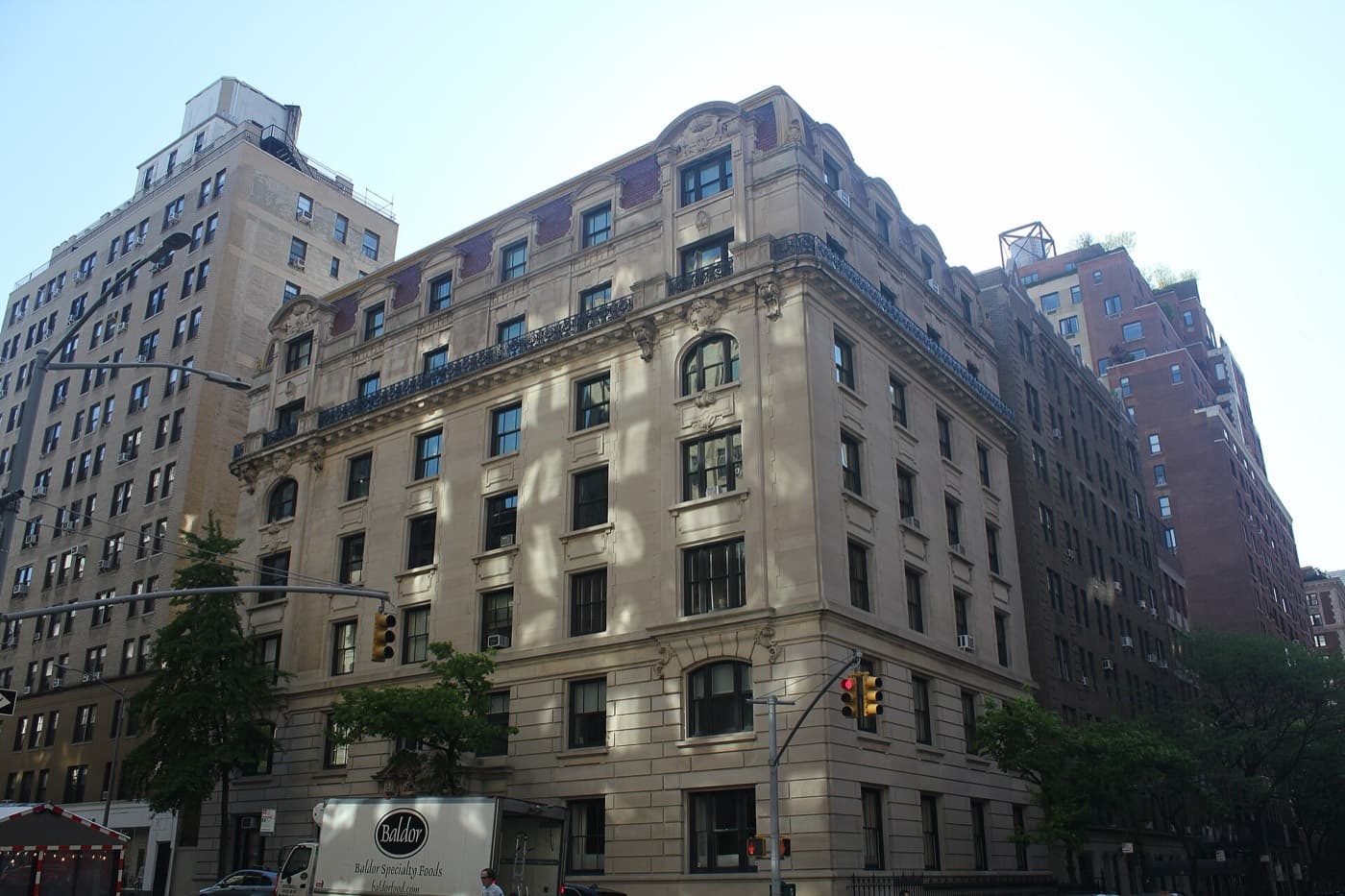
1261 Madison Avenue
1261 Madison Avenue, New York, NY 10128
Carnegie Hill, Upper East Side
BBL 1015020020 · BIN 1046984
- Year built
- 1901
- Type
- Cooperative
- Landmark
- Designated
Every recorded sale at this building, 2004–2023
Bedroom-by-bedroom medians, the full transfer record, and how units trade against ask.
- 3BR median
- $3M
- Recent range
- $2.5M – $3.5M
- Listing discount
- 4.8%
- Recorded transfers
- 10
Own an apartment here? See what it would sell for.
A Private Pricing Opinion — what your apartment at 1261 Madison Avenue would likely sell for today, what it costs to sell, and what you’d walk away with — reviewed personally against condition, exposures, renovation quality, and the competition actually on the market.
1261 Madison Avenue is one of the most distinctive small buildings in Carnegie Hill — a 1901 French Beaux-Arts apartment house by Buchman & Fox that the city singled out for individual landmark designation in 1974, three decades before the surrounding Carnegie Hill Historic District was extended around it. It was built to house just over a dozen families across seven stories, and it has carried that intimate scale ever since, operating today as a 16-unit cooperative on the corner of East 90th Street.
What sets it apart is the architecture. The base is rusticated limestone; the upper floors are brick crowned by a true mansard roof; and the composition is anchored by a monumental broken pediment that the architectural literature has long singled out as the building's defining gesture. A cast-iron common balcony wraps an upper floor — a Parisian flourish that was commonplace in Europe at the turn of the century but a genuine rarity in New York. The result is a building that reads as a piece of the Belle Époque dropped onto Madison Avenue, and that has the landmark protection to keep it that way.
For buyers, 1261 Madison offers something the larger pre-war houses cannot: scale. Sixteen apartments behind a protected limestone-and-mansard facade, steps from Central Park and the Museum Mile, is about as close-held as Carnegie Hill ownership gets.
Architecture and unit composition
Buchman & Fox designed 1261 Madison in the full French idiom — a two-story rusticated limestone base giving way to brick, the whole capped by a steep mansard and the broken pediment that anchors the parapet. The cast-iron balcony, the window surrounds, and the overall proportioning all belong to the Beaux-Arts vocabulary that the firm and its peers brought to Carnegie Hill in the years around 1900.
Inside, the seven-story building holds 16 cooperative residences — large by the standards of the era, with the high ceilings, generous room proportions, and detailing that pre-war buyers seek out. Because the building was conceived for a small number of families, layouts run to the spacious side rather than the subdivided, and the landmark designation means the exterior envelope and its detail have been preserved through the building's long cooperative life. Apartments here trade infrequently, and each that comes to market is its own renovation story.
Building operations
1261 Madison runs as a quiet, full-pre-war cooperative. The building is staffed by a live-in resident manager and offers a central laundry room, a bicycle room, and private storage — a practical service package scaled to a 16-unit house rather than a large tower. Daily life here trades amenity breadth for the privacy and discretion of a small, owner-occupied building.
On policy, the cooperative permits financing of up to 50% of the purchase price — a conservative posture typical of small Carnegie Hill houses. Pets are permitted, and pied-à-terre ownership is allowed — an unusual combination of flexibility for a building of this vintage and exclusivity. A 2% flip tax is paid by the buyer at closing. As with any small cooperative, the board reviews each purchase carefully, and the limited share count means turnover is modest.
Local Law 97
- 2024–2029 annual penalty
- $0 (under cap)
- 2030–2034 annual penalty
- $14,480/yr
- Per unit / month range
- $0 – $75
Source: NYC LL84 benchmarking and PLUTO · The Roebling Research Library. City record last verified September 2026.
See full Local Law 97 analysis — emissions history, scenarios, methodology →Facade safety — Local Law 11
The latest available FISP filing classified the facade as Safe — no repairs were required at that inspection. Facade inspections run on a fixed five-year cycle; future inspection, repair, and any assessment decisions remain building-specific.
How to read this, and where it comes from
QEWI = Qualified Exterior Wall Inspector — the licensed engineer the city requires to sign the report (the independent expert, not the managing agent).
Source: NYC DOB facade filings (FISP) · The Roebling Research Library. City record last verified September 2026.
Recent sales
Recent transfers at this building, curated by The Roebling Team research desk. Prices are the transfer amounts recorded with the NYC Department of Finance; apartment-level detail is checked against the building’s own file in The Roebling Research Library before publishing.
| Date | Unit | Apartment | Price | PPSF | vs. Ask |
|---|---|---|---|---|---|
| Aug 17, 2023 | 5N | 3 BR · 3 BA | $2,500,000 | -16.7% | |
| Apr 27, 2023 | 2N | 3 BR · 2 BA | $3,500,000 | -7.8% | |
| Sep 27, 2021 | 5S | 3 BR · 3 BA · 2,150 sf | $3,725,000 | $1,733/sf | -6.8% |
| Sep 15, 2014 | 4N | 4 BR | $3,140,000 | +8.5% | |
| Dec 19, 2011 | 2S | 3 BR | $2,600,000 | -3.7% | |
| Nov 10, 2004 | 1S | 3 BR | $1,795,000 | +0.0% | |
| Jun 24, 2004 | PH7S | 3 BR | $1,975,000 | -6.0% | |
| Feb 9, 2004 | 3N | 3 BR · 2,200 sf | $2,175,000 | $989/sf | off-mkt |
Market read. $/sf is measured on the latest sales with reliable square footage (2021): a median $1,733/sf across 1 sale. The building has traded as recently as 2023. Median listing discount 6.0% from the last ask — a recurring negotiation gap worth pricing into any offer or listing strategy.
Full closing history with price-per-square-foot over time, the complete retrade record, and every line that has traded.
Sales sourced from NYC Department of Finance recorded transfers (BBL 1-01502-0020) and verified listing data. Apartment-level facts (line, condition, asking-price context) curated and cross-verified by The Roebling Team research desk. Not all transactions cross-verify with ACRIS records — sponsor and LLC purchases sometimes record at stipulated values rather than market price; square footage on co-ops is not officially recorded, figures shown are approximate.
What to know if you’re buying
The appeal is concrete: a landmarked 1901 Beaux-Arts building, 16 apartments, on a Carnegie Hill corner one block from Central Park and within easy reach of the Museum Mile. The policy posture is friendlier than the building's pedigree might suggest — pets and pied-à-terre ownership are both permitted, which widens the buyer pool relative to stricter neighbors. Budget for up to 50% financing and a 2% flip tax payable by the buyer, and plan for a thorough board review; small cooperatives scrutinize each application closely. Because the building is individually landmarked, exterior alterations are constrained, so most renovation energy goes into the interiors. The trade-off for that small-building intimacy is a leaner amenity set — there is no doorman or gym — which suits buyers who prioritize privacy and architectural character over services.
What to know if you’re selling
The story sells itself: an individually landmarked Beaux-Arts house, the work of Buchman & Fox, with a mansard roof, a broken pediment, and a cast-iron balcony that almost nothing else on Madison can match. Lead with the architecture and the landmark status — they are durable, verifiable differentiators that set a resale here apart from the corridor's larger pre-war co-ops. Scarcity works in the seller's favor: with so few apartments, comparable supply is thin, and a well-prepared, well-priced home can move quickly to a buyer who has been waiting for the building. Position the pet and pied-à-terre flexibility as a feature, since it broadens demand. Expect the board package and interview to be part of the timeline, and price against the building's own history and the small landmarked houses of Carnegie Hill rather than the full-service towers nearby.
Comparable buildings
If you're weighing 1261 Madison Avenue, also consider these nearby Carnegie Hill and Upper East Side co-ops:
- 1230 Madison Avenue — pre-war Carnegie Hill cooperative on Madison
- 1095 Madison Avenue — pre-war Madison Avenue cooperative
- 1115 Madison Avenue — Madison Avenue cooperative nearby
- 10 East 85th Street — Carnegie Hill pre-war cooperative
- 111 East 85th Street — Carnegie Hill cooperative a few blocks south
The neighborhood
For the full corridor — architecture, schools, transit, and pricing across Upper East Side — read The Roebling Team Guide to Upper East Side.
The full playbook — what goes in the package, how boards read your financials, the interview, and the timeline — plus sample cover, reference, and personal letters you can adapt.
How to read the facts on this page. Items attributed to an offering plan describe the building as it was offered at that filing — unit mix, square footage, the amenity program as planned. They are not a statement about how the building operates today. Tax and compliance figures are sourced separately to current City records and carry their own dates. House rules, staffing and fee policy can change by board resolution without any public filing: treat every policy line here as a starting point for diligence and confirm it with the managing agent. Where this page compares one building or neighborhood to another, that is our analysis of the recorded record — it names the measure, the period and the sample it rests on, and it is an observation about medians rather than a prediction about any particular apartment.
Considering a move at 1261 Madison Avenue?
Request a private building brief with the relevant comparable sales, current and off-market availability, and an apartment-specific view of value.