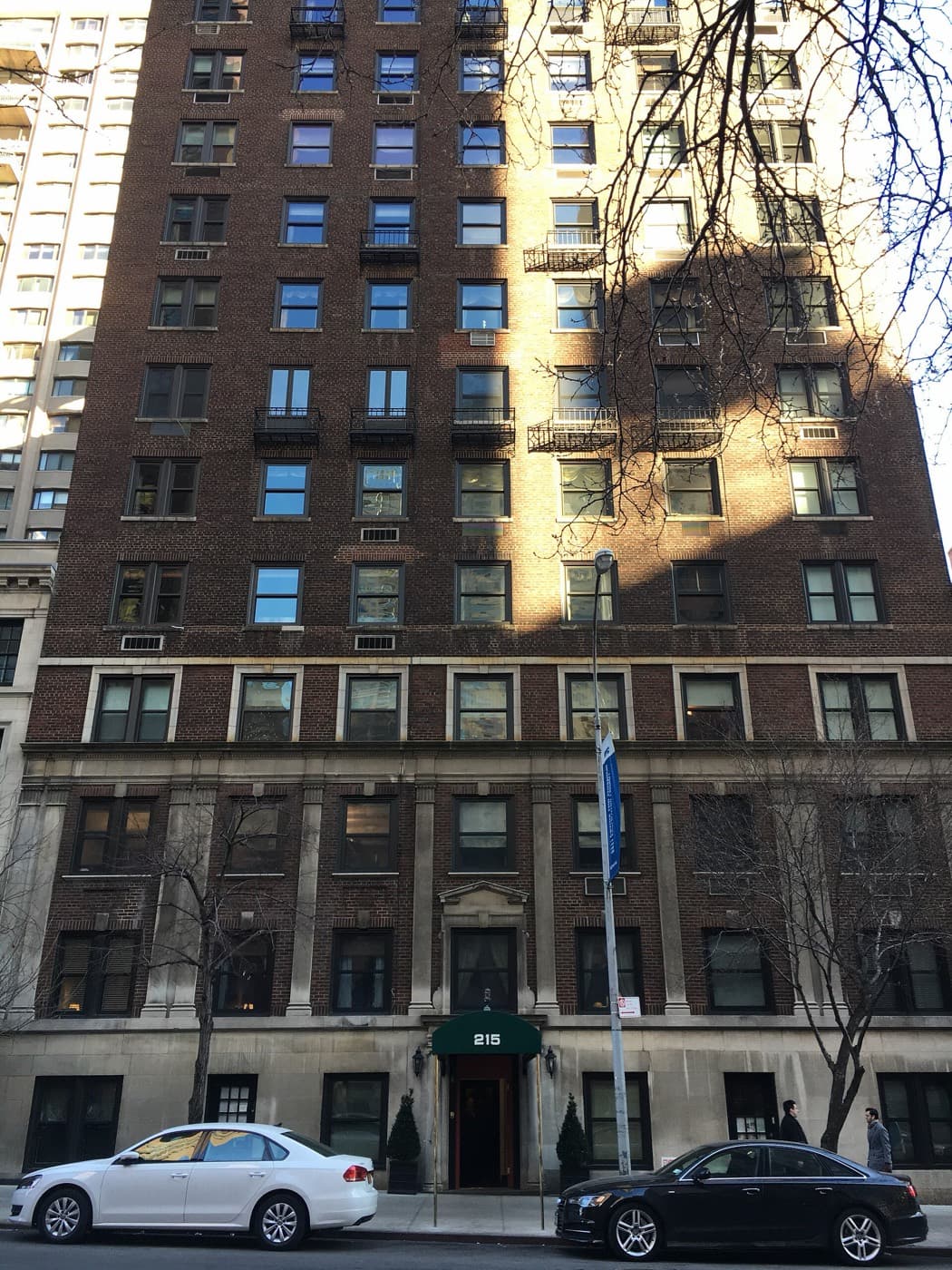
215 East 72nd Street
215 East 72nd Street, New York, NY 10021
Lenox Hill, Upper East Side
BBL 1014270007 · BIN 1043966
- Year built
- 1929
- Type
- Cooperative
- Landmark
- No
Every recorded sale at this building, 2005–2026
Bedroom-by-bedroom medians, the full transfer record, and how units trade against ask.
- 3BR median
- $3.2M
- Recent range
- $2.6M – $3.9M
- Listing discount
- 1.8%
- Recorded transfers
- 35
Own an apartment here? See what it would sell for.
A Private Pricing Opinion — what your apartment at 215 East 72nd Street would likely sell for today, what it costs to sell, and what you’d walk away with — reviewed personally against condition, exposures, renovation quality, and the competition actually on the market.
215 East 72nd Street is a charming, intimate white-glove cooperative built in 1929 on a wide crosstown block between Second and Third Avenues. Its defining advantage is light: the building is flanked by low-rise neighbors, which gives it far more open exposure and air than most mid-block buildings on a major crosstown street ever enjoy. For a pre-war of this scale, that is a meaningful and durable asset.
It is a small, well-run house — just thirty apartments across fifteen floors — operated as a full-service co-op with a long-tenured staff and a stable shareholder body. The location sits squarely in the heart of Lenox Hill, with the full breadth of the East 70s' shopping, dining, and transit within a short walk and the Q train on Second Avenue close at hand. For buyers who want a quiet, light-filled pre-war at a more accessible price than the Park and Fifth blocks command, it is an appealing target.
Architecture and unit composition
The building is a handsome pre-war in brick and limestone, with a one-story limestone base, limestone pilasters carrying the second and third floors, and limestone window surrounds at the fourth — restrained classical detailing that gives the lower elevation real presence. The flanking low-rise buildings are the architectural luck of the site: open exposures and consistent light from the side that taller mid-block neighbors elsewhere on 72nd Street cut off.
Inside, the thirty apartments are configured as gracious pre-war layouts — entry foyers, well-proportioned entertaining rooms, separated bedroom wings, hardwood floors, and high ceilings. The mix runs to comfortable two- and three-bedroom homes, with the upper floors enjoying the best of the building's open light. The small unit count keeps the building quiet and the common areas uncrowded.
Building operations
215 East 72nd Street is a full-service, white-glove cooperative. A full-time doorman, an attended elevator, and a live-in superintendent anchor the staff, with private storage among the practical amenities. The cooperative permits financing up to 50% of the purchase price, and a 2% flip tax is paid at closing. Pets are permitted with board approval. Purchases are reviewed by a board in the customary pre-war manner, and the building is run for long-term owner-occupancy.
Local Law 97
- 2024–2029 annual penalty
- $0 (under cap)
- 2030–2034 annual penalty
- $2,048/yr
- Per unit / month range
- $0 – $5
Source: NYC LL84 benchmarking and PLUTO · The Roebling Research Library. City record last verified September 2026.
See full Local Law 97 analysis — emissions history, scenarios, methodology →Facade safety — Local Law 11
The latest available filing classified the facade as SWARMP — Safe With A Repair and Maintenance Program: the engineer identified conditions requiring monitoring or repair before the next inspection cycle. The scope, timeline, and how the building funds the work are building-specific — we review the filings and board materials for you.
How to read this, and where it comes from
QEWI = Qualified Exterior Wall Inspector — the licensed engineer the city requires to sign the report (the independent expert, not the managing agent).
Source: NYC DOB facade filings (FISP) · The Roebling Research Library. City record last verified September 2026.
Management & transfer contacts
- Flip tax
- 2% flip tax
Recent sales
Recent transfers at this building, curated by The Roebling Team research desk. Prices are the transfer amounts recorded with the NYC Department of Finance; apartment-level detail is checked against the building’s own file in The Roebling Research Library before publishing.
| Date | Unit | Apartment | Price | PPSF | vs. Ask |
|---|---|---|---|---|---|
| Jun 17, 2026 | 9W | 3 BR · 3 BA · 2,100 sf | $3,100,000 | $1,476/sf | -3.0% |
| Apr 8, 2026 | 10W | 3 BR · 3 BA | $3,300,000 | +1.5% | |
| Mar 3, 2026 | 12E | 4 BR · 4 BA · 2,500 sf | $3,850,000 | $1,540/sf | -0.6% |
| Aug 15, 2023 | 7E | 4 BR | $2,650,000 | -10.0% | |
| Jul 7, 2022 | 4W | 4 BR · 2.5 BA | $3,295,000 | +0.0% | |
| Jun 21, 2022 | 3W | 3 BR · 3 BA | $3,600,000 | +12.7% | |
| Mar 15, 2022 | 5W | 3 BR · 3 BA | $2,280,000 | -8.6% | |
| Jan 6, 2022 | 10W | 3 BR · 3 BA | $3,250,000 | +3.2% |
Market read. Most recent trades (2026) cleared a median $1,471/sf across 2 sales. Median listing discount 1.1% from the last ask — a recurring negotiation gap worth pricing into any offer or listing strategy.
The retrade record
Lines that have traded more than once in the public record — the building’s appreciation arc, apartment by apartment.
Full closing history with price-per-square-foot over time, the complete retrade record, and every line that has traded.
Sales sourced from NYC Department of Finance recorded transfers (BBL 1-01427-0007) and verified listing data. Apartment-level facts (line, condition, asking-price context) curated and cross-verified by The Roebling Team research desk. Not all transactions cross-verify with ACRIS records — sponsor and LLC purchases sometimes record at stipulated values rather than market price; square footage on co-ops is not officially recorded, figures shown are approximate.
What to know if you’re buying
The light is the reason to act, and it is the thing to evaluate first — the flanking low-rise neighbors give this building open exposures that command a premium and are rare on a crosstown block. Underwrite it as a classic pre-war purchase: a board package and interview, financing capped at 50%, and a 2% flip tax at closing. Pets are welcome with board approval.
The value case is straightforward. A light-filled pre-war two- or three-bedroom in Lenox Hill, in a small white-glove building, for materially less than the equivalent a few blocks west — that is the trade on offer. Inventory is limited, so a well-positioned apartment warrants a prompt, prepared offer. We help buyers assess the specific line and exposure, read the building's financials, and benchmark the ask against recent Lenox Hill pre-war sales.
What to know if you’re selling
Lead with light and intimacy: a thirty-unit white-glove pre-war with open exposures from its low-rise flanks, in the heart of Lenox Hill. Those are the differentiators against the larger, darker mid-block co-ops nearby, and they speak directly to buyers who prize air and quiet over a marquee avenue address.
Because turnover is low, pricing should be set to the apartment's specific light, floor, and condition rather than a building average, and the scarcity of in-building competition works in a seller's favor. We market the building's exposures and small-house character to the right buyer pool, present board realities transparently to keep deals on track, and steer the cooperative's review toward a clean, on-time closing.
Comparable buildings
If you're considering 215 East 72nd Street, also evaluate nearby East 72nd Street and Lenox Hill cooperatives:
- 315 East 72nd Street — full-service East 72nd Street co-op nearby
- 320 East 72nd Street — East 72nd Street cooperative
- 325 East 72nd Street — co-op on the same crosstown block
- 340 East 72nd Street — large full-service East 72nd Street co-op
- 114 East 72nd Street — pre-war co-op west of Park Avenue
The neighborhood
For the full corridor — architecture, schools, transit, and pricing across Upper East Side — read The Roebling Team Guide to Upper East Side.
The full playbook — what goes in the package, how boards read your financials, the interview, and the timeline — plus sample cover, reference, and personal letters you can adapt.
How to read the facts on this page. Items attributed to an offering plan describe the building as it was offered at that filing — unit mix, square footage, the amenity program as planned. They are not a statement about how the building operates today. Tax and compliance figures are sourced separately to current City records and carry their own dates. House rules, staffing and fee policy can change by board resolution without any public filing: treat every policy line here as a starting point for diligence and confirm it with the managing agent. Where this page compares one building or neighborhood to another, that is our analysis of the recorded record — it names the measure, the period and the sample it rests on, and it is an observation about medians rather than a prediction about any particular apartment.
Considering a move at 215 East 72nd Street?
Request a private building brief with the relevant comparable sales, current and off-market availability, and an apartment-specific view of value.