
50 West 66th Street
50 West 66th Street, New York, NY 10023
Lincoln Square, Upper West Side
BBL 1011187503 · BIN 1028168
- Year built
- 2025
- Type
- Condominium
- Units
- 124
- Floors
- 69
- Landmark status
- Not an individual landmark; not in a historic district
- NYC Landmarks Preservation Commission and City Planning records, updated February 2026
- Leasing by owners
- Permitted
- Pied-à-terre
- Permitted
- Pets
- Pets permitted; species and limits not stated
- Washer/dryer
- Permitted
- Maximum financing
- Requires confirmation
- Our building record and the source for this line differ. Confirm with building management.
- Doorman
- Doorman (hours not stated)
- Financing
- Requires confirmation
- Subletting
- Leasing permitted (condominium); Board/association review applies. Short-term rentals and AirBnB are not permitted.
- Pied-à-terre
- Permitted.
- Washer / dryer
- Permitted in-unit.
- Pets
- Permitted, subject to Board approval.
- Co-purchasing
- Permitted. Parents purchasing for children permitted.
Compiled by The Roebling Research Desk from the building’s offering plan, amendments, and related building documents (primary source dated 2026). Board policies can change by amendment — confirm at the offer stage.
Every recorded sale at this building, 2025–2026
Price-per-square-foot over time, the line- and floor-premium curves, and every recorded sale.
- Median $/sf, 2026 to date
- $2,947
- floor-adjusted, 15 sales
- Listing discount
- -2.1%
- Recorded sales
- 109
- On record
- 2025–2026
Own an apartment here? See what it would sell for.
A Private Pricing Opinion — what your apartment at 50 West 66th Street would likely sell for today, what it costs to sell, and what you’d walk away with — reviewed personally against condition, exposures, renovation quality, and the competition actually on the market.
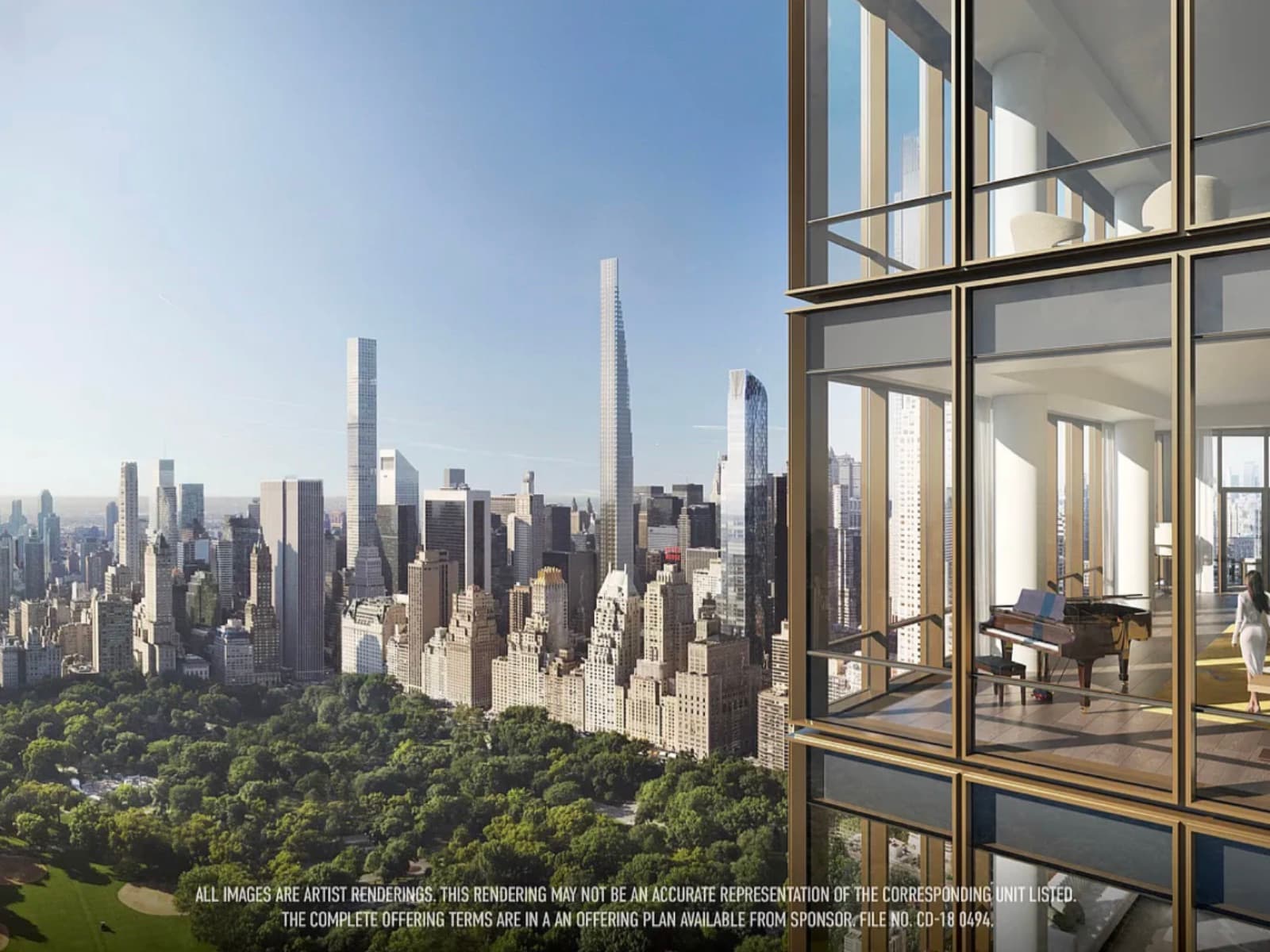
50 West 66th Street is the tallest residential building on the Upper West Side and the corridor's defining piece of contemporary architecture. It was developed by Extell Development Company, whose Manhattan trophy portfolio also includes One57 and Central Park Tower, and designed by Snøhetta — the practice responsible for the Norwegian National Opera, the Times Square reconstruction and the September 11 Memorial Museum Pavilion — in its first New York residential commission at full scale.
The design argument is legible from the street. A hand-set textured limestone podium carries burnished bronze and glass at grade; above a mid-tower setback the volume chamfers at the corners, and the chamfers produce a vertical run of recessed loggias rather than the projecting balconies that most Manhattan towers use to generate outdoor space. The tower terminates in an illuminated bronze crown. Snøhetta described the massing as sculptural excavation, and the reading holds up: this is a building that gets its outdoor space by carving rather than by adding.
The tower's height depends on engineering that was litigated for years. Interstitial mechanical space lifts the upper residential floors more than two hundred feet above the podium, and the Board of Standards and Appeals cleared the arrangement in January 2020 after sustained neighborhood opposition. The consequence is visible in the building's own apartment schedule: residences run from the third floor to the seventeenth, and then there is nothing until the fortieth. Everything between is mechanical, amenity and structure. A buyer looking at floor numbers here should understand that the "House" and "Tower" halves of the building are separated not just by price and interior treatment but by a two-hundred-foot void.
Three facts about the building's commercial position are worth stating precisely, because they are the ones most often gotten wrong.
It is new. Despite PLUTO's 2019 year-built field, the building was first occupied in 2025. The initial certificate of occupancy issued January 28, 2025, the condominium declaration was recorded December 6, 2024, and the first unit deeds were recorded on February 14, 2025.
Sellout is still running. One hundred and one deeds have been recorded against the residential unit lots — 81 in 2025 and 20 in 2026 — and 33 of the 124 unit lots remained in sponsor ownership on the FY2027 assessment roll. A developer that is still absorbing roughly a quarter of a building, and still carrying inventory financing against it, is negotiating from a different position than a board of resale sellers. That is real leverage for a buyer, and it is the single most useful thing on this page.
There is no tax abatement. No unit lot in this building carries an exemption on the current roll. Residences have been taxed at full assessment from the first closing. Buyers who have underwritten abated new construction elsewhere in Manhattan will find the monthly carrying number here materially higher than the sticker price implies, and it does not step up later — it starts where it stays.
Architecture and unit composition
The residences divide into two distinct products. The "House" occupies floors 3 through 17, in tiers lettered A through G, with interiors by Shamir Shah Design. These are the smaller plates, priced and configured for a different buyer than the tower above, and their outlooks are governed by the surrounding Lincoln Square block rather than by the skyline.
The "Tower" begins at floor 40 and runs to the penthouse, with interiors by AB Concept and residences designated by compass point — north, south, east and west — as half-floor and full-floor plates, consolidating to single-residence floors near the top. Ceilings run to 14 feet 6 inches at the upper end, floor-to-ceiling glazing is standard, and the chamfered corners produce loggias rather than balconies at many lines. Above floor 40, east-facing residences look directly over Central Park and west-facing residences over the Hudson.
The variation between lines in this building is unusually wide. The chamfer geometry means that outdoor space, glazing area and corner exposure differ materially from one designation to the next on the same floor, and the two-hundred-foot separation between the House and the Tower means that a House residence and a Tower residence are not comparable products at any price. Pricing and diligence should be done at the line level.
One unit lot at the base is classified by the Department of Finance as a professional rather than residential unit and is recorded at a nominal area. It is not a residence and should be disregarded in unit-count analysis.
Building operations
50 West 66 runs as a full-service condominium with a porte-cochère, 24-hour doorman and concierge coverage, valet services and a live-in superintendent. The amenity program is roughly 50,000 square feet across three levels and is among the largest in Manhattan new construction — indoor lap pool and spa, an outdoor pool and hot tub on the 20th-floor sky level, basketball, pickleball and squash courts, a bowling alley, a golf simulator, a fitness center with Pilates and training studios, a screening room, saunas and steam rooms, a children's studio, a gaming lounge, a sky lounge with landscaped terrace and fire pits, a common dining room, and wine and private storage.
That program has a cost, and the building is young enough that its expense and reserve baselines are still being established. Two operating questions deserve specific attention from any buyer here. The first is the common-charge trajectory: an amenity package of this scale across roughly 121 residences is a favorable ratio to use and an expensive one to fund, and early-year budgets at new condominiums are frequently revised upward as actual costs replace projections. The second is the certificate of occupancy. Department of Buildings records show the building's certificate renewed eleven times between January 2025 and July 27, 2026; no final certificate of occupancy appears in the record as of that most recent renewal. That is not unusual for a tower still in sellout with unfinished work, but it is a condition a buyer's attorney should confirm and address at contract.
Policy framework
Ownership form: Condominium. Transfers close through the board's right of first refusal rather than a cooperative-style approval, which produces 30-to-45-day closing timelines.
Pets: Permitted per management-sourced records. Confirm weight and breed limits in the house rules.
Pied-à-terre, subletting, LLC, trust and foreign ownership: All permitted under the standard condominium framework. Confirm minimum lease terms and any registration requirement with the managing agent.
Minimum down payment: 20 percent per listing records.
Flip tax: Not documented in public records. Confirm any resale capital contribution with the managing agent before pricing a sale.
Real estate taxes: No exemption of any kind appears on any unit lot on the FY2027 assessment roll. Underwrite full unabated taxes on the specific unit and run True Monthly Carrying Cost analysis against the current bill.
Application and transaction fees
Fees below are from building management's published schedule, as of October 2026. They are shown as published, item by item; no total is added because the total depends on the transaction. Deposits are listed apart from nonrefundable charges.
Purchase
5 items
Fees and charges
| Item | Paid by | When | Amount | Refundable |
|---|---|---|---|---|
| Application Processing Fee | Paid by Buyer | When With the application | Amount $1,200 | Refundable Non-refundable |
| Credit Check FeePer applicant | Paid by Buyer | When With the application | Amount $125 per applicant | Refundable Non-refundable |
| Move In Fee | Paid by Buyer | When With the application | Amount $1500 per day | Refundable Non-refundable |
| Working Capital Contribution | Paid by Buyer | When With the application | Amount 2 months common charges | Refundable Not stated |
| Move Out Fee | Paid by Seller | When With the application | Amount $1500 per day | Refundable Non-refundable |
Rental or lease
5 items
Fees and charges
| Item | Paid by | When | Amount | Refundable |
|---|---|---|---|---|
| Application Processing Fee | Paid by Tenant | When With the application | Amount $1,200 | Refundable Non-refundable |
| Credit Check FeePer applicant | Paid by Tenant | When With the application | Amount $125 per applicant | Refundable Non-refundable |
| Move In Fee | Paid by Tenant | When With the application | Amount $1500 per day | Refundable Non-refundable |
| Move Out Fee | Paid by Tenant | When With the application | Amount $1500 per day | Refundable Non-refundable |
| Working Capital Contribution | Paid by Tenant | When With the application | Amount 1 months common charges | Refundable Not stated |
Management updates its schedule without a public filing. The date is when management last updated the page, not when a rule changed. Confirm the current schedule with management before you apply.
Considering an apartment here? Send Corey the listing to discuss the building's costs and purchase requirements.
Own an apartment here? Request an apartment-specific pricing review.
Financing and purchase requirements
- Maximum financing
- Requires confirmationOur building record and the source for this line differ. Confirm with building management.
- Co-purchasing
- PermittedSource: building management's published schedule, as of October 2026
- Parent buying for an employed child
- PermittedSource: building management's published schedule, as of October 2026
- Parent buying for a student child
- PermittedSource: building management's published schedule, as of October 2026
- Purchase or lease by a corporation
- Not permittedSource: building management's published schedule, as of October 2026
Sublet and pied-à-terre policy
A condominium owner leasing a unit and a co-op shareholder subletting are different rules, and a building-wide rule is different from a restriction on one apartment. This is the building's rule; confirm it for the specific apartment.
- Leasing by owners
- PermittedSource: building management's published schedule, as of October 2026
- Pied-à-terre ownership
- PermittedSource: building management's published schedule, as of October 2026
- Short-term rentals
- Not permittedSource: building management's published schedule, as of October 2026
Considering an apartment here? Send Corey the listing to discuss the sublet and pied-à-terre rules for that apartment.
Pets and in-unit washer/dryer
- Pets
- Pets permitted; species and limits not statedSource: building management's published schedule, as of October 2026
- In-unit washer/dryer
- PermittedSource: building management's published schedule, as of October 2026
Considering an apartment here? Send Corey the listing to confirm the pet and washer/dryer rules for that apartment.
Monthly carrying charges in recent sales
- Common charges + taxes, per room
- $1,019 per room a monthMedian of 84 recorded sales since October 2023Source: recorded sales, refreshed October 2026
- Common charges + taxes, per square foot
- $2.67 per square foot a monthMedian of 83 recorded sales since October 2023Source: recorded sales, refreshed October 2026
- Common charges alone, per square foot
- $1.33 per square foot a monthMedian of 100 listings since October 2023 that give the annual taxSource: listing records, refreshed October 2026
- Real estate taxes alone, per square foot
- $1.34 per square foot a monthMedian of 100 listings since October 2023 that give the annual taxSource: listing records, refreshed October 2026
Common charges plus real estate taxes, combined into one monthly figure the way New York condominium listings show them. Add a mortgage payment for the monthly outlay. The split into common charges and taxes comes from the listings that also give the annual tax, a different sample, so the two lines need not add up exactly to the combined median; a tax abatement can hold taxes below the full amount until it expires. A summary of recorded sales and listings, not a current bill; charges change.
Building staffing and amenities
- Doorman
- Doorman (hours not stated)Source: The Roebling Team's building profile
- Concierge
- YesSource: recent listing records
- Attended lobby
- YesSource: The Roebling Team's building profile
- Live-in superintendent
- YesSource: The Roebling Team's building profile
- Valet
- YesSource: The Roebling Team's building profile
- Elevator
- YesSource: NYC Department of Buildings elevator records
- Amenities noted
- Fitness room, pool, spa, residents' lounge, media room, bike storage, storageSource: The Roebling Team's building profile
Staffing and amenities as our building profile and recent listing records describe them. A feature not listed is not confirmed absent.
Management & transfer contacts
- Sublet policy
- Allowed
- Pied-à-terre
- Allowed
- Notable fees
- Move In/Out $1,500 per day; working capital 2 months common charges (sale); short-term rentals & AirBnB not allowed
Inside 50 West 66th Street


Recent sales
50 West 66 sits at the top of the Upper West Side price band and trades against a very small set of buildings. Its comparable set is the corridor's trophy new construction and the Central Park West trophy cooperatives and condominiums, not the surrounding prewar co-op stock, whose policies, financing rules and buyer pools are structurally different.
Within the building, two separate markets exist. House residences on floors 3 through 17 and Tower residences from floor 40 up are not comparable to one another on a dollars-per-square-foot basis, and treating them as a single building average produces misleading numbers. Line, floor and outdoor-space configuration drive value here more than in most towers, because of the chamfer geometry.
The active sellout is the most important pricing variable. With roughly a quarter of the unit lots still in sponsor hands and inventory financing recorded against them, sponsor-held residences and resale residences are competing for the same buyer, and a resale seller is pricing against a developer with a carry cost and a schedule. Unit-level transaction history is maintained in The Roebling Research Library and shared with clients during diligence.
Recent closings at this building, from The Roebling Research Library. Prices are the transfer amounts recorded with the NYC Department of Finance; apartment-level detail is checked against the building’s own file in The Roebling Research Library before publishing.
| Date | Unit | Apartment | Price | PPSF | vs. Ask |
|---|---|---|---|---|---|
| Aug 28, 2026 | 41WSponsor Sale | 3 BR · 3.5 BA · 2,816 sf | $17,067,107 | $6,061/sf | +2.2% |
| Jul 16, 2026 | 3ASponsor Sale | 2 BR · 3.5 BA · 2,519 sf | $5,618,375 | $2,230/sf | -9.4% |
| Jun 5, 2026 | 40WSponsor Sale | 3 BR · 3.5 BA · 2,816 sf | $17,052,816 | $6,056/sf | +3.4% |
| May 21, 2026 | 4CSponsor Sale | 4 BR · 4.5 BA · 3,223 sf | $8,966,846 | $2,782/sf | +5.5% |
| May 15, 2026 | 4ASponsor Sale | 2 BR · 3.5 BA · 2,519 sf | $6,123,646 | $2,431/sf | +3.4% |
| Apr 29, 2026 | 9CSponsor Sale | 4 BR · 4.5 BA · 3,223 sf | $9,053,198 | $2,809/sf | +2.1% |
| Mar 12, 2026 | 8CSponsor Sale | 4 BR · 4.5 BA · 3,223 sf | $9,369,631 | $2,907/sf | +2.1% |
| Feb 19, 2026 | 8BSponsor Sale | 3 BR · 3.5 BA · 2,427 sf | $7,251,575 | $2,988/sf | +2.1% |
Market read. Most recent trades (2026 to date) cleared a median $2,947/sf (floor-adjusted) across 15 sales. Floor-adjusted means each sale is restated to a constant mix of floors, so the figure can differ from the plain median of the sales listed above. Median listing discount -2.1% over ask.
The retrade record
Lines that have traded more than once in the public record — the building’s appreciation arc, apartment by apartment.
Full closing history with price-per-square-foot over time, the complete retrade record, and every line that has traded.
Sales sourced from NYC Department of Finance recorded transfers (BBL 1-01118-7503). Apartment-level facts (line, condition, asking-price context) curated and cross-verified in The Roebling Research Library. Not all transactions cross-verify with ACRIS records — sponsor and LLC purchases sometimes record at stipulated values rather than market price; square footage from recorded condo declarations and offering plans.
Closed rents at 50 West 66th Street, last 36 months
| Size | Leases | Median / month |
|---|---|---|
| 2 bedroom | 3 | $19,250 |
| 3 bedroom | 13 | $29,250 |
16 closed leases, October 2023 to September 2026. Most recent lease September 2026. Sizes with fewer than 2 leases are not shown. Compiled by The Roebling Team at Compass from closed leases.
What would your apartment rent for?
The figures above are the building's closed leases. Enter your apartment and I'll send you what yours would rent for, from comparable leases at 50 West 66th Street and nearby.
At the recent median sale of $8.52M (86 sales since 2024), a buyer putting 25% down would pay about $399,148 to close, or 4.7% of the price.
- Mansion tax: $191,639
- Mortgage recording tax: $122,969
- Title insurance: $38,328
- Attorneys, lender, building fees, reserves and filings: $46,212
Assumes a resale (the seller pays transfer taxes), a $4,500 attorney fee and a mortgage on the rest.
Keep up with 50 West 66th Street and its market
The Roebling Report, monthly: Manhattan sales data and analysis, including buildings like 50 West 66th Street. Unsubscribe anytime.
We’ll use your email for The Roebling Report and note your interest in this building. See our privacy policy.
What to know if you’re buying
Ignore PLUTO's 2019 year built. The building was first occupied in 2025. Any age-based valuation or automated model built on the PLUTO record will be wrong.
Underwrite full taxes from day one. There is no 421-a, no 485-x and no J-51 at this building, and nothing on the roll suggests one is coming. This is the fact most likely to change your monthly number relative to abated new construction elsewhere.
The sponsor is still selling. Thirty-three unit lots remained in sponsor ownership on the current roll. Ask what remains, what has been reduced, and what concessions are being made — and price a resale against that inventory rather than against the closed record alone.
Confirm the certificate of occupancy status. The building's certificate has been renewed repeatedly and no final certificate appears in Department of Buildings records as of July 2026. Have your attorney address it at contract.
House and Tower are different buildings. They are separated by a two-hundred-foot mechanical void, by interior designer, by ceiling height, by outlook and by price. Do not comp one against the other.
Walk the specific line. The chamfered geometry produces real differences in loggia depth, glazing and corner exposure between designations on the same floor. Photographs and floor plans understate it.
Read the operating budget. Fifty thousand square feet of amenity across roughly 121 residences is a large fixed cost on a small denominator, and the building's expense baseline is still forming.
What to know if you’re selling
You are competing with the sponsor. Roughly a quarter of the building is still sponsor-held. Know what remains in your line and on adjacent floors, and what it is being offered at, before you set a price.
Lead with the architecture and the skyline position. Snøhetta's first full-scale New York residential commission and the tallest residential building on the Upper West Side are arguments no competing building can copy.
Be direct about the tax posture. Sophisticated buyers will find it. Presenting the full unabated number up front, paired with True Monthly Carrying Cost analysis, produces better outcomes than letting it surface late in diligence.
Price at the line level. With two distinct residence products and wide geometric variation between designations, a building average is not a comparable. Use the closest line and floor.
Comparable buildings
If you're considering 50 West 66th Street, also evaluate:
- 200 Amsterdam Avenue — the other Upper West Side new-construction tower of this generation; the nearest direct peer
- 15 Central Park West — the corridor's benchmark trophy condominium and the price ceiling most Upper West Side comparables are drawn against
- 220 Central Park South — the traditionally detailed trophy tower on the park's south edge; a different architectural argument at a higher tier
- The Belnord — the landmark Upper West Side conversion; the full-service historic alternative
- 165 West 66th Street — Lincoln Square full-service building on the same street; the established alternative at a different price band
- 160 West 66th Street — Lincoln Square condominium tower a few blocks west
- 10 West 66th Street — the large cooperative directly east toward Central Park West; the co-op alternative on the same block face
- 1965 Broadway — Lincoln Square full-service condominium; the amenitized mid-market comparison
- 56 Leonard Street — the downtown architect-led trophy tower; the closest peer by design ambition rather than geography
- Central Park Tower — the same developer's supertall; useful for reading Extell's pricing and sellout behavior
More Upper West Side buildings
- 46 West 95th Street — 1922 co-op
- 48 West 86th Street — co-op
- 50 Morningside Drive — 1921 co-op
- 50 West 67th Street (The Musicians' Building) — 1916 co-op
- 50 West 96th Street — co-op by George F. Pelham
- One Riverside Park (50 Riverside Boulevard) — 2012 condominium
The neighborhood
For the full corridor — architecture, transit, and pricing across Upper West Side — read The Roebling Team Guide to Upper West Side.
How to read the facts on this page. Items attributed to an offering plan describe the building as it was offered at that filing — unit mix, square footage, the amenity program as planned. They are not a statement about how the building operates today. Tax and compliance figures are sourced separately to current City records and carry their own dates. House rules, staffing and fee policy can change by board resolution without any public filing: treat every policy line here as a starting point for diligence and confirm it with the managing agent. Where this page compares one building or neighborhood to another, that is our analysis of the recorded record — it names the measure, the period and the sample it rests on, and it is an observation about medians rather than a prediction about any particular apartment.
Considering a move at 50 West 66th Street?
Request a private building brief with the relevant comparable sales, current and off-market availability, and an apartment-specific view of value.
646.939.7375 · c.cohen@compass.com