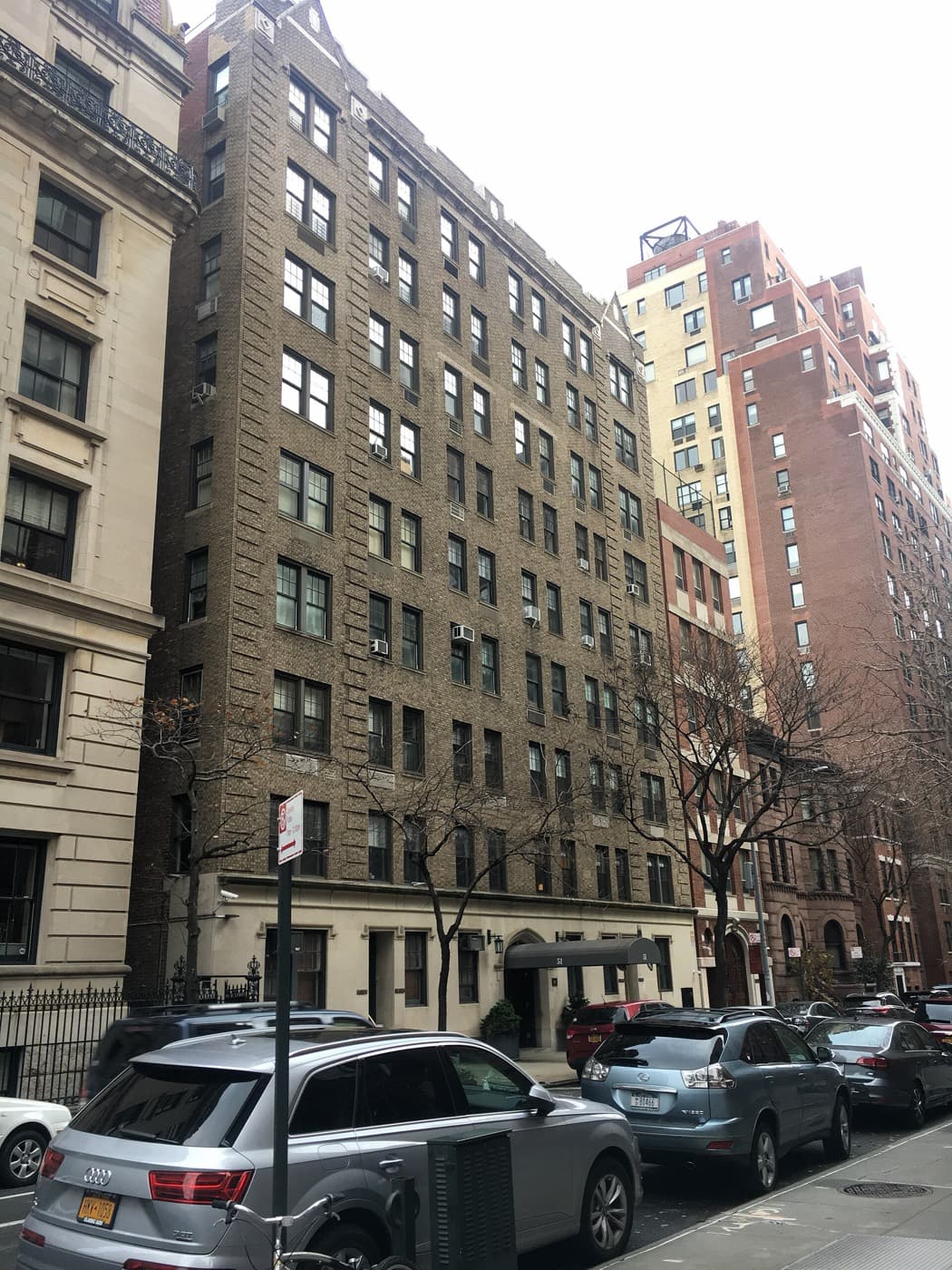
51 East 90th Street
51 East 90th Street, New York, NY 10128
Carnegie Hill, Upper East Side
BBL 1015020023 · BIN 1046985
- Year built
- 1926
- Type
- Cooperative
- Landmark
- Designated
Every recorded sale at this building, 2004–2026
Bedroom-by-bedroom medians, the full transfer record, and how units trade against ask.
- 2BR median
- $1.2M
- Recent range
- $850K – $1.7M
- Listing discount
- 2.1%
- Recorded transfers
- 31
Own an apartment here? See what it would sell for.
A Private Pricing Opinion — what your apartment at 51 East 90th Street would likely sell for today, what it costs to sell, and what you’d walk away with — reviewed personally against condition, exposures, renovation quality, and the competition actually on the market.
51 East 90th Street is the kind of address Carnegie Hill buyers come looking for and rarely find available: a well-run pre-war cooperative on a quiet side street, a block and a half from the Engineers' Gate entrance to Central Park, with the scale and staffing of a full-service building but the intimacy of just 38 homes. Built in 1926 to designs by George F. Pelham — one of the most prolific apartment-house architects of pre-war Manhattan — it sits midblock between Madison and Park, surrounded by the private schools, museums, and townhouse blocks that define this corner of the Upper East Side.
The building's appeal is its position more than its flourish. This is not a limestone showpiece; it is a dignified, beige-brick co-op that has held its value because the fundamentals never go out of style — light, proportion, a serious doorman, and a location inside one of Manhattan's most protected residential enclaves. For a buyer who wants Carnegie Hill at the building's natural price point rather than the avenue's, it is a quietly compelling option.
Architecture and unit composition
Pelham's design is typical of the better mid-1920s Upper East Side apartment house: a nine-story masonry block with a simple, well-mannered street presence, a canopied entrance, and an interior plan built around generously sized rooms. The 38 residences run to classic pre-war layouts — gracious foyers, separated living and dining rooms, and the high beamed ceilings and hardwood floors that buyers prize in this era of construction. With roughly 1,300 square feet of building area per unit on paper, the homes span comfortable one- and two-bedroom configurations up through larger family layouts, including a penthouse tier with outdoor space at the top of the building.
As a 1926 building inside the Carnegie Hill Historic District, exterior alterations are governed by Landmarks review, which has helped preserve the streetscape and the building's original character.
Building operations
51 East 90th Street operates as a full-service cooperative. The lobby is attended by full-time doormen, with a live-in superintendent on site and the practical amenities residents actually use day to day — a basement laundry room, a bike room, and private storage available to rent. It is a building run for owner-occupants who value reliability and discretion over a long roster of lifestyle amenities.
On board policy, the co-op permits financing of up to 60% of the purchase price, allows pets, and permits pied-à-terre ownership — a meaningfully flexible posture for a pre-war Carnegie Hill building, and a draw for buyers who want a part-time New York residence in a prime location. A 2% flip tax is customary on sales here. As with any cooperative, purchases clear through a board application and interview.
Local Law 97
- 2024–2029 annual penalty
- $0 (under cap)
- 2030–2034 annual penalty
- $0 (under cap)
- Per unit / month range
- —
Source: NYC LL84 benchmarking and PLUTO · The Roebling Research Library. City record last verified September 2026.
See full Local Law 97 analysis — emissions history, scenarios, methodology →Facade safety — Local Law 11
The latest available filing classified the facade as SWARMP — Safe With A Repair and Maintenance Program: the engineer identified conditions requiring monitoring or repair before the next inspection cycle. The scope, timeline, and how the building funds the work are building-specific — we review the filings and board materials for you.
How to read this, and where it comes from
QEWI = Qualified Exterior Wall Inspector — the licensed engineer the city requires to sign the report (the independent expert, not the managing agent).
Source: NYC DOB facade filings (FISP) · The Roebling Research Library. City record last verified September 2026.
Management & transfer contacts
- Flip tax
- 2% of gross sales price (Seller, at closing)
- Sublet policy
- Not Allowed
- Notable fees
- Max financing 60% of purchase price; homeowner's insurance required ($1M liability)
Recent sales
Recent transfers at this building, curated by The Roebling Team research desk. Prices are the transfer amounts recorded with the NYC Department of Finance; apartment-level detail is checked against the building’s own file in The Roebling Research Library before publishing.
| Date | Unit | Apartment | Price | PPSF | vs. Ask |
|---|---|---|---|---|---|
| Aug 24, 2026 | PHA | 2 BR · 2 BA · 1,300 sf | $2,675,000 | $2,058/sf | +7.2% |
| May 18, 2026 | 5B | 3 BR · 3 BA | $1,675,000 | -4.3% | |
| Apr 6, 2026 | 6C | 2 BR · 1.5 BA | $1,330,000 | +0.4% | |
| Nov 7, 2025 | 2D | 2 BR · 1 BA | $999,000 | -9.2% | |
| Oct 10, 2025 | 8D | 2 BR · 1.5 BA · 1,000 sf | $1,155,000 | $1,155/sf | +0.0% |
| Oct 9, 2025 | 1C | 2 BR · 2 BA | $850,000 | +0.0% | |
| Aug 25, 2025 | 7C | 2 BR · 1.5 BA | $1,300,000 | +4.9% | |
| Apr 30, 2025 | 6A | 2 BR · 2 BA | $1,338,000 | -10.7% |
Market read. Most recent trades (2026) cleared a median $2,058/sf across 1 sale. Median listing discount 0.9% from the last ask — a recurring negotiation gap worth pricing into any offer or listing strategy.
The retrade record
Lines that have traded more than once in the public record — the building’s appreciation arc, apartment by apartment.
Full closing history with price-per-square-foot over time, the complete retrade record, and every line that has traded.
Sales sourced from NYC Department of Finance recorded transfers (BBL 1-01502-0023) and verified listing data. Apartment-level facts (line, condition, asking-price context) curated and cross-verified by The Roebling Team research desk. Not all transactions cross-verify with ACRIS records — sponsor and LLC purchases sometimes record at stipulated values rather than market price; square footage on co-ops is not officially recorded, figures shown are approximate.
What to know if you’re buying
The case for buying here is location and stewardship. You are buying into a protected historic district, a block and a half from Central Park, with the schools and cultural institutions of Carnegie Hill at your doorstep. The 60% financing allowance, pet policy, and pied-à-terre acceptance make the building more accessible than many of its pre-war neighbors, which often cap financing lower and bar part-time ownership.
Budget for the full picture: a competitive all-cash-equivalent offer where possible, a thorough board package, and the 2% flip tax and standard closing costs at resale. The smartest buyers here move quickly when the right layout appears, because supply is thin and the building rarely has more than a couple of homes available at once.
What to know if you’re selling
Sellers benefit from scarcity and from the building's flexible rules. Emphasize the Central Park proximity, the Carnegie Hill Historic District setting, the full-time doorman, and — critically — the 60% financing, pet, and pied-à-terre policies, which widen your buyer pool well beyond what stricter pre-war co-ops can reach. Pricing should be benchmarked against recent trades in comparable Carnegie Hill side-street co-ops, adjusted for floor, light, and condition. Pre-sale preparation matters in a building of this caliber: a well-presented, correctly priced apartment in a small, desirable co-op tends to find its buyer without a long marketing cycle.
Comparable buildings
If you're weighing 51 East 90th Street, also consider nearby Carnegie Hill and Upper East Side pre-war cooperatives:
- 14 East 90th Street — pre-war co-op on the same block
- 114 East 90th Street — Carnegie Hill cooperative to the east
- 45 East 89th Street — full-service Carnegie Hill building one block south
- 50 East 89th Street — large Carnegie Hill cooperative nearby
- 60 East 88th Street — pre-war co-op in the heart of Carnegie Hill
The neighborhood
For the full corridor — architecture, schools, transit, and pricing across Upper East Side — read The Roebling Team Guide to Upper East Side.
The full playbook — what goes in the package, how boards read your financials, the interview, and the timeline — plus sample cover, reference, and personal letters you can adapt.
How to read the facts on this page. Items attributed to an offering plan describe the building as it was offered at that filing — unit mix, square footage, the amenity program as planned. They are not a statement about how the building operates today. Tax and compliance figures are sourced separately to current City records and carry their own dates. House rules, staffing and fee policy can change by board resolution without any public filing: treat every policy line here as a starting point for diligence and confirm it with the managing agent. Where this page compares one building or neighborhood to another, that is our analysis of the recorded record — it names the measure, the period and the sample it rests on, and it is an observation about medians rather than a prediction about any particular apartment.
Considering a move at 51 East 90th Street?
Request a private building brief with the relevant comparable sales, current and off-market availability, and an apartment-specific view of value.