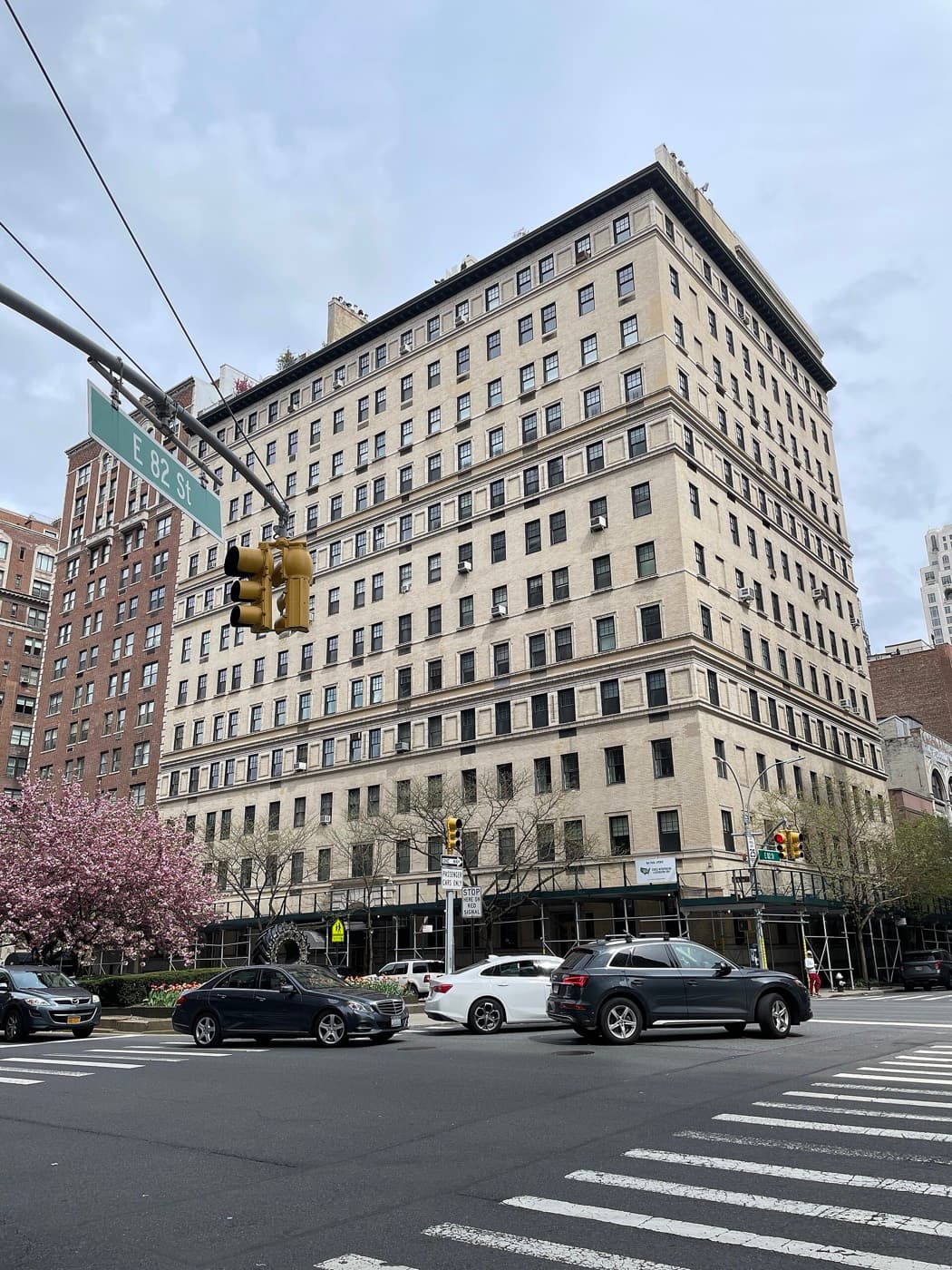
969 Park Avenue
969 Park Avenue, New York, NY 10028
Upper East Side
BBL 1015110001 · BIN 1047601
- Year built
- 1912
- Type
- Cooperative
- Units
- 76
- Landmark
- Designated
Every recorded sale at this building, 2003–2026
Bedroom-by-bedroom medians, the full transfer record, and how units trade against ask.
- 2BR median
- $1.6M
- Recent range
- $1.1M – $2.9M
- Listing discount
- 5.0%
- Recorded transfers
- 81
Own an apartment here? See what it would sell for.
A Private Pricing Opinion — what your apartment at 969 Park Avenue would likely sell for today, what it costs to sell, and what you’d walk away with — reviewed personally against condition, exposures, renovation quality, and the competition actually on the market.
969 Park Avenue is a pre-WWI Park Avenue apartment house with an unusually layered architectural history. Designed by Pickering & Walker and completed in 1912 in the Italian Renaissance-palazzo idiom, it belongs to the first generation of Park Avenue luxury apartment buildings — the cohort that established the avenue's residential character before the great 1920s boom. That early vintage alone distinguishes it from most of the corridor's better-known cooperatives, which postdate it by a decade or more.
The building's second chapter is what makes it singular. In 1941, the original layout — 36 very large suites — was comprehensively reconfigured by Emery Roth into 76 apartments ranging from three to six rooms, plus three penthouses. The result is a pre-WWI envelope with a mid-century interior plan: a building whose bones date to 1912 but whose apartment mix reflects a 1941 rethinking of how Park Avenue families wanted to live. For buyers, that history produces a more varied — and often more accessible — unit mix than the corridor's single-large-apartment-per-floor peers.
The corner position at Park Avenue and East 82nd Street places 969 in Carnegie Hill, two blocks from Central Park and the Metropolitan Museum of Art, on a stretch of Park Avenue defined by established pre-war cooperatives and the avenue's signature median plantings, with the Lexington Avenue 4/5/6 station a short walk east.
Architecture and unit composition
The Italian Renaissance exterior — a light beige brick body over a granite base, with an arched limestone entrance, six stringcourses, and an attractive cornice — reflects the early Park Avenue luxury idiom. Inside, the 1941 Emery Roth reconfiguration is the defining fact: the original twelve-room suites gave way to a spread of three- to six-room apartments, with three penthouses at the top.
The apartments retain classic pre-war elegance — beamed ceilings over ten feet, hardwood floors throughout, and wood-burning fireplaces in many units. Corner apartments are especially desirable for their multiple exposures and abundant light, with many residences taking western views over Park Avenue; the B-line corner apartments, with gracious split-bedroom layouts, are among the most sought-after lines. Renovation history and floor drive apartment-level variation; upper-floor and penthouse residences carry the clearest premiums.
Building operations and amenities
969 Park operates as a white-glove full-service cooperative with a 24-hour doorman, elevator attendants, a live-in superintendent, a fitness center, a landscaped roof terrace, a bike room, and a central laundry; washer/dryers are permitted in the building.
On policy, the building is pet-friendly and permits pied-à-terre ownership on a case-by-case basis. Financing is allowed up to 50% of the purchase price, and a 2% flip tax is paid by the purchaser on each sale. The board otherwise follows established Park Avenue cooperative norms: primary-residence orientation, demonstrated financial strength, and a thorough board package.
Local Law 97
- 2024–2029 annual penalty
- $0 (under cap)
- 2030–2034 annual penalty
- $0 (under cap)
- Per unit / month range
- —
Source: NYC LL84 benchmarking and PLUTO · The Roebling Research Library. City record last verified September 2026.
See full Local Law 97 analysis — emissions history, scenarios, methodology →Facade safety — Local Law 11
The latest available filing classified the facade as SWARMP — Safe With A Repair and Maintenance Program: the engineer identified conditions requiring monitoring or repair before the next inspection cycle. The scope, timeline, and how the building funds the work are building-specific — we review the filings and board materials for you.
How to read this, and where it comes from
QEWI = Qualified Exterior Wall Inspector — the licensed engineer the city requires to sign the report (the independent expert, not the managing agent).
Source: NYC DOB facade filings (FISP) · The Roebling Research Library. City record last verified September 2026.
Recent sales
Recent transfers at this building, curated by The Roebling Team research desk. Prices are the transfer amounts recorded with the NYC Department of Finance; apartment-level detail is checked against the building’s own file in The Roebling Research Library before publishing.
| Date | Unit | Apartment | Price | PPSF | vs. Ask |
|---|---|---|---|---|---|
| Feb 5, 2026 | 3E | 2 BR · 2 BA | $1,250,000 | +0.0% | |
| Jan 21, 2026 | 5D | 2 BR · 2 BA · 1,325 sf | $2,600,000 | $1,962/sf | -3.5% |
| Jan 13, 2026 | 6E | 2 BR · 2 BA | $1,475,000 | -1.7% | |
| Dec 22, 2025 | 6C | 1 BR · 1 BA · 1,000 sf | $1,310,000 | $1,310/sf | +4.8% |
| Mar 4, 2025 | 4B | 2 BR · 2 BA | $2,650,000 | -7.0% | |
| Dec 16, 2024 | 1G | 2 BR · 1 BA · 1,125 sf | $1,100,000 | $978/sf | +0.0% |
| Nov 27, 2024 | 6F | 2 BR · 2.5 BA | $1,800,000 | +0.0% | |
| Nov 15, 2024 | 7A | 3 BR · 3 BA | $1,625,000 | -6.9% |
Market read. Most recent trades (2026) cleared a median $1,925/sf across 1 sale. Median listing discount 3.5% from the last ask — a recurring negotiation gap worth pricing into any offer or listing strategy.
The retrade record
Lines that have traded more than once in the public record — the building’s appreciation arc, apartment by apartment.
Full closing history with price-per-square-foot over time, the complete retrade record, and every line that has traded.
Sales sourced from NYC Department of Finance recorded transfers (BBL 1-01511-0001) and verified listing data. Apartment-level facts (line, condition, asking-price context) curated and cross-verified by The Roebling Team research desk. Not all transactions cross-verify with ACRIS records — sponsor and LLC purchases sometimes record at stipulated values rather than market price; square footage on co-ops is not officially recorded, figures shown are approximate.
What to know if you’re buying
The layered history shapes the apartments. A 1912 Renaissance envelope with a 1941 Emery Roth interior produces a more varied — and often more accessible — mix than single-vintage Park Avenue peers; the B-line corners and the penthouses are the marquee lines.
Pre-WWI on Park Avenue is a distinct tier. This is among the earliest Park Avenue luxury buildings; the vintage and the wood-burning fireplaces are genuine differentiators.
The financing and flip-tax rules are buyer-friendly by Park Avenue standards. Up to 50% financing is permitted, with a 2% flip tax paid by the buyer; pets and pied-à-terres are allowed (the latter case-by-case) — plan accordingly.
Board approval follows Park Avenue norms. Strong financial profile, primary-residence intent, and a complete board package are central; underwrite accordingly.
What to know if you’re selling
Lead with the architectural lineage and the apartment character. The Pickering & Walker original, the Emery Roth 1941 reconfiguration, the beamed ten-foot ceilings, and the wood-burning fireplaces are a distinctive story; pair it with the pre-WWI Park Avenue address and the roof terrace and fitness center.
The accommodating rules widen the buyer pool. Pet-friendliness, 50% financing, and case-by-case pied-à-terre permission expand demand relative to stricter avenue co-ops — call them out.
Pricing requires apartment-level comparable work. The varied mix means floor, configuration, exposure, and renovation history all move value materially; broad averages mislead here.
Closing timelines are co-op standard. Plan for roughly 6–10 weeks from contract to closing.
Comparable buildings
If you're considering 969 Park Avenue, also evaluate nearby Park Avenue cooperatives:
- 983 Park Avenue — adjacent Park Avenue cooperative
- 985 Park Avenue — nearby Park Avenue pre-war
- 950 Park Avenue — Park Avenue peer
- 975 Park Avenue — Park Avenue cooperative nearby
- 970 Park Avenue — Park Avenue cooperative across the avenue
The neighborhood
For the full corridor — architecture, schools, transit, and pricing across Park Avenue — read The Roebling Team Guide to Park Avenue.
The full playbook — what goes in the package, how boards read your financials, the interview, and the timeline — plus sample cover, reference, and personal letters you can adapt.
How to read the facts on this page. Items attributed to an offering plan describe the building as it was offered at that filing — unit mix, square footage, the amenity program as planned. They are not a statement about how the building operates today. Tax and compliance figures are sourced separately to current City records and carry their own dates. House rules, staffing and fee policy can change by board resolution without any public filing: treat every policy line here as a starting point for diligence and confirm it with the managing agent. Where this page compares one building or neighborhood to another, that is our analysis of the recorded record — it names the measure, the period and the sample it rests on, and it is an observation about medians rather than a prediction about any particular apartment.
Considering a move at 969 Park Avenue?
Request a private building brief with the relevant comparable sales, current and off-market availability, and an apartment-specific view of value.