Emery Roth (1871–1948) designed the most architecturally ambitious twin-towered cooperatives on Central Park West. The Beresford (1929, 211 CPW), the San Remo (1930, 145–146 CPW), and the Eldorado (1931, 300 CPW — with Margon & Holder) together constitute the defining Art Deco and Renaissance Revival presence on the avenue and remain among the most searched and most aspirational buildings in the city. Roth's interiors are characterized by 10–11 foot ceilings, formal foyers leading to public-room enfilades, and a hierarchy between Park-facing front rooms and rear service wings — a program that translates seamlessly to modern luxury entertaining. The firm's portfolio extends to the Oliver Cromwell, 211 Central Park West, and several Riverside Drive commissions.
The skyline argument
Stand at the Bow Bridge in Central Park, look west, and the residential silhouette that meets the horizon is largely the work of one man. The three octagonal towers of the Beresford to the north, the twin Roman temples of the San Remo at center, the stepped Art Deco shafts of the Eldorado further uptown — each is an Emery Roth building, and together they define the Central Park West skyline more completely than any other architect's body of work defines any other Manhattan avenue.
This is not a small claim. Park Avenue's pre-war character was shaped by a cohort — Rosario Candela, J.E.R. Carpenter, Delano & Aldrich, the Blum brothers — among whom no single name dominates. Fifth Avenue is similar. Central Park West is different. Roth's commissions on the avenue extend from the pre-Art Deco Alden (1925) to his final great Mayan-inspired composition at the Ardsley (1931), and the towered silhouettes that buyers, photographers, filmmakers, and tourists associate with CPW are very largely his.
There is a market consequence to this. "Roth building" on Central Park West is a recognizable tier. A buyer arriving in New York looking for a pre-war Park-facing apartment in a building whose name carries weight on the international circuit will, within a session or two of broker conversation, learn that the Beresford, the San Remo, the Eldorado, and the Ardsley are the four addresses where his work matters most, and that — alongside the Majestic and 15 Central Park West — these constitute the tier-one CPW canon. This piece walks through Roth's career and the buildings that shaped that canon, with attention to where his role is sometimes overstated and where the documentary record requires a more careful reading than the standard summaries provide.
Biography
Emery Roth was born in 1871 in Gálszécs, a town in the Kingdom of Hungary that is now Sečovce in eastern Slovakia, to a Jewish family that fell into poverty when his father died. He emigrated to the United States as a teenager — sources place him at thirteen on arrival — without family and without English. The arc that followed is among the more improbable in American architectural history.
He landed first in the Midwest, working a series of jobs before catching on as a draftsman in the Chicago offices of Burnham & Root, the firm then preparing the World's Columbian Exposition of 1893. The Exposition was the formative event of late-nineteenth-century American architecture and a clearinghouse for the country's most ambitious designers. Working under Burnham, the twenty-two-year-old Roth was responsible for one small solo commission at the Exposition — a pavilion housing a chocolatier — and, more consequentially, was introduced to Richard Morris Hunt. Hunt was at the time the most prominent American architect of the era, the designer of the Vanderbilt mansions and the facade of the Metropolitan Museum of Art. He brought Roth back to New York to work in his office.
Hunt died in 1895. Roth spent a brief subsequent period in the office of Ogden Codman Jr. — the designer who, with Edith Wharton, co-authored The Decoration of Houses (1897) — before establishing his own practice in New York in 1898, acquiring the small firm of Stein, Cohen & Roth for one thousand dollars.
His earliest independent commissions were apartment hotels along the rapidly developing Broadway corridor on the Upper West Side. The Hotel Belleclaire (1901–1903), at Broadway and 77th, was the first significant project of his independent practice — an Art Nouveau / Vienna Secession composition that established Roth as a serious designer of large residential structures. The Belleclaire still operates today. From there, his commissions accelerated through the 1900s, the 1910s, and the 1920s in ascending scale, until by the late 1920s he was running the most prolific luxury apartment-building practice in New York.
Roth's sons Julian (1901–1992) and Richard (1904–1987) trained as architects and joined the firm; Julian specialized in construction technology and costs while Richard became the firm's principal designer. They were named partners in 1938, and the firm was formally renamed Emery Roth & Sons in 1947 — one year before Roth's death on August 20, 1948.
The architectural argument
Roth's apartment buildings are not stylistically uniform. Across a four-decade career he worked in Beaux-Arts, neo-Renaissance, Gothic Revival, classical, and Art Deco vocabularies, often within the same five-year window. What is consistent is something else: a particular discipline about the apartment building as a residential type.
Three things distinguish Roth's mature apartment-house work from his contemporaries'.
The first is massing. Roth was unusually attentive to how his buildings would read from a distance and how they would terminate against the sky. He developed the tower-on-base composition more systematically than any other Manhattan apartment architect — the lower mass of the building treated as a substantial urban block (typically with classical or Renaissance vocabulary at the base and brick body above), then the top floors rising as discrete towers, often octagonal, often paired, treated almost as sculptural objects above the residential mass. This was novel. Park Avenue's contemporary pre-war buildings by Candela and Carpenter sit as solid blocks with cornice-line terminations. Roth's CPW buildings rise into the sky.
The second is plan. Roth's apartment plans are notable for their handling of the public-private gradient — formal entry galleries leading into substantial entertaining spaces, then a service wing handled with care, then private bedroom suites at the periphery. Ceiling heights in his major buildings are generous (typically 10 to 13 feet in the principal rooms). The plans were designed for staffed service, with kitchens, service halls, and back stairs sized and located to keep household staff circulation distinct from the family's. This was the norm at the upper end of 1920s apartment design; Roth executed it with particular discipline.
The third is ornament. Roth's facades carry more decorative incident than his peers'. The terra-cotta figures at 1000 Park Avenue — Gothic men, gargoyles, squirrels — are the most extreme example, but the principle runs through his work: a Roth building rewards close looking. The Beresford's three octagonal towers are themselves decorative gestures, made meaningful only because Roth designed them as objects rather than merely as elevations. The Ardsley's Mayan frieze and zigzag stone inlay at the base are not what one expects on a Manhattan apartment building. The result is a body of work that holds up at the scale of the avenue and at the scale of the doorway.
The fourth thing, harder to measure but present in every Roth building, is the client relationship. Roth worked repeatedly for the same developers across decades — most consequentially the Bing brothers, Leo and Alexander, for whom he designed roughly a dozen buildings from the mid-1910s into the late 1920s. The Bing & Bing collaboration produced the most stable and architecturally serious developer-architect relationship of the pre-war Manhattan apartment era, and the buildings that came out of it carry a recognizable Bing & Bing / Roth signature that is part of why those addresses still command attention a century on.
The Central Park West masterworks
The Beresford (211 CPW, 1929)
The Beresford is the only CPW apartment building topped with three towers — octagonal, copper-domed, placed at the northeast, southwest, and southeast corners of the roof. The three-tower configuration is genuinely unique in Manhattan: every other towered apartment building in the city, including each of Roth's later CPW commissions, used twin towers. The asymmetry — three rather than two — gives the Beresford a silhouette that resists the conventional architectural symmetries of its peers and that, from certain angles, reads almost as if three separate small classical buildings had been placed on top of a single residential block.
The vocabulary is late Italian Renaissance with Baroque elements, not Art Deco. This is a distinction worth getting right: the Beresford was completed in 1929, at the moment when the Art Deco vocabulary was beginning to displace the classical vocabularies in luxury Manhattan apartment design, and Roth made the deliberate choice to remain classical. The three-story limestone base, the beige brick body, the entrance compositions reminiscent of Italian Renaissance palazzi — these belong to the tradition Roth had been working in since the early 1900s, refined to its mature form.
The building opened in September 1929, weeks before the stock-market crash, and went into receivership shortly afterward when the Bank of United States — which held the mortgage — collapsed. It recovered. The Beresford is today a New York City Individual Landmark (designated 1985), a contributing property to the Central Park West Historic District, and among the most consequential addresses in the city's pre-war canon.
The San Remo (145 CPW, 1930)
The San Remo is the architectural precedent for the twin-towered Manhattan apartment building. Roth's 1930 composition placed two ten-story octagonal towers, terminated with classical Roman temples, on top of a seventeen-story base — a silhouette that, within three years, had been copied by the Century, the Majestic, and the Eldorado, and that subsequently became the visual shorthand for the CPW skyline.
The site had been occupied by the original San Remo Hotel, which Roth's new structure replaced. He initially filed plans for a sixteen-story building, but the design was revised upward to twenty-six stories with the twin-tower termination. The HRH Construction Corporation built it in 1929–1930; the building opened in September 1930 to substantial press attention.
The twin Roman temples on top of the towers are the building's signature. From across Central Park, they read as miniature classical buildings floating above the residential mass; from inside the tower apartments, they form the architectural ceiling of some of the most prized residential rooms in New York. The San Remo became a New York City Individual Landmark in 1987.
The Eldorado (300 CPW, 1929–1931)
The Eldorado is the northernmost of the great twin-towered CPW landmarks and the most stylistically distinct: a full Art Deco composition with stepped twin towers, vertical fluting that emphasizes height rather than mass, and ornament executed in the geometric vocabulary of the late 1920s rather than the Renaissance vocabulary of Roth's earlier work.
The attribution requires careful handling. The architects of record are Margon & Holder — Irving Margon and Adolph M. Holder, a partnership active from 1928 to 1932 designing apartment buildings in Manhattan and the Bronx — with Emery Roth as consulting architect. Roth's role was the general plan and the massing; the early design drawings produced under his direction show a Classical Revival building, which Margon & Holder subsequently developed into the Art Deco composition that was built. The NYC Landmarks Preservation Commission, in designating the Eldorado an Individual Landmark in 1985, credited "Margon & Holder with Emery Roth" with having "created one of the finest and most dramatically massed Art Deco style residential buildings in New York City."
This is not, strictly, a Roth building in the sense that the Beresford and the San Remo are. It is a building whose massing reflects Roth's CPW tower vocabulary, executed by another firm in a different stylistic register, with Roth in a consulting role. The popular shorthand that places it alongside the Beresford and the San Remo as the third of "Roth's CPW twin-tower trio" is not wrong, exactly — Roth's influence on the building is real and structural — but the architects of record deserve the credit they are formally given. (Attribution flagged.)
The Ardsley (320 CPW, 1931)
The Ardsley is Roth's final and most stylistically adventurous CPW residential building. Completed at the corner of CPW and 92nd Street in 1931 — the same year as the Eldorado — the Ardsley moves entirely into Art Deco vocabulary, but Art Deco of a particular kind: the massing and ornamental detail are explicitly inspired by ancient Mayan temple architecture, with no trace of classical or Renaissance reference.
Vertical bands of black brick rise through the beige facade, imparting an upward thrust that contrasts with the building's stepped horizontal massing. A zigzag cast-stone frieze with four-color geometric inlay runs along the base. Pink-tinted cast-stone door surrounds in curved geometric forms ornament the entrances. The result is among the most elaborately detailed Art Deco residential buildings on Central Park West — and a coda to Roth's CPW work that, in vocabulary, has very little to do with the Italian Renaissance Beresford he had completed two years earlier.
The Alden (225 CPW, 1925)
The Alden is the predecessor to the major work — a fifteen-story apartment hotel designed by Roth for Bing & Bing, built in 1925 and opened in 1926, in Neo-Renaissance vocabulary on a beige-brick body over a rusticated two-story limestone base. The Alden does not have towers; it does not have Art Deco ornament; it operates at a different scale than the Beresford or San Remo. But it is part of the same Bing & Bing / Roth working relationship that produced the larger Park Avenue and CPW buildings, executed in the pre-Art Deco vocabulary that Roth would translate, four years later, into the towered compositions of the major CPW work.
The Park Avenue East Side work
Roth's portfolio is concentrated on the West Side; East Side commissions of comparable scale are uncommon in his work. Two are worth attention.
1000 Park Avenue (1916)
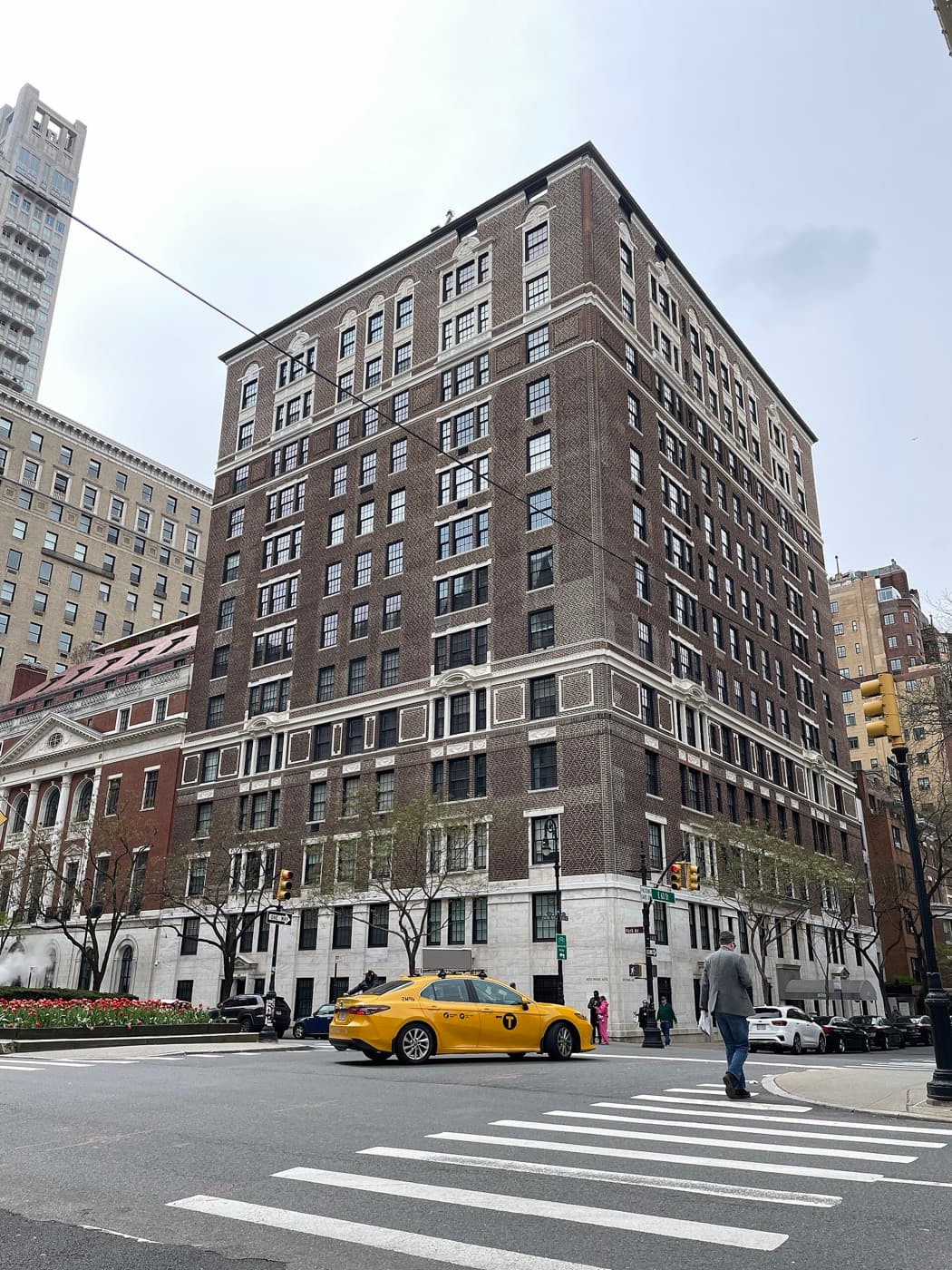
1000 Park Avenue, at the southeast corner of Park and East 84th Street, is a 1916 Roth commission for Bing & Bing — early in his Bing & Bing relationship and unusual in his portfolio for its Gothic Revival vocabulary. Most of Roth's pre-war work is classical; 1000 Park is the conspicuous exception. The brown-brick facade is decorated with terra-cotta gargoyles, Gothic figures, lanterns, and squirrels — among the most ornamentally elaborate facades on Park Avenue.
Two Gothic figures flank the main entrance. Roth, according to long-standing tradition, modeled them after his clients Leo and Alexander Bing. The choice of Gothic vocabulary was likely a response to the adjacent Park Avenue Christian Church, which had been recently completed. 1000 Park Avenue is among the most documented examples of Roth's willingness to step outside his usual classical idiom when site, client, or context warranted it.
1175 Park Avenue (1925)
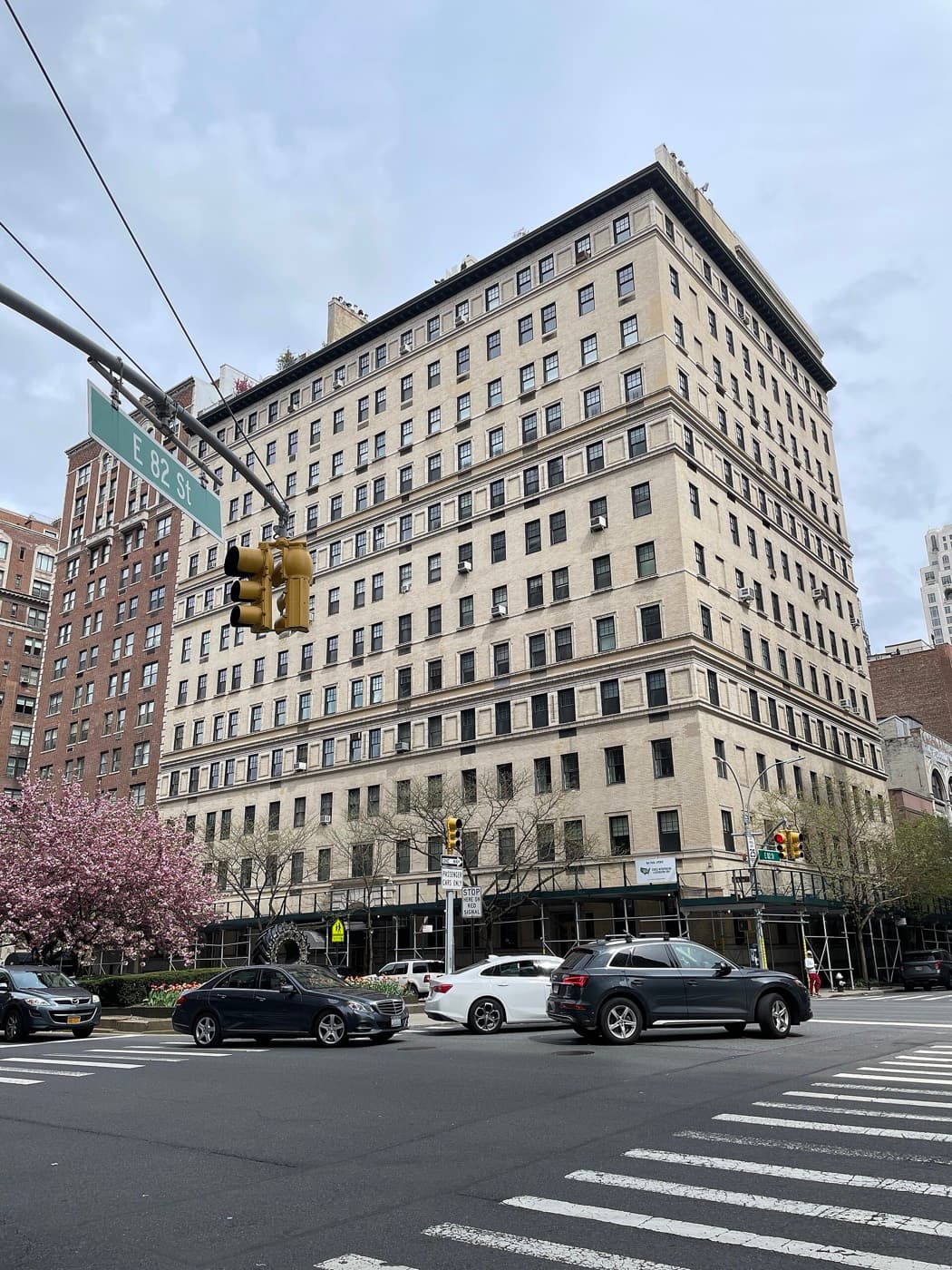
1175 Park Avenue, in northern Carnegie Hill at 93rd Street, is a 1925 Roth commission for George Backer Construction — not Bing & Bing — and a rare East Side example of Roth's mature apartment-design discipline at full scale. Fifteen stories, forty-nine apartments, two private elevator landings per floor producing materially superior apartment privacy compared to typical Park Avenue arrangements, executed at the 1925 construction-quality peak.
The Roth signature is visible throughout: 10-to-11-foot ceilings in the principal rooms, formal entry galleries, library-living combinations, primary suites with substantial closet infrastructure, service wings characteristic of staffed 1920s service. The Carnegie Hill positioning at 93rd–94th makes 1175 Park a particular kind of credential — an East Side address with an architect more closely associated with the West Side, in a building that competes with the Carnegie Hill cooperative inventory immediately surrounding it.
The Bing & Bing collaboration
Leo and Alexander Bing were the most consequential Manhattan apartment-house developers of the first half of the twentieth century, and Emery Roth was their architect of choice for roughly a quarter of a century. The collaboration began in the mid-1910s — Roth designed three Bing & Bing buildings in 1915 alone (601 West End Avenue, 570 Park Avenue, and 1000 Park Avenue) — and continued through Bing & Bing's run of distinguished Greenwich Village apartment houses in the late 1920s and into the early 1930s.
The relationship had structural advantages on both sides. The Bings developed at scale and across a range of price points, which gave Roth the volume and continuity that allowed his practice to mature. Roth's classical and Renaissance vocabulary suited the Bing & Bing positioning — apartment buildings designed for the upper-middle and upper tier of the New York residential market, where architectural seriousness was a marketable asset. The two Bing brothers, by the available accounts, were unusually engaged clients; Roth's decision to model the Gothic figures at 1000 Park Avenue after Leo and Alexander is among the more pointed gestures of affection in the developer-architect canon.
The Bing & Bing buildings Roth designed remain among the most consistently respected apartment houses of the period. The Alden on CPW is one. 1000 Park is another. The Village buildings — 45 Christopher Street, 59 West 12th, 299 West 12th, 302 West 12th — are part of the same body of work, modest in scale relative to the CPW towers but operating with the same care about plan, ornament, and the residential type as a designed object.
Emery Roth & Sons: the post-war firm
Emery Roth's sons Julian and Richard had trained in their father's office and were elevated to partnership in 1938. The firm was renamed Emery Roth & Sons in 1947, one year before Roth's death. The post-war firm was a different kind of practice from the one Roth had run between the wars.
The post-war Manhattan market did not want neo-Renaissance apartment buildings with octagonal towers and terra-cotta ornament. It wanted high-volume rental and cooperative apartment buildings on the most efficient possible plans, and increasingly, beginning in the late 1950s, it wanted commercial office towers. Emery Roth & Sons pivoted with the market. They produced dozens of mid-century Manhattan apartment buildings — competent, efficient, generally lacking the ornamental ambition of the pre-war work — and then, as the firm matured into the 1960s and 1970s, became one of the most prolific commercial office practices in Manhattan. They were hired as associate architects on the Pan Am Building (1963), the original World Trade Center (1966–1973), and the Citicorp Center (1977).
This second phase of the Roth name's work is genuinely important to the post-war Manhattan skyline, but it is a different body of work from the one that established Emery Roth as the defining residential architect of Central Park West. The sons designed buildings that the city needed; the father had designed buildings the city's most discerning residents wanted. The two are not the same.
Buying a Roth today
For buyers, "Roth building" on Central Park West signals a particular tier and a particular set of expectations. Several considerations bear on a transaction in this group.
Architectural premium is real and measurable. Apartments in Roth's tier-one CPW buildings — the Beresford, San Remo, and to a slightly more variable degree the Eldorado — trade at the upper end of the CPW pre-war pricing range, with corner Park-facing and tower units commanding meaningful premiums over otherwise-comparable inventory in non-Roth buildings.
Board culture is rigorous across the group. All four of the major CPW Roth co-ops (Beresford, San Remo, Eldorado, Ardsley) maintain selective boards. The Beresford and San Remo are widely understood to be among the more demanding on the avenue; the Eldorado and Ardsley operate with somewhat more institutional flexibility but still apply substantial scrutiny. Buyers should expect substantial financial documentation, references, and primary-residence intent.
Financing posture varies meaningfully. The San Remo caps financing at 50% of purchase price; the Ardsley permits up to 65%; the Beresford and Eldorado sit in between depending on apartment specifics. Foreign buyers face additional friction across the group. LLC ownership is generally not permitted.
Renovation is constrained by landmark status across all four buildings. The Beresford, San Remo, Eldorado, and Ardsley are individually landmarked or within the Central Park West Historic District; alterations are reviewed with attention to preservation of original architectural detail. The Ardsley's Art Deco interior elements, the Beresford's Renaissance entry compositions, and the San Remo's tower-unit configurations are not appropriate sites for wholesale modernization. Renovation that respects the buildings' character is the expected path.
The St. Moritz / 50 CPS situation is structurally different. The 1930 Hotel St. Moritz that Roth designed on Central Park South was demolished in stages and rebuilt as the Ritz-Carlton Residences at 50 Central Park South, which opened in 2002. The current building retains elements of the historic envelope where preservation permitted, but the residential program is a contemporary condominium structure, not a Roth-designed apartment. Buyers attracted to "the Roth St. Moritz" should understand that what they would be buying is a 2002 Ritz-Carlton-managed condominium on the site of Roth's original hotel.
View permanence is structural across the CPW group. Central Park sits across the avenue from each of the four major Roth co-ops; the side streets are residential with stable building heights. View permanence at all four addresses is among the strongest in New York.
Closing
There is a particular Manhattan exercise — choosing an apartment on Central Park West — for which the architect of the building matters as much as the apartment itself. Roth's name on a building is part of what is being bought. It signals continuity with a tradition of residential architecture that the post-war city, for the most part, stopped producing. It signals an institutional culture that has, in most of his buildings, been maintained across generations. And it signals a silhouette — the octagonal copper-domed towers at the Beresford, the Roman temples atop the San Remo, the stepped Art Deco of the Eldorado, the Mayan frieze of the Ardsley — that has, more than the work of any other architect, given Central Park West its identity.
A century after most of his buildings opened, that identity holds.
Corey Cohen, Principal
The Roebling Team at Compass 646.939.7375 · c.cohen@compass.com
This page reflects publicly available information and The Roebling Team transaction experience. Sources include the NYC Landmarks Preservation Commission designation reports for the Beresford (1985), the San Remo (1987), the Eldorado (1985), and the Ardsley; public records and building pages; LandmarkWest; Christopher Gray's New York Times "Streetscapes" columns; and Steven Ruttenbaum's biographical study Mansions in the Clouds (1986). The Roebling Team at Compass does not represent any of the buildings discussed in this article, their management, boards, or sponsors. © 2026 The Roebling Team at Compass. Compass is a licensed real estate broker.
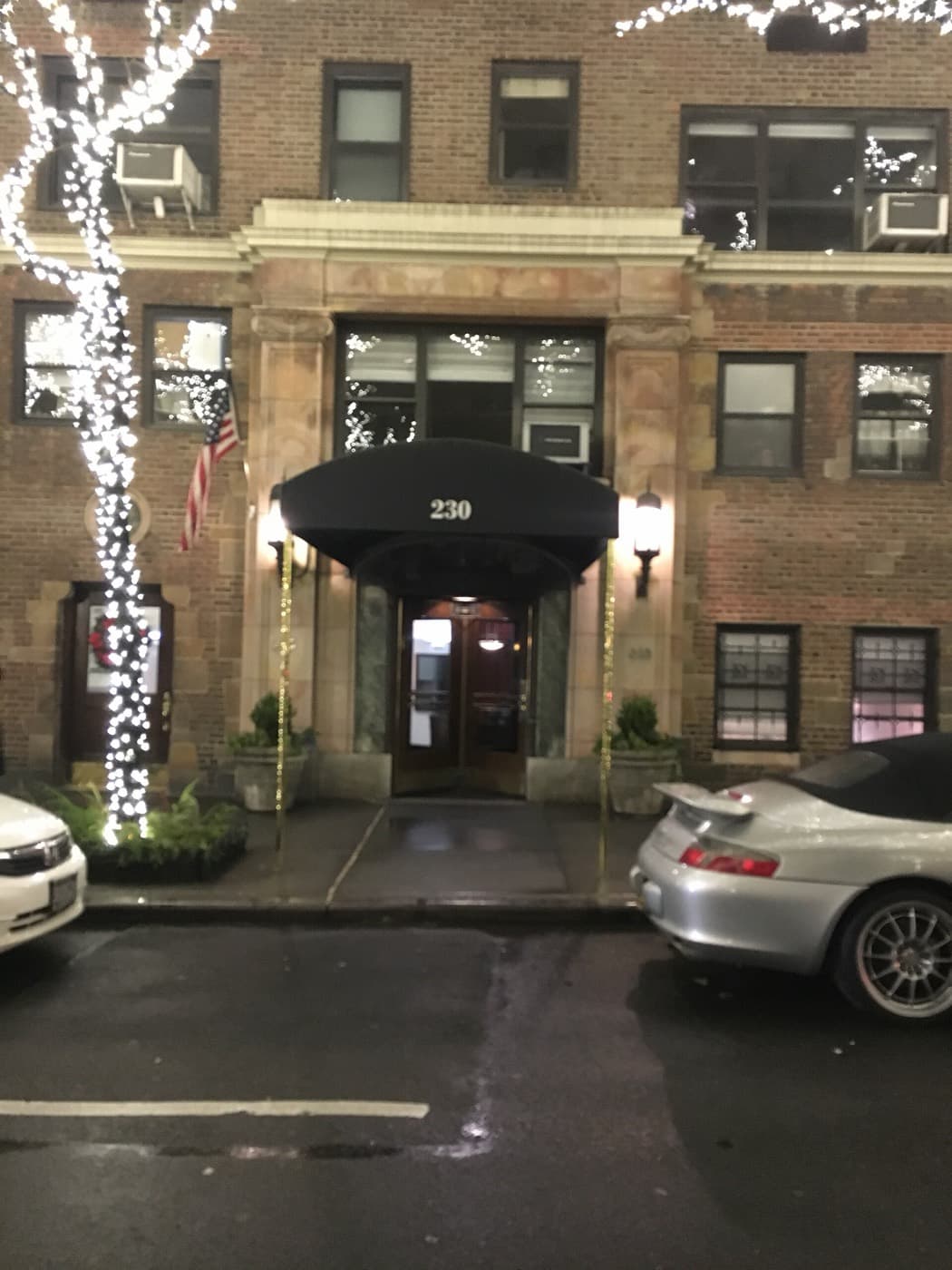
Buildings designed by Emery Roth








The drawings are public. The rest isn't.
How these buildings have actually traded, which lines deliver what the plans promise, and how each board handles financing and approvals.