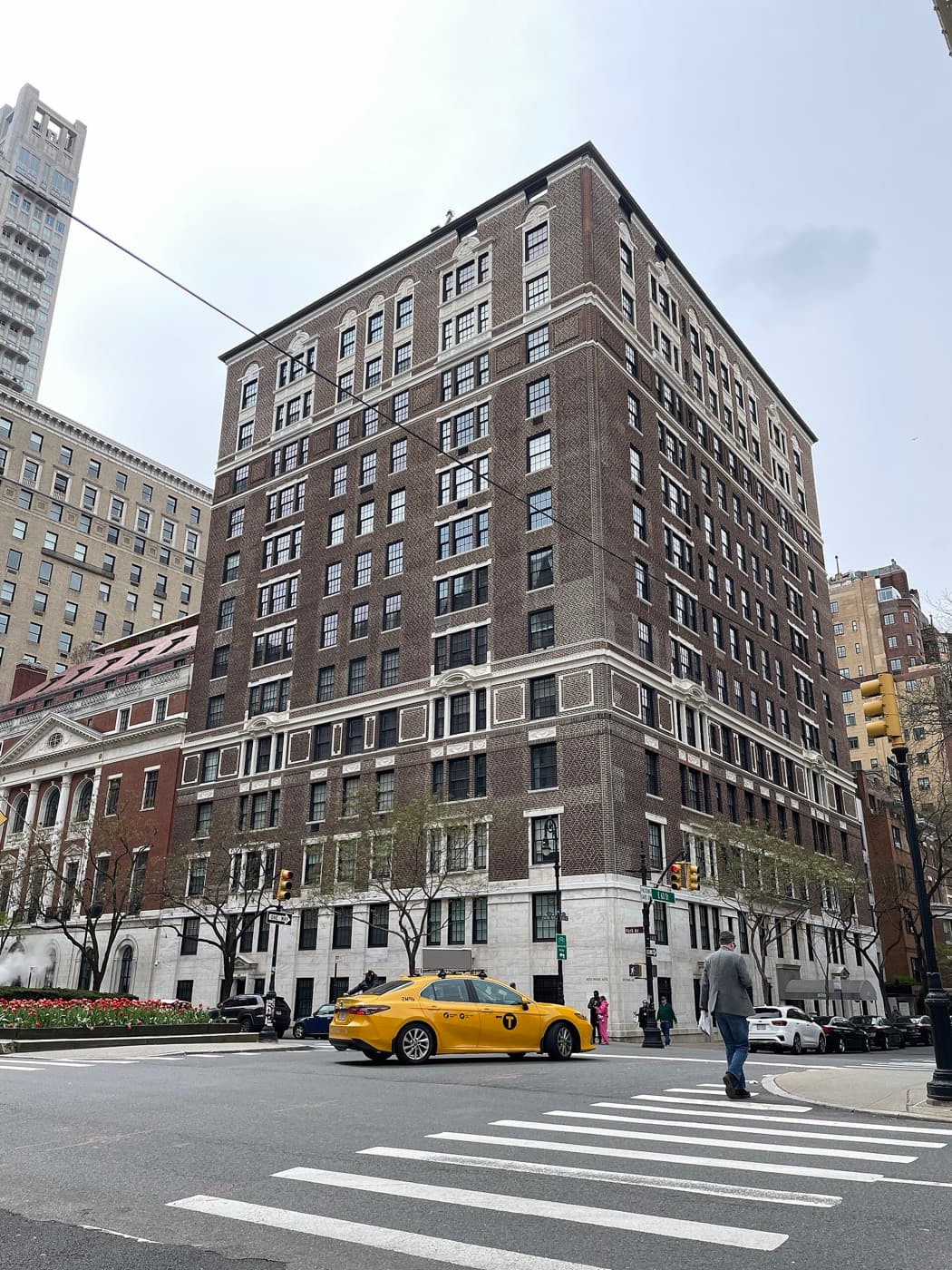
570 Park Avenue
570 Park Avenue, New York, NY 10065
Lenox Hill, Upper East Side
BBL 1013770040 · BIN 1040900
- Year built
- 1916
- Type
- Cooperative
- Units
- 52
- Landmark
- No
Every recorded sale at this building, 2003–2025
Bedroom-by-bedroom medians, the full transfer record, and how units trade against ask.
- 3BR median
- $3.5M
- Recent range
- $1.3M – $4.6M
- Listing discount
- 8.5%
- Recorded transfers
- 54
Own an apartment here? See what it would sell for.
A Private Pricing Opinion — what your apartment at 570 Park Avenue would likely sell for today, what it costs to sell, and what you’d walk away with — reviewed personally against condition, exposures, renovation quality, and the competition actually on the market.
570 Park Avenue is among the early Park Avenue luxury cooperatives — a 1916 Emery Roth commission for the Bing & Bing development firm, built on the southwest corner of East 63rd Street and converted to cooperative ownership in 1923. The 1916 vintage places it among the earlier examples of the Park Avenue apartment-house tradition, pre-dating the great 1920s boom that produced the avenue's most famous Candela and Carpenter buildings to the north.
The Roth / Bing & Bing pairing is the building's pedigree. Emery Roth is best remembered for his three twin-towered Central Park West landmarks, but his pre-war work for Bing & Bing produced a series of refined, beautifully detailed apartment houses, of which 570 Park is a distinguished example. The building's Georgian composition — richly textured and patterned red brick, exquisitely molded white terra-cotta ornament, and an unusually rich two-story white-marble base beneath a canopied entrance — gives it a presence on lower Park Avenue that belies its relatively intimate scale of 52 apartments.
That intimate scale is itself a defining feature. At a corner near the southern end of the residential Park Avenue corridor — within walking distance of Central Park, the Frick Collection, the Whitney, the Park Avenue Armory, and Madison Avenue shopping, and one block from the F train with the 4/5/6 five blocks east — 570 Park offers buyers a boutique pre-war cooperative with Emery Roth architecture, gracious layouts, and the discretion of a small shareholder community.
Architecture and unit composition
Roth's facade is a textured, ornamental Georgian composition: the patterned red brick carries decorative coursing, the white terra-cotta detailing is exquisitely molded, and the two-story white-marble base lends the entrance an unusual richness for a building of this scale. The lobby continues the theme — a marble floor, a coffered ceiling, and a canopied street entrance. The corner siting at East 63rd Street gives the building cross-exposures and a commanding presence at the intersection.
The 52 apartments range from six to nine rooms, arranged in the gracious pre-war manner: high ceilings, spacious living rooms, libraries, pantries, grand entry galleries, and semi-private elevator landings. Each apartment has at least one wood-burning fireplace — a genuine rarity in the modern market — and in-unit washer/dryers are permitted. The small unit count produces larger average floor plates than the bigger Park Avenue buildings of the same era. Finish and configuration vary apartment to apartment after a century of ownership and renovation.
Building operations
570 Park Avenue operates as a full-service pre-war cooperative, with a 24-hour doorman and porter service, a live-in resident manager, a fitness center, private storage units, and a central laundry room.
The co-op's rules are notably accommodating for a tier-one Park Avenue building: pets are permitted, pied-à-terre ownership is allowed, and subletting is permitted. Financing is capped at 50% of the purchase price, and a 3% flip tax is paid by the purchaser at closing. Trust purchases and secondary-residence ownership are considered case by case, while corporate purchases are not permitted and the purchase of non-contiguous apartments is disallowed. Renovation is reviewed with attention to the building's pre-war character, and in-window air conditioners and windows are governed by the building's replacement standards.
Local Law 97
- 2024–2029 annual penalty
- $0 (under cap)
- 2030–2034 annual penalty
- $24,378/yr
- Per unit / month range
- $0 – $39
Source: NYC LL84 benchmarking and PLUTO · The Roebling Research Library. City record last verified September 2026.
See full Local Law 97 analysis — emissions history, scenarios, methodology →Facade safety — Local Law 11
The latest available filing classified the facade as SWARMP — Safe With A Repair and Maintenance Program: the engineer identified conditions requiring monitoring or repair before the next inspection cycle. The scope, timeline, and how the building funds the work are building-specific — we review the filings and board materials for you.
How to read this, and where it comes from
QEWI = Qualified Exterior Wall Inspector — the licensed engineer the city requires to sign the report (the independent expert, not the managing agent).
Source: NYC DOB facade filings (FISP) · The Roebling Research Library. City record last verified September 2026.
Management & transfer contacts
- Flip tax
- 3% of purchase price due from the purchaser
- Sublet policy
- Allowed
- Pied-à-terre
- Allowed
Recent sales
Recent transfers at this building, curated by The Roebling Team research desk. Prices are the transfer amounts recorded with the NYC Department of Finance; apartment-level detail is checked against the building’s own file in The Roebling Research Library before publishing.
| Date | Unit | Apartment | Price | PPSF | vs. Ask |
|---|---|---|---|---|---|
| Sep 11, 2025 | 3B | 3 BR · 3 BA | $4,600,000 | -14.0% | |
| Jun 24, 2025 | 3D | 2 BR · 2.5 BA | $1,300,000 | -23.3% | |
| Oct 1, 2024 | 1B | 4 BR · 3.5 BA · 2,430 sf | $4,375,000 | $1,800/sf | -2.8% |
| Aug 19, 2024 | 8D | 3 BR · 3 BA | $2,525,000 | -2.9% | |
| Jun 13, 2024 | 1D | 2 BR | $2,200,000 | +0.0% | |
| Jun 13, 2024 | 1D2 | 2 BR · 3 BA | $2,000,000 | -9.1% | |
| May 9, 2023 | 9B | 3 BR · 3 BA | $3,500,000 | -22.1% | |
| Jun 13, 2022 | 7D | 2 BR · 2 BA | $1,740,000 | -0.6% |
Market read. $/sf is measured on the latest sales with reliable square footage (2024): a median $1,819/sf across 1 sale. The building has traded as recently as 2025. Median listing discount 4.3% from the last ask — a recurring negotiation gap worth pricing into any offer or listing strategy.
The retrade record
Lines that have traded more than once in the public record — the building’s appreciation arc, apartment by apartment.
Full closing history with price-per-square-foot over time, the complete retrade record, and every line that has traded.
Sales sourced from NYC Department of Finance recorded transfers (BBL 1-01377-0040) and verified listing data. Apartment-level facts (line, condition, asking-price context) curated and cross-verified by The Roebling Team research desk. Not all transactions cross-verify with ACRIS records — sponsor and LLC purchases sometimes record at stipulated values rather than market price; square footage on co-ops is not officially recorded, figures shown are approximate.
What to know if you’re buying
The Emery Roth pedigree and the wood-burning fireplaces are genuine assets. Roth's pre-war Bing & Bing work is admired and identifiable, and working fireplaces are increasingly scarce in the co-op market.
The rules are flexible by Park Avenue standards. Pets, a pied-à-terre, and subletting are all permitted — unusual at this tier — though financing is capped at 50% and a 3% flip tax falls to the buyer at closing.
The boutique scale shapes the experience. A 52-unit cooperative offers discretion and a small shareholder community — and, correspondingly, infrequent inventory.
The 1916 vintage is structural. Six- to nine-room layouts, high ceilings, and early-pre-war systems reward thoughtful renovation planning within the building's standards.
What to know if you’re selling
The Roth / Bing & Bing authorship, the marble base, and the fireplaces are marketing assets. Listing copy should foreground the 1916 pre-war pedigree and the building's distinctive presence on lower Park Avenue.
The accommodating rules widen the buyer pool. Pet, pied-à-terre, and sublet flexibility distinguish 570 Park from stricter Park Avenue cooperatives — say so directly.
Pricing requires apartment-level comparable analysis. With 52 units in mixed pre-war configurations, floor, exposure, and renovation history drive value more than building averages.
Closing timelines are co-op standard. Plan for roughly 6–10 weeks from contract signing to closing.
Comparable buildings
If you're considering 570 Park Avenue, also evaluate:
- 550 Park Avenue — nearby lower Park Avenue pre-war co-op
- 580 Park Avenue — nearby Park Avenue pre-war peer
- 535 Park Avenue — nearby lower Park Avenue building
- 525 Park Avenue — nearby Park Avenue pre-war co-op
- 610 Park Avenue — nearby Park Avenue building
- 625 Park Avenue — nearby Park Avenue pre-war peer
The neighborhood
For the full corridor — architecture, schools, transit, and pricing across Park Avenue — read The Roebling Team Guide to Park Avenue.
The full playbook — what goes in the package, how boards read your financials, the interview, and the timeline — plus sample cover, reference, and personal letters you can adapt.
How to read the facts on this page. Items attributed to an offering plan describe the building as it was offered at that filing — unit mix, square footage, the amenity program as planned. They are not a statement about how the building operates today. Tax and compliance figures are sourced separately to current City records and carry their own dates. House rules, staffing and fee policy can change by board resolution without any public filing: treat every policy line here as a starting point for diligence and confirm it with the managing agent. Where this page compares one building or neighborhood to another, that is our analysis of the recorded record — it names the measure, the period and the sample it rests on, and it is an observation about medians rather than a prediction about any particular apartment.
Considering a move at 570 Park Avenue?
Request a private building brief with the relevant comparable sales, current and off-market availability, and an apartment-specific view of value.