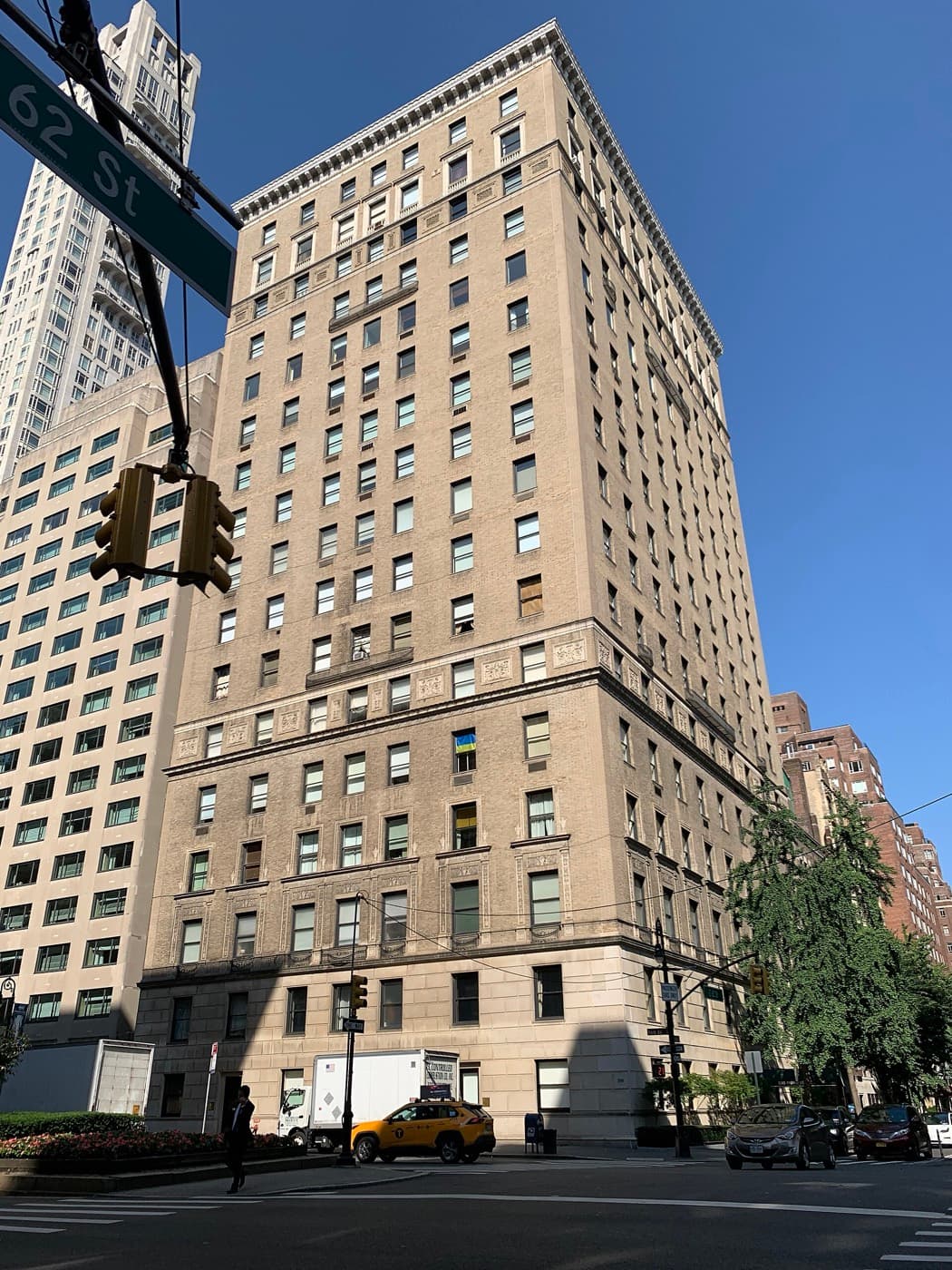
The Yosemite (550 Park Avenue)
550 Park Avenue, New York, NY 10065
Lenox Hill, Upper East Side
BBL 1013760037 · BIN 1040856
- Year built
- 1917
- Type
- Cooperative
- Units
- 32
- Landmark
- Designated
Every recorded sale at this building, 2004–2026
Bedroom-by-bedroom medians, the full transfer record, and how units trade against ask.
- 4BR+ median
- $7.8M
- Recent range
- $2M – $18M
- Listing discount
- 4.3%
- Recorded transfers
- 33
Own an apartment here? See what it would sell for.
A Private Pricing Opinion — what your apartment at The Yosemite would likely sell for today, what it costs to sell, and what you’d walk away with — reviewed personally against condition, exposures, renovation quality, and the competition actually on the market.
550 Park Avenue — The Yosemite — is a 1917 J.E.R. Carpenter cooperative at the corner of Park Avenue and East 62nd Street, one of the early luxury apartment houses that established Park Avenue's identity as the city's premier residential avenue. Completed in December 1917, it stands among the avenue's pioneering full-luxury buildings, finished just as the Park Avenue apartment tradition was crystallizing into the form that would dominate the next two decades.
The Carpenter authorship is the point. J.E.R. Carpenter was the leading architect of Manhattan's golden-age luxury apartment houses — the figure most responsible for codifying the large, formally planned Park and Fifth Avenue residence that buyers still seek today. At 550 Park, that pedigree shows in the building's defining feature: an exceptionally low apartment count. With only around three dozen residences across 17 stories, The Yosemite is among the most exclusive buildings on the avenue by density, with large, gracious layouts and the rare intimacy of a building where neighbors number in the dozens, not the hundreds. It converted to cooperative ownership in 1952 and has been tightly held ever since; over the decades its residents have included August Belmont Jr., Diana Vreeland, and the building's own architect.
Architecture and unit composition
The Yosemite's residences are large by any measure — the building's roughly 4,400 square feet of area per home signals full-floor and grand simplex-and-duplex configurations rather than the divided layouts of denser buildings. Carpenter's golden-age planning recurs throughout: ceiling heights reaching eleven feet in the primary rooms, formal entry galleries, separate dining rooms, libraries, herringbone walnut floors, oversized windows with varied exposures, and wood-burning fireplaces in many apartments. Private elevator landings serve many of the homes.
The corner siting at Park and 62nd delivers light and air on two sides, with Park Avenue exposures looking across the avenue's landscaped median. The combination of low density, large floor plates, and Carpenter detailing puts The Yosemite firmly in the connoisseur tier of pre-war Park Avenue cooperatives.
Building operations
The Yosemite operates as a white-glove full-service cooperative with a full-time doorman, attended elevator, a live-in superintendent, and private storage. The very low apartment count produces the intimate, highly personal operating environment characteristic of the most exclusive Park Avenue buildings. Pets are allowed, and — unusual for a building of this caliber — pied-à-terre purchases are permitted, which broadens the buyer pool to include part-time New Yorkers and trust or family buyers. Financing is limited, in keeping with tier-one Park Avenue practice, with the cooperative permitting only modest leverage (on the order of half the purchase price). A board-approval process applies, consistent with the avenue's most selective buildings.
Local Law 97
- 2024–2029 annual penalty
- $0 (under cap)
- 2030–2034 annual penalty
- $51,155/yr
- Per unit / month range
- $0 – $122
Source: NYC LL84 benchmarking and PLUTO · The Roebling Research Library. City record last verified September 2026.
See full Local Law 97 analysis — emissions history, scenarios, methodology →Facade safety — Local Law 11
The latest available FISP filing classified the facade as Safe — no repairs were required at that inspection. Facade inspections run on a fixed five-year cycle; future inspection, repair, and any assessment decisions remain building-specific.
How to read this, and where it comes from
QEWI = Qualified Exterior Wall Inspector — the licensed engineer the city requires to sign the report (the independent expert, not the managing agent).
Penalties shown are amounts DOB assessed against filings on record across 2005–10 to 2020–25. The FISP dataset does not record whether they were paid, contested or remain open, so treat the figure as history rather than a current balance and confirm the building’s standing with the managing agent.
Source: NYC DOB facade filings (FISP) · The Roebling Research Library. City record last verified September 2026.
Management & transfer contacts
- Sublet policy
- Allowed
- Pied-à-terre
- Not allowed
Recent sales
Recent transfers at this building, curated by The Roebling Team research desk. Prices are the transfer amounts recorded with the NYC Department of Finance; apartment-level detail is checked against the building’s own file in The Roebling Research Library before publishing.
| Date | Unit | Apartment | Price | PPSF | vs. Ask |
|---|---|---|---|---|---|
| Jun 9, 2026 | 16AE | 2 BR · 2 BA · 1,225 sf | $1,975,250 | $1,612/sf | +32.1% |
| May 11, 2026 | 12E | 5 BR · 4.5 BA · 4,592 sf | $8,050,000 | $1,753/sf | -15.3% |
| Mar 23, 2026 | 3W | 4 BR · 3.5 BA | $4,800,000 | +1.1% | |
| Sep 16, 2025 | 2E | 5 BR · 5 BA · 4,500 sf | $7,200,000 | $1,600/sf | +0.0% |
| Sep 11, 2024 | 3E | 4 BR · 3.5 BA · 4,480 sf | $7,500,000 | $1,674/sf | -3.2% |
| May 1, 2024 | 17E | 4 BR · 3.5 BA · 4,500 sf | $13,750,000 | $3,056/sf | -8.0% |
| Sep 14, 2023 | 11W | 3 BR · 4 BA | $6,672,500 | -8.0% | |
| Mar 2, 2022 | 12A | 4 BR · 4.5 BA | $8,750,000 | -7.9% |
Market read. Most recent trades (2026) cleared a median $1,279/sf across 2 sales. Median listing discount 6.1% from the last ask — a recurring negotiation gap worth pricing into any offer or listing strategy.
The retrade record
Lines that have traded more than once in the public record — the building’s appreciation arc, apartment by apartment.
Full closing history with price-per-square-foot over time, the complete retrade record, and every line that has traded.
Sales sourced from NYC Department of Finance recorded transfers (BBL 1-01376-0037) and verified listing data. Apartment-level facts (line, condition, asking-price context) curated and cross-verified by The Roebling Team research desk. Not all transactions cross-verify with ACRIS records — sponsor and LLC purchases sometimes record at stipulated values rather than market price; square footage on co-ops is not officially recorded, figures shown are approximate.
What to know if you’re buying
Scarcity is the defining fact: with so few apartments, opportunities are rare and large, and buyers need to be both patient and ready to move. The Carpenter pedigree, the 1917 vintage, and the eleven-foot ceilings, galleries, libraries, and fireplaces are the real assets. Two policies matter to your strategy: pied-à-terre purchases are permitted, which is a meaningful flexibility at this tier, and a 3% flip tax is paid by the purchaser on acquisition — a cost buyers should build into their all-in number from the outset. Financing is restricted to roughly half the price, so plan for substantial cash. Board approval is rigorous; strong financials and clean references are essential. We help buyers source rare availability, evaluate the apartment, and prepare for a selective board.
What to know if you’re selling
Lead with exclusivity and pedigree: the very low unit count, the Carpenter authorship, the 1917 vintage, the eleven-foot ceilings and fireplaces, and the prime Park-and-62nd corner are the headline assets. The permitted pied-à-terre policy widens your buyer pool relative to many tier-one peers — a genuine marketing advantage worth foregrounding. With thin internal turnover, pricing draws on corridor-level golden-age Park Avenue precedent adjusted for the specific home. The buyer pool is narrow but deep; the right marketing reaches well-qualified buyers directly, and the closing follows the building's selective board process.
Comparable buildings
If you're considering The Yosemite, also evaluate these nearby pre-war Park Avenue cooperatives:
- 520 Park Avenue — nearby Park Avenue building
- 525 Park Avenue — Schwartz & Gross's 1914 Park Avenue condominium
- 530 Park Avenue — nearby Park Avenue cooperative
- 555 Park Avenue — Lenox Hill Park Avenue peer
- 580 Park Avenue — pre-war Park Avenue cooperative
- 571 Park Avenue — 1927 Park Avenue cooperative nearby
The neighborhood
For the full corridor — architecture, schools, transit, and pricing across Park Avenue — read The Roebling Team Guide to Park Avenue.
The full playbook — what goes in the package, how boards read your financials, the interview, and the timeline — plus sample cover, reference, and personal letters you can adapt.
How to read the facts on this page. Items attributed to an offering plan describe the building as it was offered at that filing — unit mix, square footage, the amenity program as planned. They are not a statement about how the building operates today. Tax and compliance figures are sourced separately to current City records and carry their own dates. House rules, staffing and fee policy can change by board resolution without any public filing: treat every policy line here as a starting point for diligence and confirm it with the managing agent. Where this page compares one building or neighborhood to another, that is our analysis of the recorded record — it names the measure, the period and the sample it rests on, and it is an observation about medians rather than a prediction about any particular apartment.
Considering a move at The Yosemite?
Request a private building brief with the relevant comparable sales, current and off-market availability, and an apartment-specific view of value.