James Edwin Ruthven Carpenter (1867–1932) was the dominant Gold Coast apartment architect of the 1910s and 1920s, producing the substantial Fifth Avenue and Park Avenue cooperative inventory that defined upper-tier pre-war Manhattan. Carpenter's portfolio includes 825, 845, 850, 860, 875, 890, 907, 1110, and 1120 Fifth Avenue, along with substantial Park Avenue inventory — buildings whose layout discipline (separate service entrance, library-living combinations, primary-suite isolation from public rooms) established the upper-tier apartment vocabulary that Candela would refine a decade later. Carpenter's reputation has been somewhat overshadowed by Candela's, but his work — particularly 845 Fifth (1920) — produces some of the largest recorded co-op trades in the city's history.
The architect who invented the Fifth Avenue apartment
If you have ever stood in a pre-war Fifth Avenue lobby with a barrel-vaulted entry, walked through a circular gallery into a 30-foot living room with library and dining room flanking it on either side, and registered the building as belonging to a particular and rarely-replicated tier of New York residential property — you have walked through a building that was almost certainly designed, or designed in the lineage of, James Edwin Ruthven Carpenter Jr.
Carpenter is the architect most responsible for what Fifth Avenue physically looks like today between 60th Street and 100th Street. He designed more apartment buildings on Fifth Avenue than any other architect — at least sixteen, by the count assembled across public records, Friends of the Upper East Side, and Andrew Alpern's canonical 2002 monograph — plus another dozen on Park Avenue and a smaller West Side portfolio. At the time of his death in 1932, the trade press referred to him as "the father of the modern New York apartment house," and that designation has aged unusually well.
This piece is the long-form version of a question we get asked regularly: what is a Carpenter building, and why does it still command a price premium nearly a century after he died? The answer is partly architectural — Carpenter codified a floor plate, a ceiling height, a relationship between public and private rooms that defined luxury vertical living in New York — and partly market-structural. Carpenter buildings have aged into a specific prestige class adjacent to but distinct from the Candela tier that followed him. Understanding the difference matters if you are buying or selling at this level.
We have verified every attribution in this piece against two or more independent sources. Where attribution is genuinely contested, we flag it rather than pretending otherwise.
Biography: from Columbia, Tennessee to 598 Madison Avenue
James Edwin Ruthven Carpenter Jr. was born on January 7, 1867, in Columbia, Tennessee — a Middle Tennessee town about 45 miles south of Nashville. He studied at the University of Tennessee and then at the Massachusetts Institute of Technology, graduating from MIT's architecture program. Like the architecturally ambitious of his generation, he followed MIT with study at the École des Beaux-Arts in Paris, which trained him in the classical compositional logic — symmetry, hierarchy, proportion, and the rigorous use of historicist vocabulary — that would mark every building he subsequently produced.
He began his career in the South. He practiced in Nashville beginning around 1888 and in Norfolk, Virginia in the 1890s. His Tennessee work included the Maury County courthouse in Columbia, the Stahlman Building and the Hermitage Hotel in Nashville, and the Kirkland Tower at Vanderbilt University — substantial commercial and institutional commissions that established his competence at scale but did not yet point toward the residential specialty that would define him.
Carpenter relocated to New York City, and by 1903 he was established there. He worked from 1904 to 1908 in the partnership of Carpenter & Blair, then on his own. Critically, he also took an operating role at the development firm Fullerton-Weaver Realty — making him an unusual hybrid: an architect who was also an investor and partial owner in some of his own buildings. This dual position gave him an economic understanding of the apartment building that most architects of his generation did not have. He knew what rented and what sold; he knew how the underwriting math worked at the floor-plate level; and he designed accordingly.
He maintained his office at 598 Madison Avenue, where he died of a heart attack on June 11, 1932, at age 65. His final project — collaborated on with other architects — was the Lincoln Building at 42nd Street and Vanderbilt Avenue, completed posthumously in 1930. By that point, the press had already accorded him the title that has stuck: father of the modern New York apartment house.
What Carpenter actually invented
Carpenter's architectural contribution is sometimes flattened to a stylistic one — Italian Renaissance palazzo facades in limestone, cornices, rusticated bases, balustraded rooflines. That description is accurate but not load-bearing. The stylistic vocabulary was available to anyone trained at the Beaux-Arts. What Carpenter actually did, and what makes a Carpenter building structurally different from a contemporary, was three things.
He scaled the apartment building up to mansion proportions. Before Carpenter, an apartment in New York carried a class connotation: it was where you lived if you could not afford a townhouse. The mansion-class buyer would not live in one. Carpenter's premise — and the premise he was selling to clients, to developers, and to mortgage underwriters — was that a properly designed apartment could deliver everything a Fifth Avenue mansion delivered (scale, light, formal entertaining capacity, staffed service, neighborhood, view) without the maintenance burden of a private house. To make this work, the apartments had to actually be at mansion scale. His full-floor and half-floor units routinely ran 5,000 to 8,000+ square feet, with ceiling heights of 10 to 12 feet in primary rooms (and in his most generous buildings, 14 feet). The 18-room single-apartment-per-floor plan at 845 Fifth Avenue (4 East 66th Street), designed for William Henry Barnum in 1920, is the architectural argument made explicit: an entire Fifth Avenue mansion, stacked vertically.
He codified the entry sequence. The Carpenter signature is the gallery — typically circular, generously proportioned, sometimes 18 feet across at the center, anchoring the apartment plan and distributing rooms off of it on a logic of formal hierarchy. The living room, library, and dining room occupy the prime exposures; bedrooms and service rooms work backward from there. The two best-executed examples are 580 Park Avenue and 635 Park Avenue, both of which place a circular foyer at the apartment's center as the organizing armature. Once you have lived in one of these plans, generic developer-era plans feel cramped and illogical in a way that is hard to un-see.
He fought the Fifth Avenue height restriction and won. In 1922, the Board of Estimate moved to cap building heights on upper Fifth Avenue at roughly 75 feet — effectively six stories. Carpenter, working through a mandamus action brought by developer Mary Jennings and the support of his developer clients, took the fight to court and prevailed. The result was the wave of 12-, 13-, and 15-story Fifth Avenue apartment buildings that followed through the late 1920s — most of them his. Without Carpenter's role in overturning that restriction, the Fifth Avenue skyline north of 60th Street would look meaningfully different today.
The combination — mansion-scaled apartments, gallery-anchored floor plans, and the legal vehicle to actually build at the heights the buildings required — is the Carpenter invention. Everyone who came after him, including Rosario Candela, was working in a market Carpenter had structurally created.
The Fifth Avenue portfolio
Carpenter's Fifth Avenue commissions are denser than any other architect's on any other Manhattan avenue. The list below has been triangulated across public records, Friends of the Upper East Side, Landmark Branding, and Alpern's monograph; we exclude buildings where attribution does not survive cross-checking.
907 Fifth Avenue (1916). The breakthrough commission. The first apartment building to replace a private mansion on Fifth Avenue above 59th Street, at 72nd Street, on the site of the former James A. Burden mansion. Won Carpenter the A.I.A. Gold Medal in 1916. The argument that an apartment could replace a Fifth Avenue mansion was made here, in limestone, with full conviction.
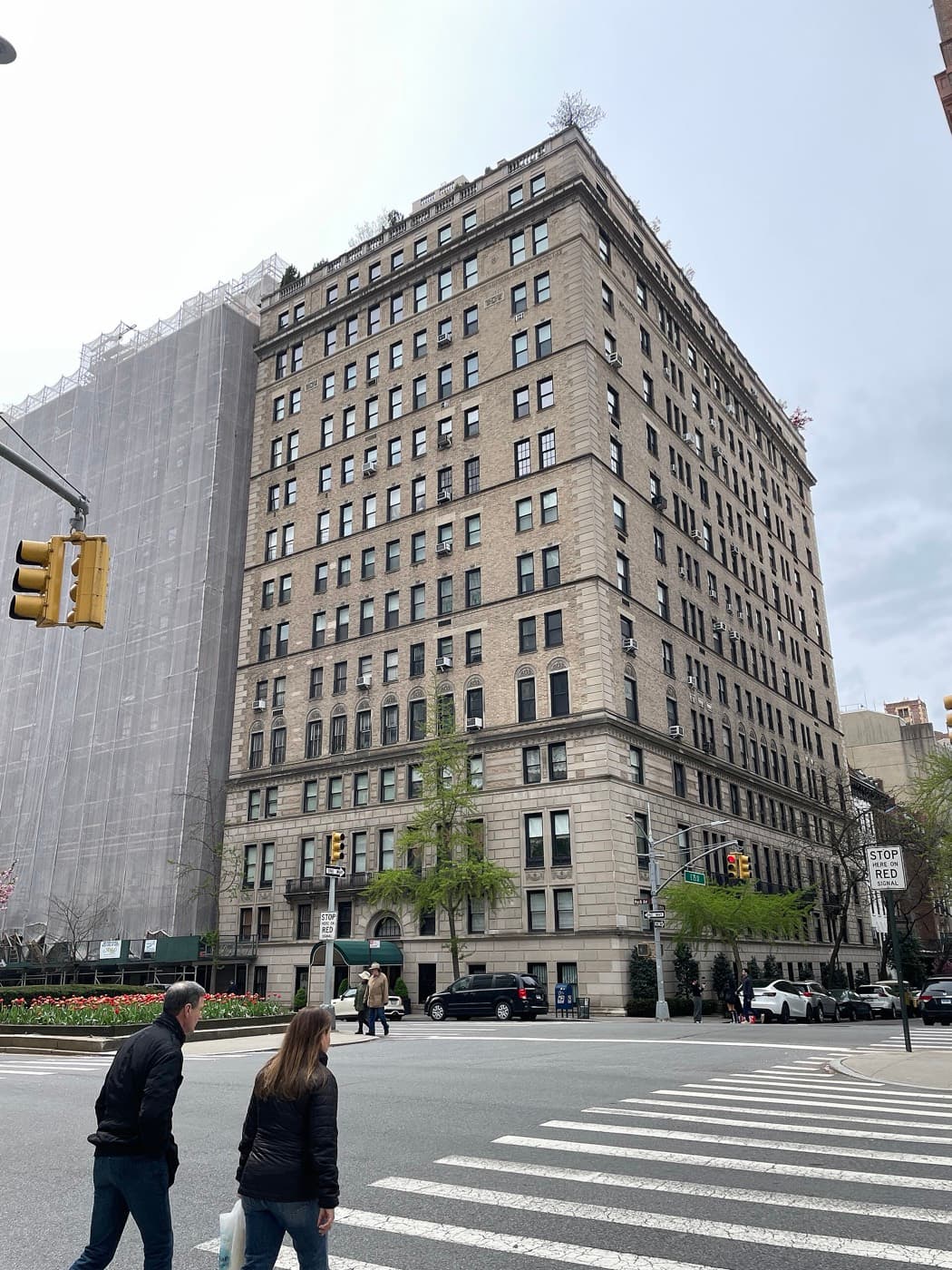
950 Fifth Avenue (1926). Italian Renaissance palazzo facade at the northeast corner of 76th Street. Only seven apartments across fourteen stories — among the most intimate full-service residences on the avenue. The four-story rusticated limestone base, decorative bandcourses, and refined cornice make this one of Carpenter's most carefully detailed buildings.
1030 Fifth Avenue (1925). Thirteen stories, sixteen apartments, between 84th and 85th — directly across from the Metropolitan Museum. Full-floor residences of 8 to 15 rooms, private elevator landings.
1060 Fifth Avenue (1928). One of Carpenter's largest Fifth Avenue commissions — 48 apartments at the northeast corner of 87th Street, in Carnegie Hill. The larger units retain 30-foot corner living rooms, butler's pantries, and original staff quarters.
1165 Fifth Avenue (1925). Sixteen stories, 61 apartments. The southern half of one of Carpenter's distinctive "twin" pairings — 1165 and 1170 Fifth face each other across a side street, with 1170 (1926) reversing 1165's plan and entrance details. Carpenter built another twin pair earlier at 1115 and 1120 Fifth, at 93rd Street.
825 Fifth Avenue (1926). Carpenter for the Paterno Brothers. A 23-story neo-Classical tower with limestone at the lower four floors, brick above, and the red-tile rooftop and chimneys that are one of the few unmistakable silhouettes on the central Park skyline. Joseph Paterno initially classified the building as an apartment-hotel — a legal maneuver to escape the 15-story restriction that otherwise applied to apartment houses.
Other verified Carpenter Fifth Avenue buildings (no Roebling building page yet): 810, 920, 988 (1925-26, Italian Renaissance condominium since 1981, 12 full-floor residences at the southeast corner of 80th Street), 1035, 1115 (1925-26, for builder Anthony Campagna), 1120, 1143, 1150, 1170 (1926, the 1165 twin).
Disputed / requires further verification — flagged:
- 1148 Fifth Avenue (1923). Attribution disputed. public records and several real-estate-industry sources credit J.E.R. Carpenter as the primary architect with Walter B. Chambers as associate. Other sources — including stock photo provenance and architectural databases — credit Walter B. Chambers as the primary designer in neo-Georgian style. The building was the subject of the Mary Jennings mandamus action that overturned the Fifth Avenue height restriction, which Carpenter publicly supported, suggesting at minimum a documented Carpenter involvement. We list the attribution as disputed pending review of the Alpern monograph and LPC designation reports.
Excluded from the Carpenter list — important to flag because they are commonly misattributed:
- 944 Fifth Avenue (1925). Designed by Nathan Korn, not Carpenter. Korn also designed 956 Fifth at 77th Street. Italian Renaissance palazzo style, 14 stories, 15 apartments. Frequently grouped with Carpenter's Fifth Avenue work because of stylistic similarity and the date; the attribution does not survive sourcing.
- 1136 Fifth Avenue (1924-25). Designed by George F. Pelham.
- 1000, 1010, 1020 Fifth Avenue. Variously the Metropolitan Museum itself (1000), the Fred F. French Company (1010), and Warren & Wetmore (1020).
The Park Avenue work
Carpenter's Park Avenue portfolio is smaller in count than his Fifth Avenue work but equally consequential — and at the apartment-plan level, arguably more refined.
580 Park Avenue (1923). Italian Renaissance, a full blockfront between 63rd and 64th — one of only three buildings on Park Avenue occupying an entire blockfront. The circular central foyer plan here is among Carpenter's two best (the other being 635 Park). White-glove co-op, originally 53 apartments, now 60.
625 Park Avenue (1929-31). Developed by banker Louis Graveraet Kaufman. Limestone-clad, 13 stories, with a corner balcony beneath large arched windows on the 10th floor. One of Carpenter's most lavish designs and among his last completed works.
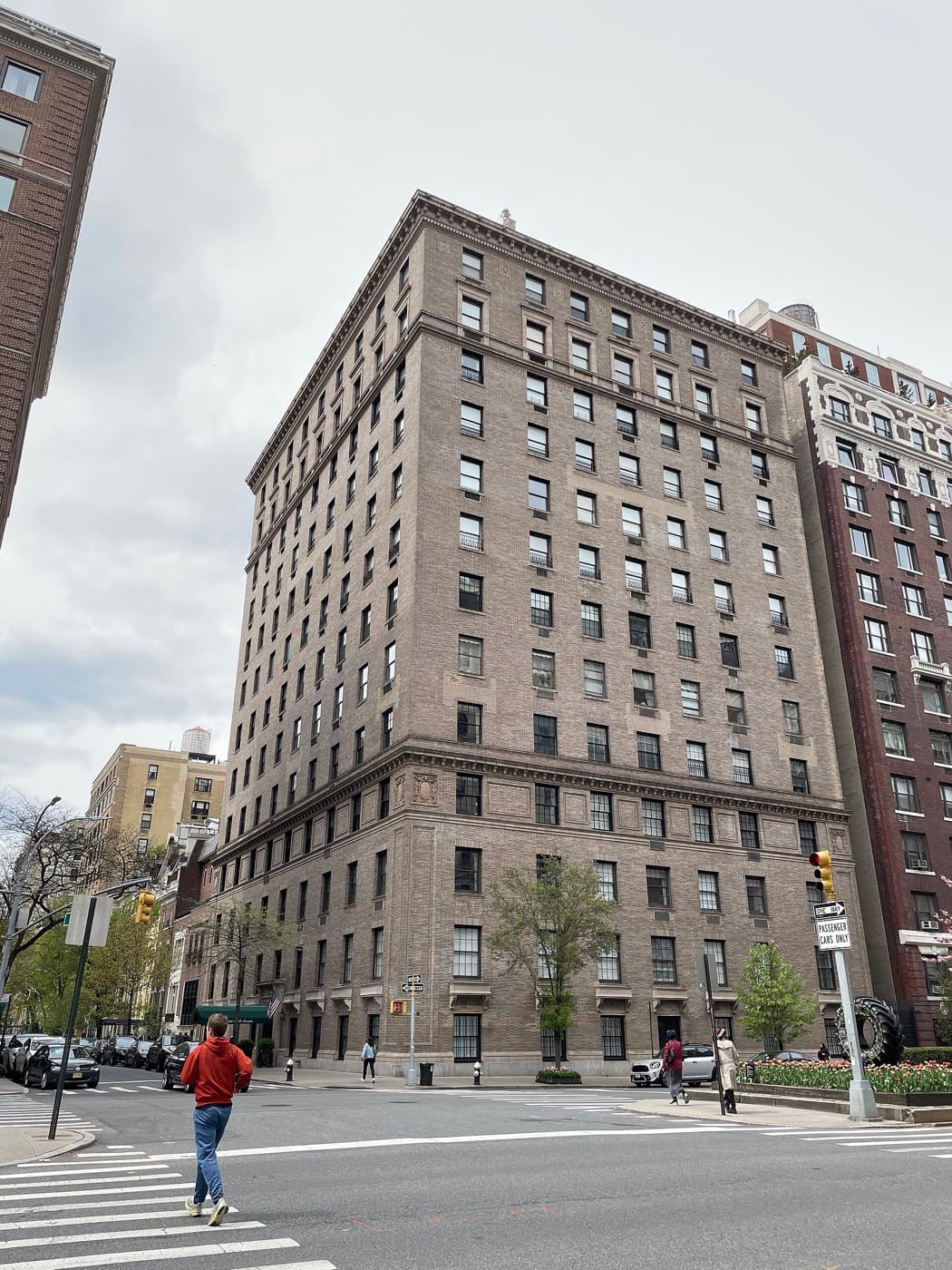
950 Park Avenue (1921). Dark brown-brick Italian Renaissance palazzo at the corner of 82nd Street. Fourteen stories, 29 units. Plan is nearly identical to Carpenter's 550 Park Avenue of three years earlier — eight-room and 12-room apartments alternating on each floor.
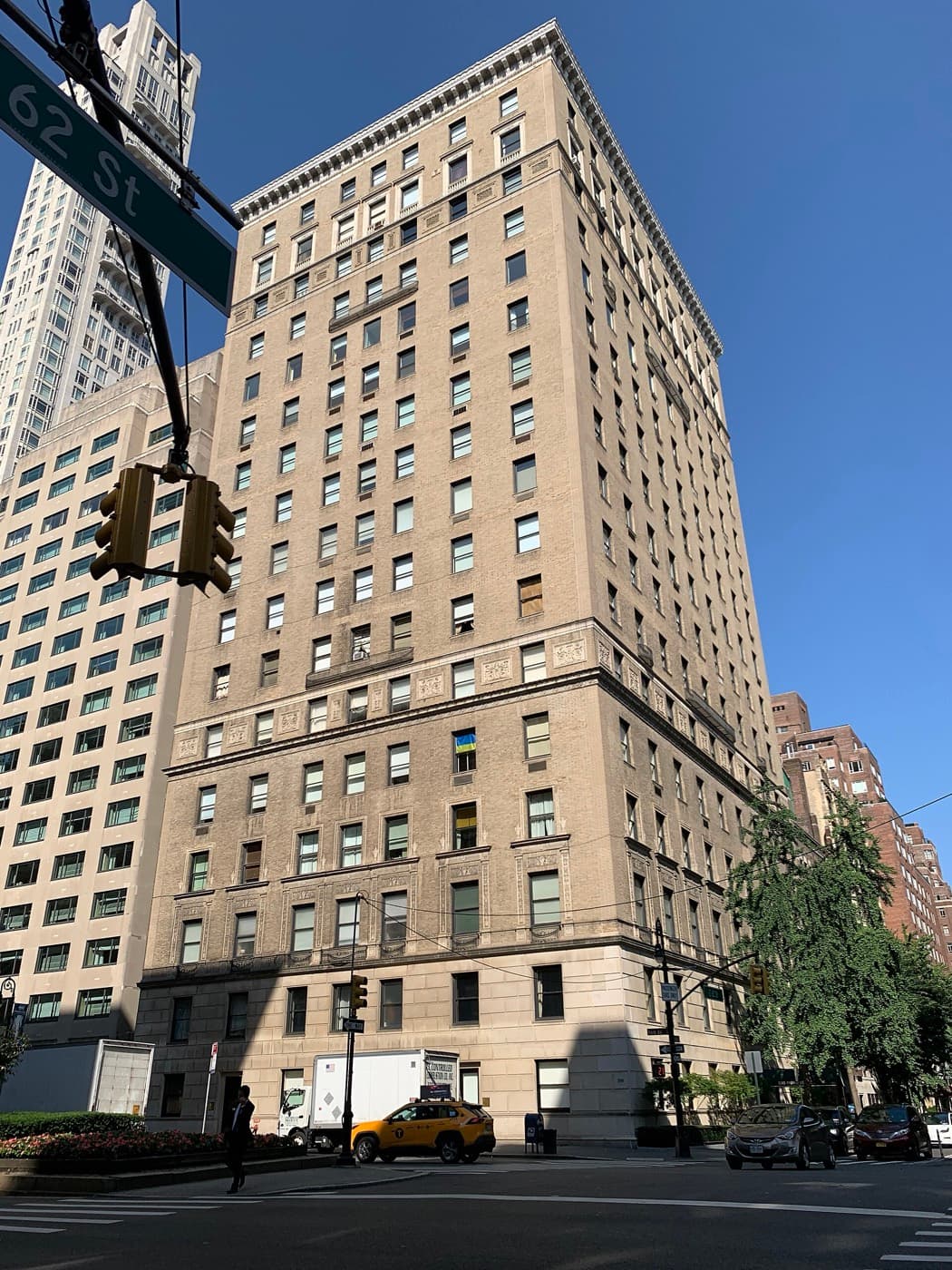
Other verified Carpenter Park Avenue buildings: 550 Park (1917, "The Yosemite," at the southwest corner of 62nd, 17 stories, 32 apartments, syndicate-developed); 635 Park (1912, the "Adelaide," 13 stories, only 16 apartments, developed by Spencer Fullerton Weaver who also developed 630 and 640 Park); 640 Park (1914); 655 Park (1924, with Mott B. Schmidt as collaborating architect — the staggered-height massing was a deed restriction imposed by the syndicate of mansion owners who sold the land); 630 Park; 812 Park; 819 Park (which won the New York chapter A.I.A. Gold Medal in 1926); 960 Park; 1050 Park.
The 1916 A.I.A. Gold Medal for 907 Fifth and the 1926 A.I.A. Gold Medal for 819 Park bookend Carpenter's mature decade — a recognition by his professional peers that the apartment-house typology, in his hands, had become something serious.
Developers: the Paterno Brothers, Fullerton-Weaver, and others
Carpenter's career was made possible by a small set of developer relationships, and understanding them clarifies why his portfolio looks the way it does.
Fullerton-Weaver Realty. Carpenter served as vice president of this firm, which positioned him as both architect and developer for a meaningful slice of his portfolio. Spencer Fullerton Weaver, the firm's principal, was the developer of 630, 635, and 640 Park Avenue — all Carpenter designs. This is the relationship that distinguishes Carpenter from architects who worked on commission only: he had skin in the buildings, and his design decisions reflected an investor's understanding of what the buildings needed to do economically.
The Paterno Brothers. Joseph (1881-1939) and Charles (1878-1946) Paterno, sons of Italian immigrants from Castelmezzano, took over their father Giovanni's apartment construction business in 1899 and built over 140 Manhattan apartment buildings in the first half of the 20th century. They worked with many architects — Carpenter was one of several. Their most architecturally significant Carpenter collaboration is 825 Fifth Avenue (1926), a 23-story tower at 64th Street. The Paterno operating method — the apartment-hotel legal classification, the use of stylistically distinctive rooflines for skyline identification — shapes 825 Fifth as much as Carpenter's plan does. The Paterno brothers-in-law Anthony Campagna and Armino Campagna also developed Carpenter buildings independently: Anthony Campagna's 93rd St. & 5th Avenue Corp. built 1115 Fifth in 1925-26.
Bing & Bing. The Bing brothers (Leo and Alexander) were among the most active luxury apartment developers in interwar Manhattan, with a particular concentration in Greenwich Village and on the Upper East Side. The Bings are most associated with architect Emery Roth, who designed the bulk of their portfolio (The Alden, the Southgate complex, and others). We have not been able to verify direct J.E.R. Carpenter / Bing & Bing collaborations from publicly available sources; if such collaborations exist, they appear marginal to Carpenter's portfolio. We flag this rather than asserting a relationship the sourcing does not support.
Independent owner-developers. Several Carpenter buildings — 907 Fifth, 1148 Fifth, 845 Fifth / 4 East 66th — were developed by syndicates assembled for a single building, with Carpenter providing both architectural and (in some cases) underwriting input. This pattern is common in the 1915-1925 window before the larger developer firms consolidated the market.
Carpenter vs. Candela: the two architects of pre-war Manhattan
The canonical pairing of Carpenter with Rosario Candela was made explicit by Andrew Alpern's 2002 monograph The New York Apartment Houses of Rosario Candela and James Carpenter (Acanthus Press), and it is the right pairing. The two architects defined the form. But the pairing also flattens a real generational and sensibility difference that matters at the market level.
Carpenter precedes Candela by roughly a decade in peak output. Carpenter's mature Fifth Avenue and Park Avenue work runs from approximately 1915 to 1930. Candela's signature buildings — 720 Park, 740 Park (with Cross & Cross), 770 Park, 778 Park, 834 Fifth, 960 Fifth, 1040 Fifth, 1220 Park — cluster in the 1927-1931 window. By the time Candela was hitting his peak, Carpenter had been at the top of the trade for fifteen years and was approaching the end of his career.
Stylistic vocabulary differs. Carpenter is the master of restraint. His facades are Italian Renaissance palazzo — limestone bases, brick or limestone shafts, balustraded rooflines, careful cornices — but they read as compositionally calm. The buildings are not trying to attract attention; they are trying to settle into the street wall with authority. Candela's exteriors are also restrained but his plans are more theatrical: dramatic ceiling-height shifts, elaborate room-to-room sight lines, the floor-plate gymnastics that produce the famous Candela duplexes and triplexes.
Plan logic differs. Carpenter's plans favor the gallery — a circular or elliptical foyer as the organizing pivot, off which rooms distribute on classical principles of hierarchy. The plan is calm. Candela's plans favor procession — entry through a sequence of rooms, with the floor plate doing more of the dramatic work. Both architects produced apartments at the same square-footage scale; they organize that scale differently.
Market positioning today. A Carpenter apartment and a Candela apartment of comparable scale and condition trade in roughly the same range — at the top of the pre-war market — but the buyer pools tilt slightly differently. Candela's name carries more brand-equity in the market because of the cultural weight 740 Park, in particular, has accumulated through Michael Gross's 2005 book and decades of New York Times coverage. Carpenter's name is recognized at the architecturally literate end of the buyer pool but less so among the casual luxury buyer. The practical effect: a Carpenter apartment may be slightly under-priced relative to its architectural merit in markets where the buyer is less educated, and may trade at fair value or above where the buyer understands the lineage.
The two architects together defined a form — the Fifth Avenue and Park Avenue luxury apartment building — that has not been replicated in New York since their generation. Everything that came after, from the post-war white-brick boxes to the contemporary glass towers, is operating in a different idiom. The Carpenter-Candela apartments are the irreducible reference set.
Buying a Carpenter apartment today
For buyers considering Carpenter buildings at the apartment level, several things are worth understanding.
Plan integrity is the principal underwriting question. A Carpenter apartment that retains its original gallery, original ceiling heights, original room proportions, and original library-living-dining relationship is a different asset than a Carpenter apartment that has been gutted to an open-plan configuration. The market premiums to original plan integrity have grown over the past fifteen years as the inventory of un-renovated pre-war apartments has shrunk. If you are buying for hold, the gallery is the asset; do not let a renovation team talk you out of it.
Ceiling height varies by line, not just by building. Within a single Carpenter building, primary rooms in the line that faces Park or Fifth typically have higher ceilings than secondary rooms or back-of-building rooms. The marketing material at the building level may quote a top-line number that does not apply uniformly. Verify at the apartment.
Service infrastructure is not optional. Carpenter designed his apartments for staffed living — butler's pantries, maids' rooms, formal entry galleries, separate service entrances. Modern buyers often want to reconfigure this infrastructure for casual living. The renovations that work best preserve the service-and-formal duality and use it; the renovations that fail try to erase it.
Board cultures vary widely. Carpenter buildings range from rigorously restrictive (950 Fifth, 950 Park, 580 Park) to comparatively permissive. Some allow financing; some do not. Some allow pied-à-terre use; some do not. Some allow international buyers without friction; some do not. Carpenter is the architect, not the board — assume nothing about board posture from building age.
Maintenance costs are real. The Carpenter buildings are 95 to 110 years old. Mechanical systems, facade pointing, lobby restoration, elevator modernization — all are ongoing institutional costs that show up in maintenance and assessments. The well-run buildings reserve aggressively against these; the less well-run buildings do not, and the deferred maintenance shows up at the wrong moment in your hold.
Comparable-sales analysis is harder than at newer buildings. Carpenter buildings have small unit counts (often 7 to 50 apartments), low transaction frequency, and significant apartment-to-apartment heterogeneity. Generic average-PPSF analysis is unreliable. The pricing work needs to be done at the apartment level by someone who knows the building's recent history, including off-market activity.
What Carpenter built, and why it still matters
Carpenter died in 1932, in his office, of a heart attack. He had been at the top of his profession for roughly twenty years and had designed more luxury apartment buildings in New York than any architect of his generation. The buildings have aged into landmarks — formally, as components of historic districts, and informally, as the irreducible reference set for what a pre-war Manhattan apartment is supposed to be.
The Carpenter argument was straightforward and is now obvious: that a properly designed apartment could deliver everything a mansion delivered, at a price the early-20th-century affluent buyer was willing to pay. The argument was correct, but it required a particular architect to make it credible in built form. Carpenter was that architect. Everything on Fifth Avenue and Park Avenue between 60th and 100th Street that you walk past today and register as belonging to the apex of New York residential property carries his fingerprint, directly or through the lineage of imitators and successors he produced.
If you are buying or selling at this level, this is the lineage you are buying or selling into. Knowing what you are looking at is the first move.
Considering a transaction in a Carpenter building?
Corey Cohen, Principal The Roebling Team at Compass 646.939.7375 · c.cohen@compass.com
Run the numbers
- Mansion Tax Calculator — Carpenter apartments routinely transact above the $5M, $10M, and $20M mansion tax thresholds
- Buyer Closing Cost Calculator
- Seller Closing Cost Calculator
Related guides
- Manhattan Co-op Buying Guide — board approval mechanics in detail
- Park-Facing Apartments Guide — comparative analysis across pre-war park-facing buildings
- NYC Real Estate Tax & Closing Cost Guide
Carpenter buildings with Roebling building pages
- 907 Fifth Avenue (1916)
- 950 Fifth Avenue (1926)
- 1030 Fifth Avenue (1925)
- 1060 Fifth Avenue (1928)
- 1165 Fifth Avenue (1925)
- 825 Fifth Avenue (1926, for the Paterno Brothers)
- 580 Park Avenue (1923)
- 625 Park Avenue (1929-31)
- 950 Park Avenue (1921)
- 845 Fifth Avenue (4 East 66th Street) (1920) — also addressed 845 Fifth Avenue
- 1148 Fifth Avenue (1923, attribution disputed — see above)
This profile reflects publicly available information cross-checked across multiple architectural and real-estate sources, including public records, Friends of the Upper East Side Historic Districts, Landmark Branding, the., the Tennessee Encyclopedia, and Andrew Alpern's The New York Apartment Houses of Rosario Candela and James Carpenter (Acanthus Press, 2002). Where sources disagree, attribution is flagged. The Roebling Team at Compass does not represent any of the buildings discussed in this profile. © 2026 The Roebling Team at Compass.
Buildings designed by J.E.R. Carpenter




The drawings are public. The rest isn't.
How these buildings have actually traded, which lines deliver what the plans promise, and how each board handles financing and approvals.