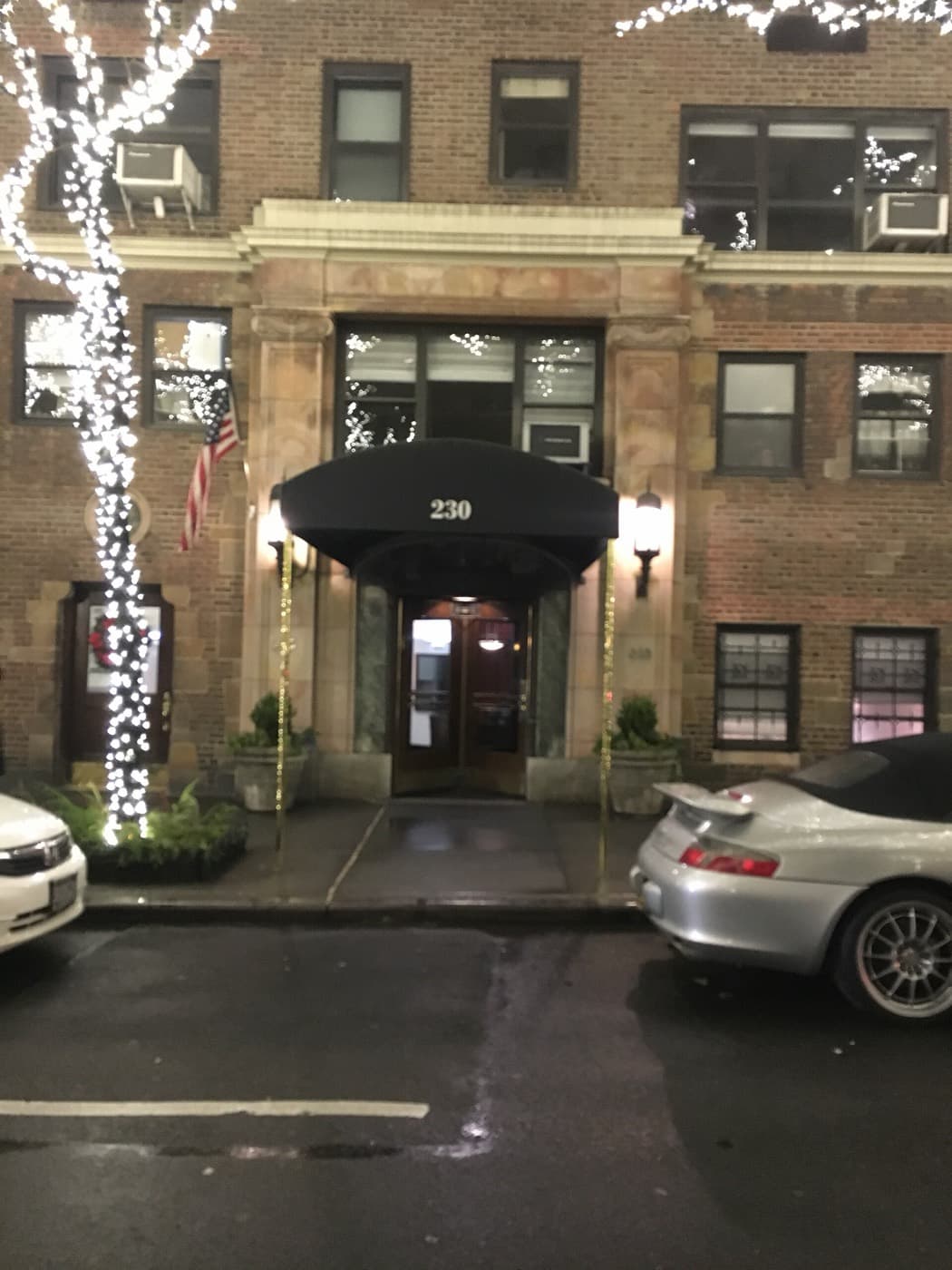
230 East 73rd Street (Eastgate)
230 East 73rd Street, New York, NY 10021
Lenox Hill, Upper East Side
BBL 1014270030 · BIN 1043975
- Year built
- 1936
- Type
- Cooperative
- Units
- 92
- Floors
- 12
- Pets
- Pets permitted (dogs welcome)
- Flip tax
- Reported at $10 per share (verify rate and payer against offering plan)
Every recorded sale at this building, 2002–2026
Bedroom-by-bedroom medians, the full transfer record, and how units trade against ask.
- 1BR median
- $613K
- Recent range
- $345K – $4.2M
- Listing discount
- 1.1%
- Recorded transfers
- 102
Own an apartment here? See what it would sell for.
A Private Pricing Opinion — what your apartment at Eastgate would likely sell for today, what it costs to sell, and what you’d walk away with — reviewed personally against condition, exposures, renovation quality, and the competition actually on the market.
230 East 73rd Street — Eastgate — is an Emery Roth-designed, Bing & Bing-built prewar cooperative at the heart of the "Eastgate" enclave of brown-brick apartment houses that Bing & Bing raised along East 73rd Street. It pairs one of Manhattan's most celebrated apartment architects with one of its most respected prewar developers, delivering genuine architectural pedigree at Lenox Hill pricing rather than the Park-and-Fifth premium.
The building's appeal rests first on its Emery Roth / Bing & Bing pedigree. Roth's residential work defines much of prewar Manhattan's finest apartment stock, and Bing & Bing's buildings are prized for construction quality and layout intelligence. Eastgate was originally marketed with its sister buildings as an enclave, its apartments sold as "mansionettes" — a positioning that still reads in the generous, well-proportioned layouts. Its near-twin at 235 East 73rd Street across the block completes the paired-building urban context that gives the enclave its distinctive character.
Layered onto the architecture is a landscaped courtyard and full-service program — a planted rear garden, a fitness center, two elevators, and staffed lobby service that give the building operational depth uncommon among boutique Lenox Hill cooperatives.
Architecture and unit composition
Eastgate is a 12-story prewar cooperative of roughly 92 units, designed by Emery Roth and built by Bing & Bing in 1936. The brown-brick facade carries Georgian/Tudor-influenced masonry with textured "knobby" brickwork and random inset stones, a canopied two-story sandstone entrance surround with a revolving door, a step-down lobby, decorative gargoyles, and a rounded top-floor parapet with a decorative rooftop water-tank enclosure. The lobby carries Art Deco detailing.
Original apartments featured sunken living rooms and generous "mansionette" proportions; fireplaces in this building are decorative rather than working. The mix runs from one-bedrooms through larger combined and penthouse units, some with terraces. The building was converted to cooperative ownership in 1987.
Building operations
Eastgate operates as a full-service prewar cooperative with a full-time doorman/concierge, two elevators, a landscaped courtyard/rear garden, a fitness center, a central laundry room, private storage (waitlisted), and a bike room. There is no parking garage. The superintendent is understood to be full-time; live-in status should be confirmed at offer stage.
Financing is permitted up to 80% (20% minimum down payment). A transfer fee (flip tax) applies; the building's fee has been reported on a per-share basis, and the exact rate and payer should be confirmed against the current offering plan and house rules. Subletting is permitted, with an occupancy period required before subletting and term limits thereafter — the specific terms should be verified against house rules. Pied-à-terre ownership, co-purchasing, and guarantors are permitted. As with any cooperative, board approval and a board interview are required.
Local Law 97
- 2024–2029 annual penalty
- $0 (under cap)
- 2030–2034 annual penalty
- $61,601/yr
- Per unit / month range
- $0 – $56
- Modeled exposure split equally across 92 units (the city tax-lot count). Not an assessed amount; co-op shareholders are typically charged by share allocation.
Source: NYC LL84 benchmarking and PLUTO · The Roebling Research Library. City record last verified September 2026.
See full Local Law 97 analysis — emissions history, scenarios, methodology →Facade safety — Local Law 11
The latest available filing classified the facade as SWARMP — Safe With A Repair and Maintenance Program: the engineer identified conditions requiring monitoring or repair, with repairs due by the deadline stated in the filing. The scope, timeline, and how the building funds the work are building-specific — we review the filings and board materials for you.
How to read this, and where it comes from
QEWI = Qualified Exterior Wall Inspector — the licensed engineer the city requires to sign the report (the independent expert, not the managing agent).
Penalties shown are amounts DOB assessed against filings on record across 2005–10 to 2020–25. The FISP dataset does not record whether they were paid, contested or remain open, so treat the figure as history rather than a current balance and confirm the building’s standing with the managing agent.
Source: NYC DOB facade filings (FISP) · The Roebling Research Library. City record last verified September 2026.
Recent sales
Eastgate trades as an architecturally pedigreed prewar Lenox Hill cooperative, with value expressed on a per-room and per-share basis. Pricing reflects the Emery Roth / Bing & Bing provenance and the generous "mansionette" layouts: the building's appeal to buyers seeking prewar bones and full-service infrastructure without the Park-and-Fifth premium supports steady demand across one-bedroom through combined and penthouse inventory. As with any cooperative, per-room value is best read within a unit's specific line, floor, exposure, and condition rather than a single building average; comparable selection should account for terrace configuration and renovation level.
Recent transfers at this building, from The Roebling Research Library. Prices are the transfer amounts recorded with the NYC Department of Finance; apartment-level detail is checked against the building’s own file in The Roebling Research Library before publishing.
| Date | Unit | Apartment | Price | PPSF | vs. Ask |
|---|---|---|---|---|---|
| Feb 12, 2026 | 12AB | 4 BR · 3 BA | $4,150,000 | -2.4% | |
| Sep 29, 2025 | 10GH | 3 BR · 2 BA · 1,800 sf | $1,825,000 | $1,014/sf | -8.5% |
| Mar 6, 2025 | 1H | 1 BR · 1.5 BA | $515,000 | +3.0% | |
| Aug 29, 2024 | 1G | 1 BR · 1 BA | $710,000 | +1.6% | |
| Dec 22, 2023 | 5C | 2 BR · 2 BA · 1,150 sf | $1,350,000 | $1,174/sf | -3.2% |
| Jul 7, 2023 | 2D | 1 BA | $345,000 | +0.0% | |
| Jul 13, 2022 | 6B | 1 BR · 1 BA · 885 sf | $800,000 | $904/sf | -1.8% |
| Jun 23, 2022 | 9A | 1 BR · 1 BA | $800,000 | -5.3% |
Market read. $/sf is measured on the latest sales with reliable square footage (2025): a median $1,067/sf (floor-adjusted) across 1 sale. The building has traded as recently as 2026. Median listing discount 2.4% from the last ask — a recurring negotiation gap worth pricing into any offer or listing strategy.
The retrade record
Lines that have traded more than once in the public record — the building’s appreciation arc, apartment by apartment.
Other recent transfers
| Date | Unit | Price |
|---|---|---|
| Oct 2, 2003 | 1B | $249,000 |
Full closing history with price-per-square-foot over time, the complete retrade record, and every line that has traded.
Sales sourced from NYC Department of Finance recorded transfers (BBL 1-01427-0030). Apartment-level facts (line, condition, asking-price context) curated and cross-verified in The Roebling Research Library. Not all transactions cross-verify with ACRIS records — sponsor and LLC purchases sometimes record at stipulated values rather than market price; square footage on co-ops is not officially recorded, figures shown are approximate.
At the recent median sale of $1.82M (3 transfers since 2024), a buyer putting 25% down would pay about $32,800 to close, or 1.8% of the price.
- Mansion tax: $18,250
- No mortgage recording tax or title insurance on a co-op purchase
- Attorneys, lender, building fees and filings: $14,550
Assumes a resale (the seller pays transfer taxes), a $4,500 attorney fee and a mortgage on the rest.
Keep up with Eastgate and its market
The Roebling Report, monthly: Manhattan sales data and analysis, including buildings like Eastgate. Unsubscribe anytime.
We’ll use your email for The Roebling Report and note your interest in this building. See our privacy policy.
What to know if you’re buying
The Emery Roth / Bing & Bing pedigree is real institutional context. One of prewar Manhattan's finest apartment architects paired with a top prewar developer, at Lenox Hill pricing.
The "mansionette" layouts are a genuine differentiator. Sunken living rooms and generous proportions distinguish the interior program from typical postwar stock.
Financing is comparatively flexible for a prewar co-op. Up to 80% financing (20% down) is more permissive than many Park-and-Fifth peers.
Confirm the flip tax and sublet terms. The transfer fee and subletting rules should be verified against current house rules and the offering plan at offer stage.
Board approval and a board interview are required. Build the cooperative timeline into your plan.
What to know if you’re selling
Lead with the architecture. Emery Roth, Bing & Bing, the "mansionette" heritage, and the Eastgate enclave context are the marketing story.
Highlight the amenity depth. Landscaped courtyard, fitness center, two elevators, and full staff differentiate Eastgate from boutique Lenox Hill peers.
Price within the enclave carefully. Take care not to conflate Eastgate with its near-twin at 235 East 73rd — comparables should be building-specific and account for terrace and renovation variation.
Prepare buyers for the board. A clean board package and realistic financial guidance shorten the path to approval.
Comparable buildings
If you're considering 230 East 73rd, also evaluate:
- 422 East 72nd Street — nearby full-service Lenox Hill building
- 220 East 67th Street — nearby full-service Lenox Hill cooperative
- 170 East 78th Street (The Morgan Studios) — nearby prewar Lenox Hill cooperative
- 130 East 75th Street — Schwartz & Gross prewar Lenox Hill cooperative
- 14 East 75th Street — Schwartz & Gross prewar Lenox Hill cooperative
More Upper East Side buildings
- 225 East 73rd Street (Eastgate) — 1932 co-op by Emery Roth
- 225 East 74th Street — 1938 co-op
- 229 East 79th Street — 1930 co-op
- 233 East 69th Street — 1951 condop
- 233 East 70th Street — 1957 co-op by H.I. Feldman
- The Park East (233 East 86th Street) — 1983 co-op by Liebman & Liebman
The neighborhood
For the full corridor — architecture, transit, and pricing across Upper East Side — read The Roebling Team Guide to Upper East Side.
The full playbook — what goes in the package, how boards read your financials, the interview, and the timeline — plus sample cover, reference, and personal letters you can adapt.
How to read the facts on this page. Items attributed to an offering plan describe the building as it was offered at that filing — unit mix, square footage, the amenity program as planned. They are not a statement about how the building operates today. Tax and compliance figures are sourced separately to current City records and carry their own dates. House rules, staffing and fee policy can change by board resolution without any public filing: treat every policy line here as a starting point for diligence and confirm it with the managing agent. Where this page compares one building or neighborhood to another, that is our analysis of the recorded record — it names the measure, the period and the sample it rests on, and it is an observation about medians rather than a prediction about any particular apartment.
Considering a move at Eastgate?
Request a private building brief with the relevant comparable sales, current and off-market availability, and an apartment-specific view of value.