Schwartz & Gross (Simon I. Schwartz and Arthur Gross, active 1901–1939) was one of the most prolific Manhattan apartment-building firms of the early 20th century, producing a substantial inventory across the Upper West Side, Upper East Side, and Central Park West. The firm's CPW work includes 285 Central Park West (the Brentmore, 1909–1910), 295 Central Park West, and several Riverside Drive commissions; on the East Side, Schwartz & Gross designed numerous Park Avenue and Fifth Avenue apartment houses across the 1910s and 1920s. Their interiors typically deliver the broader pre-war program (10-foot ceilings, formal entry galleries, library-living combinations) at price points materially more accessible than the Candela or Carpenter tier — a structural advantage for buyers seeking pre-war architectural character without tier-one Gold Coast pricing.
The volume argument
The pre-war Manhattan apartment building, as a residential type, is the product of perhaps two dozen firms working between roughly 1900 and the Great Depression. A handful of names dominate the prestige conversation: Rosario Candela, J.E.R. Carpenter, Emery Roth, McKim Mead & White, Cross & Cross, Delano & Aldrich, Bing & Bing's regulars. Buyers learn those names quickly. They are the credentials that appear in property descriptions, that broker presentations lean on, that show up in the architectural histories that buyers consult when they begin to take pre-war seriously.
Schwartz & Gross is a different kind of credential. Across roughly forty years of practice, the partnership of Simon I. Schwartz and Arthur Gross produced more luxury Manhattan apartment buildings than any of the more storied firms — by a substantial margin in the case of West End Avenue and Morningside Heights, and credibly enough on Central Park West and Park Avenue to put their name on a meaningful share of the inventory there. The Park Avenue Historic District designation report identifies Schwartz & Gross as the most prolific firm in the district: twelve contributing buildings, the most of any architect. They designed eight contributing buildings within the Central Park West Historic District, including the first fully Art Deco residential building on the avenue. The Morningside Heights inventory runs to roughly twenty-eight apartment buildings.
The result is a peculiar position in the pre-war canon. Schwartz & Gross are less storied than the prestige firms but built more of the city. Their buildings tend to trade at the mid-tier of pre-war prestige — distinctly above the unbranded inventory, distinctly below the Candelas — but the firm's reach across neighborhoods means a buyer evaluating pre-war Manhattan apartments will, in practice, encounter a Schwartz & Gross commission more often than any other architect's. This profile is an attempt to give the firm the careful reading the volume deserves, and — because attributions to Schwartz & Gross have proliferated in property marketing in ways the documentary record does not always support — to draw a clean line between what they actually built and what gets casually credited to them.
Biography and partnership
Simon I. Schwartz (c. 1877–1956) and Arthur Gross (1877–1950) met as students at the Hebrew Technical Institute, the Manhattan vocational school that trained a generation of Jewish immigrants in the practical professions. The Institute occupied a building on Stuyvesant Street in what is now the East Village; its architecture program turned out a striking number of New York's early-twentieth-century apartment-building architects, and the Schwartz–Gross partnership belongs to that tradition.
The two worked for other firms after graduating before founding their own practice. Most sources place the founding around 1902; the firm name appears on filed plans by 1903. They would remain partners for roughly four decades. Schwartz handled the design side; Gross managed the practice and the developer relationships that, in apartment-house architecture, are what kept commissions flowing. Both men stopped personally designing buildings sometime after the Great Depression, though the firm name continued through 1963.
The portfolio that resulted is among the largest of any New York apartment-building practice. Estimates vary — the firm's commercial work and small-scale residential work are imperfectly documented — but the substantial luxury apartment buildings number in the high two figures across Manhattan. By neighborhood:
- Morningside Heights — roughly twenty-eight apartment buildings, the largest single-neighborhood concentration in their portfolio and a body of work that, together with the contemporaneous work of Neville & Bagge and George F. Pelham, defined the neighborhood's residential character.
- West End Avenue — twenty-five buildings, by the firm's own historical accounting.
- Park Avenue — twelve contributing buildings in the Park Avenue Historic District, more than any other architect.
- Central Park West — eight contributing buildings in the Central Park West Historic District, including some of the most consequential addresses on the avenue.
The Jewish background of the principals is not incidental. The early-twentieth-century New York apartment-house business was substantially Jewish on the developer side; the major restricted addresses on Park and Fifth typically did not accept Jewish residents, and the parallel inventory on Central Park West and on West End Avenue developed in part to accommodate the prosperous Jewish professional class that was barred from the East Side prestige co-ops. Schwartz & Gross worked extensively for Jewish developers — the Bricken Construction Company, the Tishman family, others — and their buildings on the West Side and on the more accessible stretches of Park Avenue were among the addresses that this clientele actually occupied. The cultural geography of pre-war Manhattan is not separable from the firm's portfolio.
The architectural argument
Schwartz & Gross's work resists the kind of stylistic summary that fits more disciplined firms. Across a four-decade practice, they worked in Renaissance Revival, Beaux-Arts, Georgian Revival, Colonial Revival, neo-Gothic, and full Art Deco — sometimes within the same calendar year. They had no signature ornamental vocabulary in the way that Roth had his terra-cotta figures or Candela his particular handling of setbacks. What is consistent in their work is something more practical.
Three things distinguish the firm's apartment-house work.
The first is disciplined plan. Schwartz & Gross were unusually attentive to apartment layout. Their buildings typically achieve a small number of apartments per elevator landing — at 1185 Park, two; at most of their West Side and Park Avenue buildings, two to four — even at building scales where four-to-six would have been the developer's preference. Formal entry galleries, library-living combinations, primary suites with substantial closet infrastructure, and service wings sized for staffed pre-war service are routine. The firm understood that the apartment buyer's daily experience was determined by plan more than by elevation, and they protected the plan against the developer pressure for unit count.
The second is massing calibrated to context. Their Park Avenue buildings sit as solid blocks with classical or Renaissance cornices in the manner of the avenue's dominant vocabulary. Their CPW buildings, particularly the late-1920s commissions, work harder to make the building read against the sky — 55 CPW's color-graduated brick rising from purple at the base to a near-white at the crown is a deliberate vertical composition that distinguishes it from the firm's contemporaneous Park Avenue work. The firm's Riverside Drive and West End Avenue work, at smaller scale and different sightlines, reads differently again. A Schwartz & Gross building is not stylistically predictable, but it is consistently appropriate to its avenue.
The third is construction quality at the 1920s peak. The firm's mid-1920s and late-1920s commissions were executed at the construction-quality high-water mark of pre-war Manhattan apartment building. The brickwork, terra-cotta detailing, plaster, woodwork, and mechanical infrastructure of a 1925–1929 Schwartz & Gross building are characteristically robust — the windows and water pipes in many of the firm's buildings have outlived multiple cycles of mechanical replacement. The construction quality is part of why the buildings remain desirable a century on.
What the firm is not is stylistically distinctive in the way that elevates a building's prestige tier. Buyers who arrive at pre-war Manhattan looking for an architectural signature — the towered silhouette of a Roth, the apartment-layout virtuosity of a Candela, the limestone classicism of a Carpenter — will not find an equivalent shorthand in Schwartz & Gross. Their work is good, often very good, and the firm's volume means a buyer who wants to remain in pre-war Manhattan inventory will routinely consider Schwartz & Gross addresses. But the buildings tend to trade at the mid-tier of pre-war prestige rather than at the apex.
The Park Avenue work
Twelve buildings in the Park Avenue Historic District is a substantial body of work. The firm's first Park Avenue commission was 970 Park Avenue (1911–12), a fourteen-story Georgian Revival building at the southwest corner of 83rd Street and the building that established the firm's working relationship with the avenue. From there, their Park Avenue commissions extend through the 1920s in ascending scale, with the densest concentration in Carnegie Hill — though the firm's work runs the length of the avenue.
The Carnegie Hill concentration is real. Within roughly a fifteen-block stretch of upper Carnegie Hill, the firm produced four substantial luxury apartment buildings during the 1920s: 911 Park (1925–26), 1095 Park (1929–30), 1111 Park (1924–25), and 1185 Park (1929). These are not a planned cluster — they were commissioned by different developers over a five-year window — but the result is a coherent presence on the upper Park Avenue corridor that, alongside the firm's other commissions further south, makes Schwartz & Gross perhaps the single architectural firm most identified with the avenue's pre-war residential stock.
1185 Park Avenue (1929)
1185 Park Avenue is the firm's most architecturally consequential commission and the building that, more than any other, makes the case for Schwartz & Gross as a firm of consequence rather than only of volume. It is the only remaining grand courtyard apartment building on Park Avenue and one of a small handful of luxury New York apartment houses ever built around a central courtyard — the peer set is the Dakota, the Apthorp, the Belnord, and Graham Court. Of those five buildings, only 1185 Park has never been given a building name.
The architectural decisions are unusual on every dimension. The vocabulary is neo-Gothic — almost alone on Park Avenue, which runs heavily classical and Art Deco. The entrance is a Gothic triple-arch porte-cochère that opens from Park Avenue into a fully landscaped private courtyard, which serves as both vehicle turnaround and central organizing feature for resident circulation. Six separate lobbies — one per courtyard quadrant pair — serve the building's apartments, with each elevator landing serving only two apartments. The building occupies the full blockfront between East 93rd and East 94th Streets. The original 1929 plan called for 172 apartments; subsequent combinations have reduced the count to 164.
The developer was the Bricken Construction Company. The cooperative conversion came in 1953, relatively early in the Park Avenue rental-to-co-op transition. Notable residents over the decades have included Broadway producer Moss Hart and actress Kitty Carlisle (in a duplex penthouse), and currently Jamie Dimon, the chairman and CEO of JPMorgan Chase.
The architectural premise — sacrificing developable footprint for a private outdoor courtyard at the heart of the building — has not been repeated on Park Avenue since. 1185 Park is, on the dimensions that matter, sui generis. It is the building that elevates Schwartz & Gross's portfolio from prolific to architecturally consequential.
1111 Park Avenue (1924–25)
1111 Park Avenue, at the southeast corner of East 90th Street, is a fourteen-story Colonial Revival building executed in red brick over a two-story limestone base. The vocabulary is restrained — pilasters in the base, simple geometric ornament above the windows, an oval window in a pediment surround atop the entrance — and the building belongs to the moderate-tier Carnegie Hill cooperative inventory rather than to the avenue's apex. Eighty apartments; conversion to cooperative ownership in 1957.
1095 Park Avenue (1929–30)
1095 Park Avenue is an eighteen-story red-brick building with limestone base at the southeast corner of East 89th Street. The Tishman family developed it; the cooperative conversion came in 1951. Sixty-eight apartments. The terraces on the top four floors and the building's ornamental frieze are the visible signatures of the firm's late-1920s detailing.
911 Park Avenue (1925–26)
911 Park Avenue is a Renaissance Revival building in the lower Park Avenue corridor, mid-twenties vintage. The building is a Park Avenue Historic District contributing property and represents the firm's competent mid-1920s commercial-luxury work — not the most distinguished entry in their portfolio but a representative one.
970 Park Avenue (1911–12)
970 Park Avenue, the firm's first Park Avenue commission, is a fourteen-story Georgian Revival building at the southwest corner of 83rd Street. The early date matters: this is pre-1920s Park Avenue, before the avenue had fully settled into its luxury character, and 970 Park is among the addresses that helped establish the residential vocabulary the later 1920s buildings would inherit.
A note on the attribution misreads
A number of Park Avenue addresses are casually credited to Schwartz & Gross in property marketing and broker materials. The documentary record does not support most of these. The most consequential misattributions:
- 1175 Park Avenue (1925) is an Emery Roth commission for George Backer Construction. It is not a Schwartz & Gross building. The two buildings — 1175 Park (Roth) and 1185 Park (Schwartz & Gross) — sit on adjacent blockfronts in Carnegie Hill and are sometimes confused, but the architects are different and the design vocabularies are different (Roth's classical at 1175; the firm's neo-Gothic at 1185). 1175 Park Avenue belongs in the Roth portfolio, not the Schwartz & Gross portfolio.
- 1133 Park Avenue (1924) is the work of Nathan Korn, a less-frequently-credited pre-war architect, for the Uris family. It is not a Schwartz & Gross building. 1133 Park is a competent pre-war Carnegie Hill cooperative — and shares the block with 1185 Park — but the attribution belongs elsewhere.
- 1136 Park Avenue does not exist as a substantial residential building. The address is sometimes invoked in marketing in confusion with 1136 Fifth Avenue (a George F. Pelham 1925 building) or with the Schwartz & Gross Carnegie Hill cluster.
- 775 Park Avenue (765 Park) (1927) is a Rosario Candela commission and one of his Italian Renaissance Lenox Hill cooperatives. It is not a Schwartz & Gross building.
- 1192 Park Avenue (1926) is also a Candela commission. Not Schwartz & Gross.
- 1158 Fifth Avenue (1924) is the work of C. Howard Crane and Kenneth Franzheim, a Detroit partnership operating nationwide. Not Schwartz & Gross.
The pattern in these misreads is consistent. Schwartz & Gross's volume makes them a plausible default attribution for any unsigned 1920s pre-war building; when the actual architect is one of the more obscure names (Korn, Crane & Franzheim) or when the building is part of a cluster of Schwartz & Gross addresses (1185 Park has three near-neighbors that are not Schwartz & Gross), the misattribution propagates through real-estate marketing copy and is rarely corrected. Buyers attentive to architectural pedigree should verify against the LPC designation reports and the firm-specific scholarly sources rather than against listing copy.
The Central Park West work
If the firm's Park Avenue work runs to twelve contributing buildings, the Central Park West work is smaller in count (eight contributing buildings within the historic district) but contains some of the firm's most identifiable commissions. The CPW work concentrates in two windows — the early 1910s, when the firm produced two of CPW's earliest substantial pre-war buildings, and the late 1920s and early 1930s, when four major commissions completed within roughly three years established the firm as a consequential presence on the avenue.
55 Central Park West (1929–30)
55 CPW is the firm's most culturally visible building. Plans were filed in 1929; the building opened in 1930. It is the first fully Art Deco residential building on Central Park West — the precedent for the wave of Art Deco apartment houses that followed on the avenue across the early 1930s. The signature design move is the color-graduated brick facade, which transitions from deep purple at the base through intermediate hues to a near-white at the crown, producing a vertical reading that distinguishes the building from the more uniformly clad pre-war CPW inventory. Nineteen stories, 109 apartments.
The building's wider cultural footprint is the result of its appearance in the 1984 Ivan Reitman film Ghostbusters, in which the building (rebadged "550 Central Park West" / "The Shandor Apartments") served as the principal exterior backdrop for the film's supernatural plot. For non-New-Yorkers, 55 CPW is the Ghostbusters building. For the firm's portfolio, it is the building that demonstrated that Schwartz & Gross could execute a fully Art Deco composition at scale — and the building that, along with 336 CPW and 241 CPW, anchored the firm's late-1920s Art Deco run on the avenue.
336 Central Park West (1929)
336 CPW is the firm's other architecturally distinctive CPW commission. Fifteen stories, 103 apartments, completed in 1929 just before the building-code revision that permitted setbacks — which means 336 CPW reads as a solid block rather than as the stepped towers that would dominate CPW from 1930 onward. The vocabulary is Art Deco with explicit Egyptian-Revival ornament: a maroon-brick facade, an undulating roofline with terra-cotta cornice that historians have described as resembling stylized papyrus plants. Interior features at original construction included stainless chromium-plated plumbing fittings, herringbone oak floors, and wood-burning fireplaces.
241 Central Park West (1930–31)
241 CPW is the firm's other Art Deco CPW commission, completed for Henry Goodman in 1930–31. Nineteen stories, brick and cast stone, the entire blockfront between West 84th and West 85th. The decorative vocabulary near the entrance and at the upper tiers — golden corn-shaped ornament in cast stone, the tallest of the "corn stalks" running four stories — is among the more idiosyncratic compositions in the firm's portfolio. 241 CPW remains a Rudin-family rental and has never converted to ownership structure, which makes it less visible in transaction inventory than the converted Schwartz & Gross CPW buildings but no less significant in the firm's portfolio.
91 Central Park West (1929)
91 CPW is the more classically detailed of the firm's late-1920s CPW commissions. Seventeen stories, beige brick over rusticated limestone base, with a multi-story octagonal water-tank enclosure punctuating the roofline. The vocabulary is neo-Renaissance with Beaux-Arts embellishments — restraint rather than Art Deco invention. The building's most famous resident was William Randolph Hearst, who occupied the penthouse duplex; T-Mobile CEO John Legere purchased the apartment in 2015.
101 Central Park West (1929)
101 CPW, developed by Abraham Bricken, is the firm's blockfront commission between West 70th and West 71st Streets. Seventeen stories, neo-Renaissance, red brick over a two-story limestone base with three-story stone pilasters near the corners. The building is one of the addresses that developed within the Jewish-professional CPW market that the East Side restricted buildings did not serve. Conversion to cooperative came in 1953; ninety-six apartments.
The Brentmore (88 Central Park West, 1910)
The Brentmore is the firm's earliest CPW commission and a pre-Art Deco building in every respect. Twelve stories, 28 apartments, completed in 1910 in a Beaux-Arts vocabulary with neo-Renaissance elements. A light court gives the building the appearance of two paired identical structures from the avenue. The 28-unit scale places it among the smallest tier-one CPW buildings — in the same intimate-institutional category as the Dakota and the Langham — and represents the firm's mature handling of early-twentieth-century apartment-house design before the scaling-up that the 1920s would demand.
271 Central Park West (1912–13)
271 CPW, at the corner of 87th Street, is the firm's other early CPW commission. Fourteen stories, twenty-six apartments two to a floor, neo-Renaissance with some French Second Empire elements, completed in 1913. Like 970 Park Avenue from roughly the same period, 271 CPW belongs to the firm's pre-1920s body of work — the buildings that established their working relationship with the developer community before the volume of the 1920s.
The Riverside Drive and West End Avenue work
The firm's West Side work outside of Central Park West is its largest single body of building. Twenty-five buildings on West End Avenue alone; substantial commissions on Riverside Drive, in Morningside Heights, and across the residential side streets. Buyers focused on the prestige avenues sometimes underweight this work, but it is where the firm operated at full scale and where the firm's developer relationships produced the most consistent output.
A few representative buildings:
- 845 West End Avenue (1925) — a Colonial Revival composition in brick and terracotta. Among the higher-quality entries in the firm's West End Avenue portfolio.
- 90 Riverside Drive (1926) — a substantial 1920s Riverside Drive apartment building.
- 155 Riverside Drive (1911) — an early commission, characteristic of the firm's pre-1920s Beaux-Arts work.
- 610 West 110th Street (1922) — a 14-story, 72-unit Morningside Heights building.
- 260 West End Avenue (1920s) — among the firm's larger West End Avenue compositions.
- Majestic Towers (215 West 75th Street, 1924) — a substantial Upper West Side commission.
A point of clarification on Riverside Drive attributions worth registering: 175 Riverside Drive (1925) is sometimes credited to Schwartz & Gross in property marketing, but the building is actually a J.E.R. Carpenter commission. The firm's Riverside Drive portfolio is substantial but does not include 175 Riverside. Buyers evaluating Riverside Drive inventory who encounter a "Schwartz & Gross" attribution should verify against the LPC Riverside-West End Historic District Extension reports rather than relying on listing copy.
Cultural and market legacy
Schwartz & Gross's position in the pre-war prestige hierarchy is, as noted, mid-tier. Their buildings transact at meaningful premiums relative to unbranded pre-war inventory but at discounts relative to the apex Candela / Carpenter / Cross & Cross / McKim Mead & White work. This is not a market mispricing — the firm's portfolio is genuinely heterogeneous, and the buildings that distinguish themselves architecturally (1185 Park, 55 CPW, 336 CPW, the Brentmore) trade closer to the apex while the more competent-but-undistinguished commissions trade closer to the mid-tier pre-war floor.
What buyers should understand about a Schwartz & Gross building:
The architect's name is not the prestige driver — the building is. A Schwartz & Gross building should be evaluated on its own architectural and operational merits rather than on the firm's brand. 1185 Park is a tier-one Carnegie Hill cooperative because of the courtyard premise and the operational organization, not because Schwartz & Gross designed it. The same is true of 55 CPW (the Art Deco signature), 336 CPW (the Egyptian-Revival ornament), and the Brentmore (the small-scale intimate-institutional configuration). Buyers should resist the temptation to treat the firm name as either a credit or a debit — the variance within the portfolio is too large for the name alone to do useful work.
Construction quality at the late-1920s peak is real. Buildings from the firm's 1925–1929 commissions were executed at the construction-quality high-water mark of pre-war Manhattan apartment building. Brick, terra cotta, plaster, woodwork, and structural systems from this window are characteristically robust. The mechanical systems have typically been replaced multiple times across the building's life; the structural envelope rarely needs the kind of capital intervention that prematurely built late-twentieth-century buildings require.
Plan discipline produces apartments that work. Schwartz & Gross's apartment plans tend to age well. The formal entry galleries, the library-living combinations, the primary-suite-with-substantial-closet-infrastructure layouts, and the service-wing organization were designed for a particular kind of staffed pre-war service that has not been universally relevant since the 1940s — but the plans themselves are flexible. A Schwartz & Gross apartment renovated thoughtfully for contemporary use typically retains the entry-gallery sequence, the public-private gradient, and the apartment privacy that the original plan delivered.
The firm's neighborhood reach is a feature. Buyers who want to remain in pre-war Manhattan inventory but who are flexible across neighborhoods will find that Schwartz & Gross's Park Avenue, CPW, West End Avenue, and Riverside Drive commissions form a portable architectural credential. The firm's buildings on different avenues are not identical — they are calibrated to their context — but the underlying construction quality and plan discipline are consistent enough that a buyer evaluating a CPW Schwartz & Gross commission can extrapolate reliably from experience with a Park Avenue Schwartz & Gross commission.
Buying a Schwartz & Gross building today
Three practical considerations for buyers approaching the firm's inventory.
Verify the attribution. As noted above, Schwartz & Gross are over-attributed in property marketing. A "Schwartz & Gross" credit on a listing should be checked against the LPC designation report for the relevant historic district, against the firm-specific scholarly sources (the Marabella Family compendium, the New York Architect database, the Wired New York firm page), or against the building's own historical materials. Misattribution is the rule, not the exception, particularly for buildings that share a block with confirmed Schwartz & Gross commissions.
The mid-tier pre-war pricing is approximately correct. A buyer should expect a Schwartz & Gross building to price within a recognizable mid-tier pre-war band — meaningfully above unbranded post-war inventory, below the apex Candela / Carpenter work. The exceptional buildings (1185 Park, 55 CPW) trade at the upper end of the band rather than at the apex; the merely competent buildings trade at the mid-tier floor. A buyer paying tier-one prestige pricing for a merely competent Schwartz & Gross building is overpaying for the firm name; a buyer paying mid-tier pricing for an exceptional Schwartz & Gross building is recognizing the architectural distinction.
Co-op board cultures vary across the firm's buildings. Schwartz & Gross designed the buildings; they did not write the board policies. The cooperative culture at 1185 Park is materially different from the cooperative culture at 55 CPW, which is different from 336 CPW, which is different from 91 CPW. Financing limits, flip-tax structures, pied-à-terre policies, sublet restrictions, and board-approval rigor are building-specific and require building-by-building diligence. The firm credit does not predict the institutional culture.
Comparable architects
If you're researching Schwartz & Gross's body of work, also consider:
- Rosario Candela — the apex Park Avenue / Fifth Avenue pre-war architect; the standard against which other pre-war Manhattan luxury work is measured
- Emery Roth — the firm whose CPW work most directly competed with Schwartz & Gross's CPW work; very different stylistic register
- J.E.R. Carpenter — the Park Avenue and Fifth Avenue limestone classicist; a different vocabulary at a different tier
- The Blum brothers — the firm whose ornamental brick-and-terra-cotta vocabulary makes the closest stylistic comparison to Schwartz & Gross's mid-1920s work
The Roebling Team on Schwartz & Gross buildings
The Roebling Team at Compass specializes in Central Park West, the Upper West Side, and the broader Park-facing Manhattan market. The firm's substantial CPW portfolio — 55 CPW, 91 CPW, 101 CPW, 241 CPW, 336 CPW, the Brentmore — means a buyer or seller engaging with us on a CPW Schwartz & Gross building is engaging with a team that has carried building-specific intelligence on those addresses through multiple transactions. The Park Avenue work, particularly 1185 Park, sits within our broader Park Avenue pre-war coverage.
We publish architect profiles like this one because buyers and sellers deserve the careful documentary record — what was actually built by which firm, where attribution propagation has corrupted listing copy, and how a particular architect's portfolio should affect the way a buyer reads a particular building. The pre-war Manhattan apartment is a careful product. The architect-attribution conversation should be equally careful.
If you're considering a purchase or sale at a Schwartz & Gross building, a 30-minute consultation is the right starting point. We'll bring the full context this page provides plus the transactional specifics your situation requires — building-specific board culture, comparable analysis at the apartment level, pricing-band positioning, and the pacing strategy that fits your timeline.
Run the numbers
Related guides
- Manhattan Co-op Buying Guide — Pillar 4 — board approval mechanics in detail
- Park-Facing Apartments Guide — Pillar 5 — comparative analysis
- NYC Real Estate Tax & Closing Cost Guide — Pillar 3
Considering a Schwartz & Gross building?
Corey Cohen, Principal The Roebling Team at Compass 646.939.7375 · c.cohen@compass.com
This page reflects publicly available information, the LPC designation reports for the Park Avenue Historic District, the Central Park West Historic District, and the Riverside-West End Historic District, and The Roebling Team transaction experience. The Roebling Team at Compass does not represent any Schwartz & Gross building's management, board, or sponsor. © 2026 The Roebling Team at Compass.
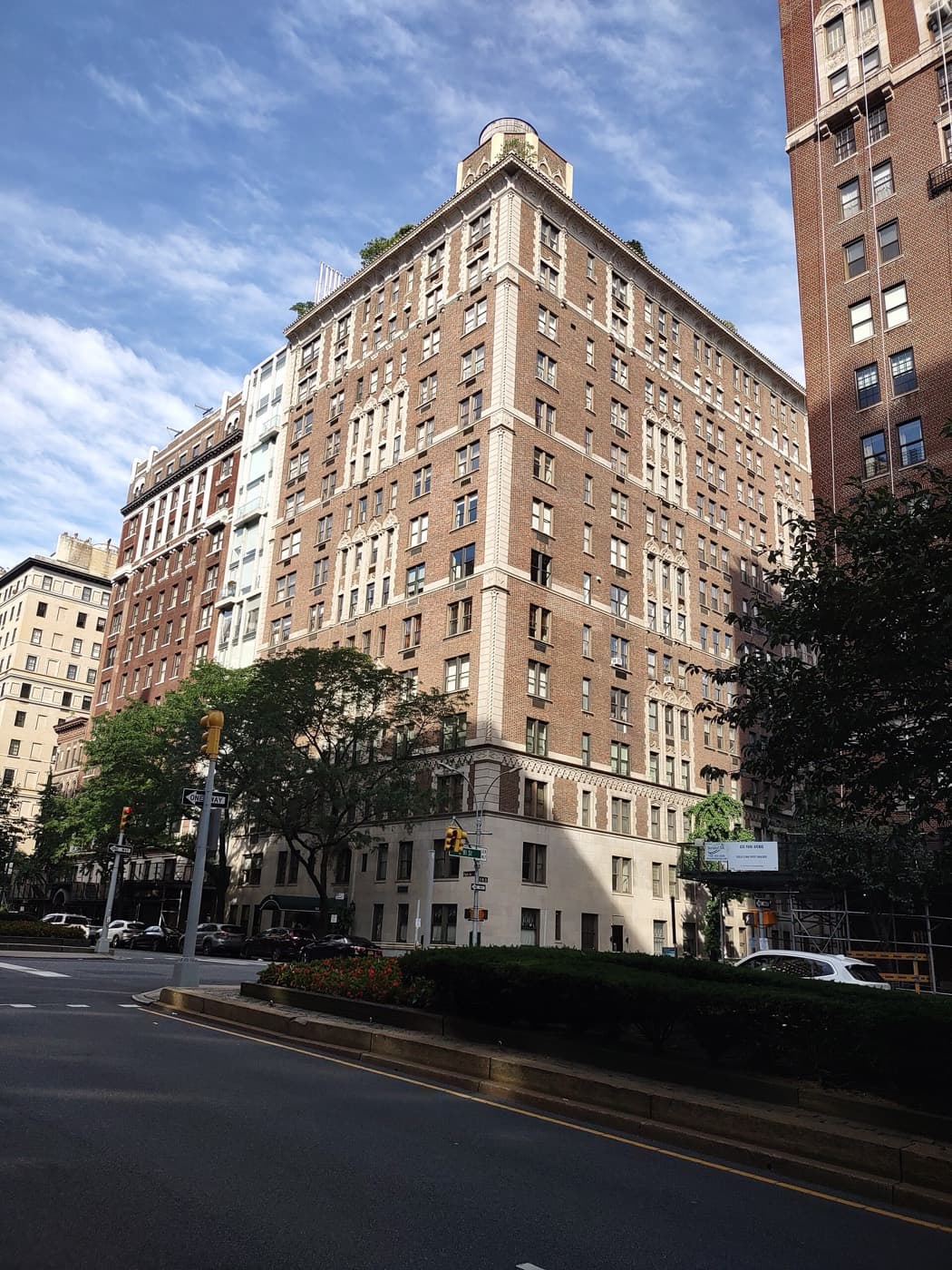
Buildings designed by Schwartz & Gross




The drawings are public. The rest isn't.
How these buildings have actually traded, which lines deliver what the plans promise, and how each board handles financing and approvals.