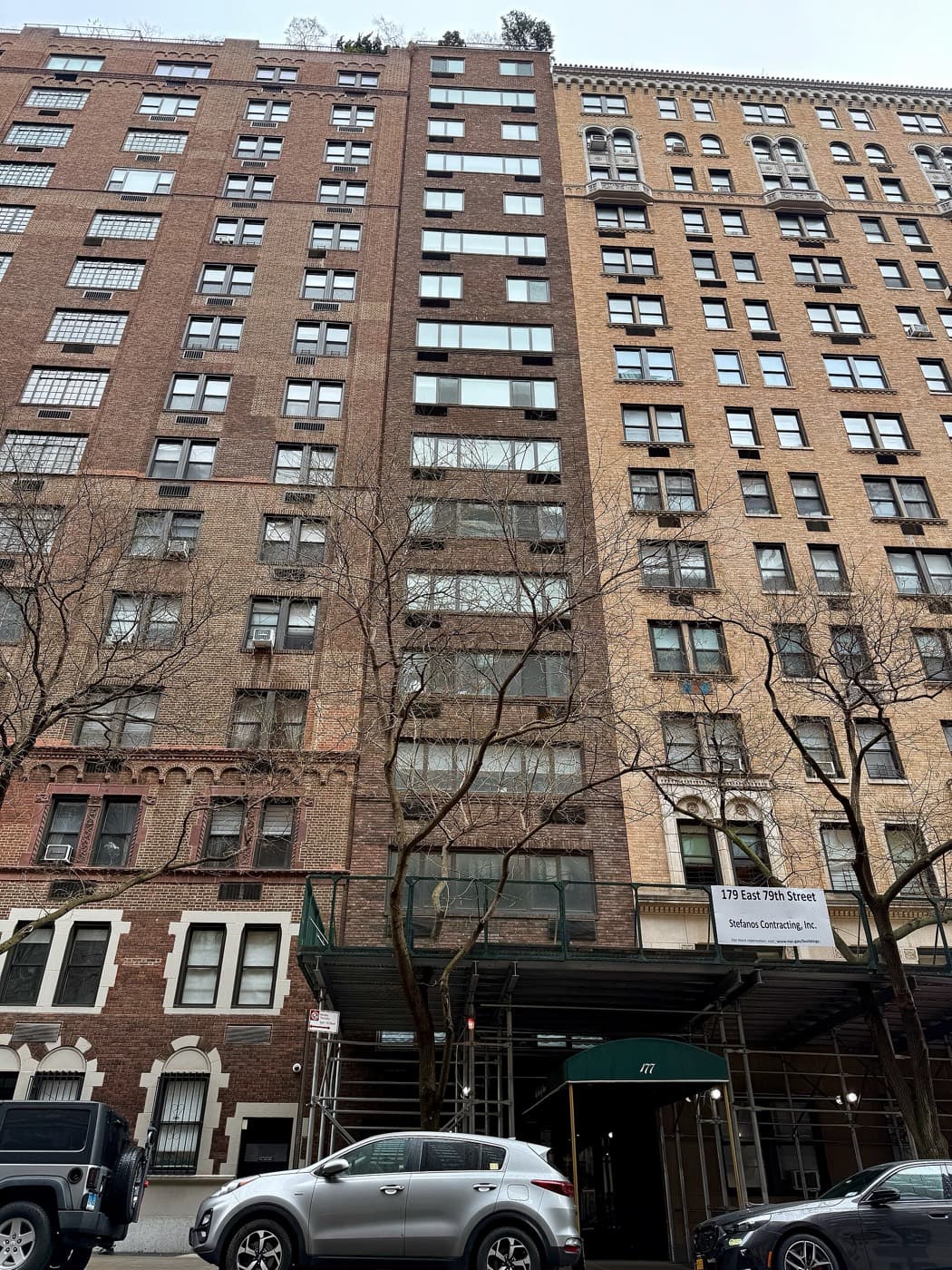
177 East 79th Street
177 East 79th Street, New York, NY 10075
Upper East Side
BBL 1015080130 · BIN 1047498
- Year built
- 1980
- Type
- Cooperative
- Landmark
- No
Every recorded sale at this building, 2003–2025
Price-per-square-foot over time, the line- and floor-premium curves, and every recorded sale.
- Median $/sf
- $1,000
- Listing discount
- 0.6%
- Recorded sales
- 21
- On record
- 2003–2025
Own an apartment here? See what it would sell for.
A Private Pricing Opinion — what your apartment at 177 East 79th Street would likely sell for today, what it costs to sell, and what you’d walk away with — reviewed personally against condition, exposures, renovation quality, and the competition actually on the market.
177 East 79th Street is an unusual and quietly desirable cooperative: a narrow, 17-story mid-block tower built in 1980 that contains just 15 residences, each occupying a full floor (or, higher up, two). The defining feature is privacy — a keyed elevator opens directly into each home, so there is no shared hallway and no neighbor across the landing. For buyers who want the feeling of a private floor-through apartment with the convenience and security of an elevator building, this is a rare configuration on the Upper East Side, and it is the reason the building trades on exclusivity rather than amenity.
The siting is prime Carnegie Hill. East 79th Street is one of the neighborhood's "double" cross-streets — wide and well-trafficked in the best sense — and the building sits between Lexington and Third Avenues, a few blocks from Central Park, Museum Mile, and the boutiques of Madison Avenue. It is a post-war building in a pre-war neighborhood, which means it offers the practical advantages that the surrounding 1920s co-ops cannot: in-unit washer/dryers, modern systems, and floor plans engineered without the structural quirks of older stock.
What you trade for that exclusivity is scale and staffing. With only 15 apartments, there is no 24-hour doorman and no amenity suite; the building runs lean, with a live-in superintendent and part-time weekday door coverage. That structure suits the building's character — a small, private, owner-occupied house for buyers who prize the keyed-elevator floor-through over a lobby full of staff.
Architecture and unit composition
The building is a slim, dark brown-brick infill tower — the kind of narrow mid-block apartment house that 1980 East Side development produced when a single lot came available between pre-war neighbors. A canopied entrance marks the address. The architecture is utilitarian rather than ornamental; the value is entirely inside, in the layouts.
The 15 residences are organized for privacy. The lower floors are single full-floor apartments, one per landing, reached by a keyed elevator that opens directly into the home. The upper floors are configured as duplexes, giving those residences two levels of living space with internal stairs. Every apartment is a through-floor plan with light on multiple exposures, generous proportions for a building of this size, and the modern conveniences — in-unit laundry chief among them — that distinguish it from the neighborhood's pre-war co-ops. A video intercom serves each residence.
Building operations
177 East 79th Street is a small cooperative operated for privacy and predictability. A live-in superintendent handles day-to-day building management, with part-time door staff covering weekday mornings; there is no full-time doorman, which keeps the maintenance structure efficient for a 15-unit building. The keyed-elevator system means common-area circulation is minimal — another reason carrying costs stay contained relative to a staffed full-service tower.
On board policy, the cooperative permits financing up to 75% of the purchase price and charges a 2% flip tax, paid at closing. The building is pet-friendly, and pied-à-terre purchases are permitted — a notable and buyer-friendly stance, since many East Side co-ops prohibit non-primary-residence ownership. In-unit washer/dryers are already installed throughout, removing a common renovation hurdle. As with any cooperative, purchases require a board application and interview, and the small share count means each transfer matters to the building's financial picture.
Local Law 97
- 2024–2029 annual penalty
- $0 (under cap)
- 2030–2034 annual penalty
- $7,488/yr
- Per unit / month range
- $0 – $42
Source: NYC LL84 benchmarking and PLUTO · The Roebling Research Library. City record last verified September 2026.
See full Local Law 97 analysis — emissions history, scenarios, methodology →Facade safety — Local Law 11
The latest available filing classified the facade as SWARMP — Safe With A Repair and Maintenance Program: the engineer identified conditions requiring monitoring or repair before the next inspection cycle. The scope, timeline, and how the building funds the work are building-specific — we review the filings and board materials for you.
How to read this, and where it comes from
QEWI = Qualified Exterior Wall Inspector — the licensed engineer the city requires to sign the report (the independent expert, not the managing agent).
Penalties shown are amounts DOB assessed against filings on record across 2005–10 to 2020–25. The FISP dataset does not record whether they were paid, contested or remain open, so treat the figure as history rather than a current balance and confirm the building’s standing with the managing agent.
Source: NYC DOB facade filings (FISP) · The Roebling Research Library. City record last verified September 2026.
Recent sales
Recent transfers at this building, curated by The Roebling Team research desk. Prices are the transfer amounts recorded with the NYC Department of Finance; apartment-level detail is checked against the building’s own file in The Roebling Research Library before publishing.
| Date | Unit | Apartment | Price | PPSF | vs. Ask |
|---|---|---|---|---|---|
| Aug 13, 2025 | 16 | 3 BR · 2 BA | $1,875,000 | -1.1% | |
| Sep 12, 2024 | 14 | 3 BR · 2 BA | $1,850,000 | -2.4% | |
| May 3, 2023 | 5 | 2 BR · 2 BA · 1,585 sf | $1,585,000 | $1,000/sf | -6.5% |
| Dec 17, 2021 | 9 | 2 BR · 2 BA · 1,585 sf | $1,800,000 | $1,136/sf | +0.0% |
| Oct 2, 2019 | 6A | 2 BR · 2 BA · 1,585 sf | $1,555,000 | $981/sf | -4.3% |
| Sep 26, 2016 | 4 | 2 BR · 2 BA · 1,585 sf | $1,800,000 | $1,136/sf | -4.0% |
| Apr 27, 2016 | 16 | 3 BR · 1,700 sf | $2,182,000 | $1,284/sf | -0.6% |
| Jan 21, 2016 | 9 | 2 BR · 1,585 sf | $1,940,000 | $1,224/sf | +4.9% |
Market read. $/sf is measured on the latest sales with reliable square footage (2023): a median $1,000/sf across 1 sale. The building has traded as recently as 2025. Median listing discount 0.6% from the last ask — a recurring negotiation gap worth pricing into any offer or listing strategy.
The retrade record
Lines that have traded more than once in the public record — the building’s appreciation arc, apartment by apartment.
Full closing history with price-per-square-foot over time, the complete retrade record, and every line that has traded.
Sales sourced from NYC Department of Finance recorded transfers (BBL 1-01508-0130) and verified listing data. Apartment-level facts (line, condition, asking-price context) curated and cross-verified by The Roebling Team research desk. Not all transactions cross-verify with ACRIS records — sponsor and LLC purchases sometimes record at stipulated values rather than market price; square footage on co-ops is not officially recorded, figures shown are approximate.
What to know if you’re buying
You are buying privacy and format. The keyed-elevator, full-floor (or duplex) plan is the headline — no shared hallways, your own private landing, light on multiple sides, and in-unit laundry already in place. The financing allowance of 75% is reasonable for the neighborhood, the 2% flip tax is standard and falls to the seller, and the building's acceptance of pied-à-terre ownership and pets widens its appeal to buyers who would be screened out elsewhere.
Underwrite it as a small co-op: review the financials, reserves, and any planned capital work — facade, elevator, mechanicals — in your board package, since fixed costs in a 15-unit building are spread across few shareholders. Expect a board application and interview. For a buyer who wants a private floor in Carnegie Hill without a townhouse's maintenance burden, and who does not need a 24-hour doorman, this building delivers a configuration that is genuinely hard to replicate.
What to know if you’re selling
Sell the floor-through privacy and the policy flexibility. The keyed elevator opening into a single private residence, the full-floor or duplex layout, in-unit laundry, pet-friendliness, permitted pied-à-terre use, and 75% financing together describe a building that competes for a specific, motivated buyer — and there are very few comparable products nearby. Scarcity is your ally: with 15 apartments, supply is structurally limited.
Benchmark to full-floor and duplex co-op residences in Carnegie Hill and the surrounding East 70s and 80s, not to standard line-by-line apartments in larger buildings. Emphasize light, the private-landing arrival experience, and the move-in practicality of a post-war building in a pre-war neighborhood. A well-presented listing with a clean board-package narrative tends to find its buyer efficiently given how rarely these homes come available.
Comparable buildings
If you're considering 177 East 79th Street, these nearby Carnegie Hill and East 70s–80s cooperatives offer useful points of comparison:
- 173 East 79th Street — cooperative on the same block
- 151 East 79th Street — Carnegie Hill co-op a few doors west
- 161 East 79th Street — East 79th Street cooperative nearby
- 136 East 79th Street — pre-war East 79th Street co-op
- 180 East 79th Street — full-service co-op directly across the street
The neighborhood
For the full corridor — architecture, schools, transit, and pricing across Upper East Side — read The Roebling Team Guide to Upper East Side.
The full playbook — what goes in the package, how boards read your financials, the interview, and the timeline — plus sample cover, reference, and personal letters you can adapt.
How to read the facts on this page. Items attributed to an offering plan describe the building as it was offered at that filing — unit mix, square footage, the amenity program as planned. They are not a statement about how the building operates today. Tax and compliance figures are sourced separately to current City records and carry their own dates. House rules, staffing and fee policy can change by board resolution without any public filing: treat every policy line here as a starting point for diligence and confirm it with the managing agent. Where this page compares one building or neighborhood to another, that is our analysis of the recorded record — it names the measure, the period and the sample it rests on, and it is an observation about medians rather than a prediction about any particular apartment.
Considering a move at 177 East 79th Street?
Request a private building brief with the relevant comparable sales, current and off-market availability, and an apartment-specific view of value.