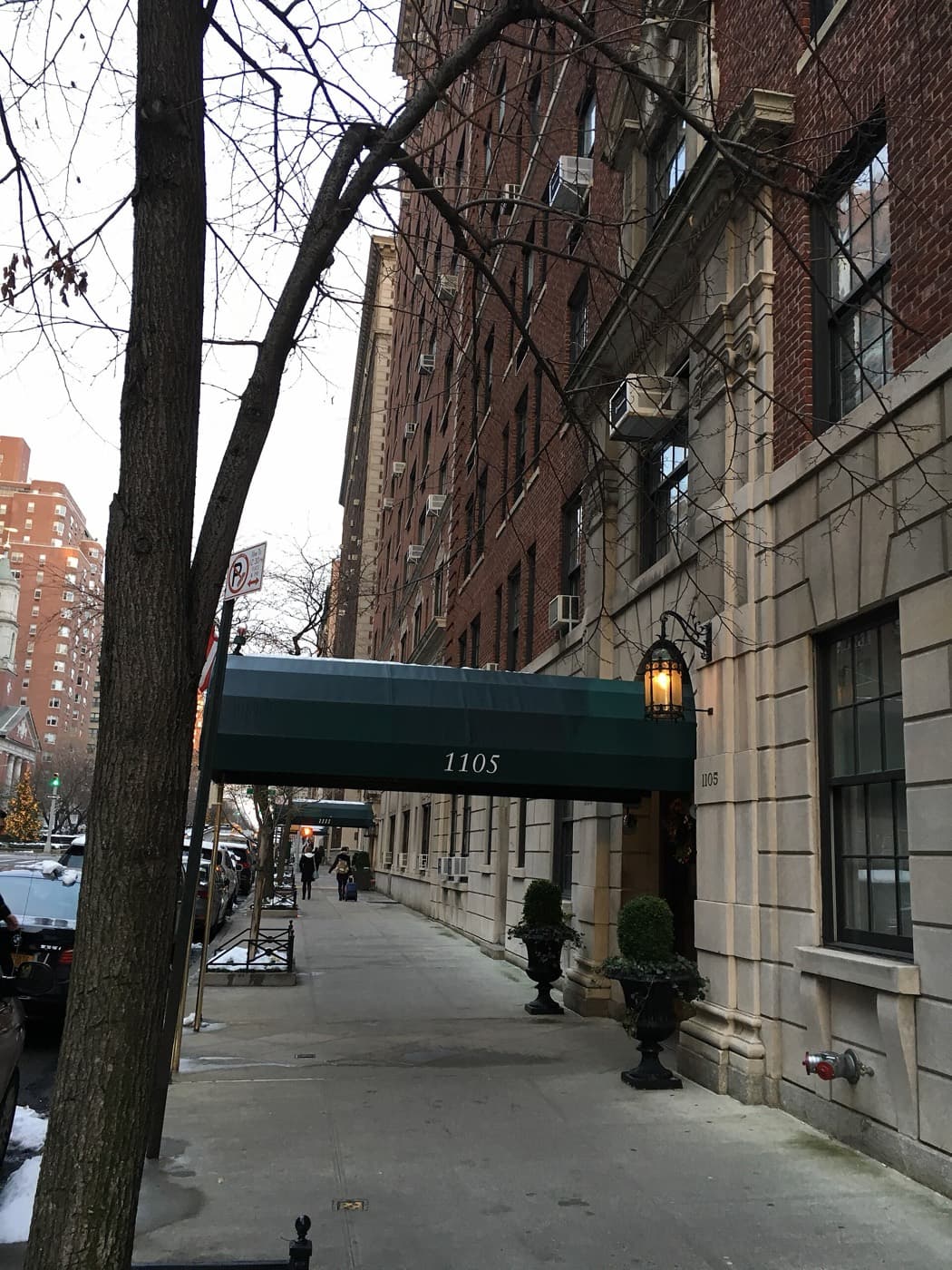
1105 Park Avenue
1105 Park Avenue, New York, NY 10128
Carnegie Hill, Upper East Side
BBL 1015180001 · BIN 1048105
- Year built
- 1923
- Type
- Cooperative
- Units
- 57
- Landmark
- Designated
Every recorded sale at this building, 2004–2026
Bedroom-by-bedroom medians, the full transfer record, and how units trade against ask.
- 3BR median
- $3.2M
- Recent range
- $2.3M – $4.5M
- Listing discount
- 6.1%
- Recorded transfers
- 32
Own an apartment here? See what it would sell for.
A Private Pricing Opinion — what your apartment at 1105 Park Avenue would likely sell for today, what it costs to sell, and what you’d walk away with — reviewed personally against condition, exposures, renovation quality, and the competition actually on the market.
1105 Park Avenue carries one of the most valuable architectural attributions in residential New York: it is an early Rosario Candela design, completed in 1923 at the northeast corner of Park and 89th Street. Candela would go on to author the most coveted apartment houses on Park and Fifth in the late 1920s and early 1930s — 740 Park, 770 Park, 834 and 960 Fifth among them — and 1105 belongs to the formative phase of that career, before the celebrated terraced setbacks but already showing the proportion and detail that defined his work.
The building sits squarely in Carnegie Hill, the stretch of Park Avenue north of 86th that became one of the city's premier family residential enclaves. Built for the Paterno family — developers whose name is attached to a remarkable share of the era's best buildings — 1105 was designed as a serious cooperative-grade apartment house from the start, with the limestone base, ornamented entrance, and red-brick body that signal pre-war Park Avenue pedigree. The sculptural figures flanking the entrance, supporting a broken pediment, are among the building's most identifiable features.
The building converted to cooperative ownership in 1951 and today sits within the Park Avenue Historic District, designated in 2014. For a buyer, 1105 offers what the best Carnegie Hill co-ops do — a Candela name, gracious pre-war layouts, and serious full-time service — paired with a comparatively flexible board posture: pets are welcome and in-unit washer/dryers are permitted, neither of which can be taken for granted on this stretch of Park.
Architecture and unit composition
The exterior is textbook pre-war Park Avenue: a limestone base, a red-brick body, and an ornamented limestone entrance distinguished by sculptural figures supporting a broken pediment — a flourish that marks 1105 out from its more austere neighbors. Candela's hand shows in the proportion and the disciplined fenestration even at this early point in his career.
Inside, the apartments deliver the layouts that make Candela buildings perennially desirable: gracious entry galleries, separated public and private wings, high ceilings, and the generous room counts of solid 1920s construction. With roughly 57 apartments across 14 floors, the building runs only a few homes to a landing — a low-density plan that produces privacy, quiet, and large floor plates. In-unit washer/dryers are permitted, a meaningful modern convenience in a building of this vintage.
Building operations
1105 Park Avenue is a full-service pre-war cooperative. Service includes a 24-hour doorman and concierge and a live-in resident manager. Amenities run deep for a building this size: a fitness center, a central laundry room, a bike room, and private storage for residents. The cooperative is pet-friendly, in-unit washer/dryers are allowed, and financing is permitted up to 50% of the purchase price. A 2% flip tax applies on resale and is paid by the buyer — an arrangement worth noting in any offer math, since it differs from the more common seller-paid structure. Several commercial garages are available within a short walk.
Local Law 97
- 2024–2029 annual penalty
- $0 (under cap)
- 2030–2034 annual penalty
- $2,838/yr
- Per unit / month range
- $0 – $4
Source: NYC LL84 benchmarking and PLUTO · The Roebling Research Library. City record last verified September 2026.
See full Local Law 97 analysis — emissions history, scenarios, methodology →Facade safety — Local Law 11
The latest available FISP filing classified the facade as Safe — no repairs were required at that inspection. Facade inspections run on a fixed five-year cycle; future inspection, repair, and any assessment decisions remain building-specific.
How to read this, and where it comes from
QEWI = Qualified Exterior Wall Inspector — the licensed engineer the city requires to sign the report (the independent expert, not the managing agent).
Source: NYC DOB facade filings (FISP) · The Roebling Research Library. City record last verified September 2026.
Management & transfer contacts
- Flip tax
- 2% of purchase price
- Sublet policy
- Case-by-case, strongly discouraged
Recent sales
Recent transfers at this building, curated by The Roebling Team research desk. Prices are the transfer amounts recorded with the NYC Department of Finance; apartment-level detail is checked against the building’s own file in The Roebling Research Library before publishing.
| Date | Unit | Apartment | Price | PPSF | vs. Ask |
|---|---|---|---|---|---|
| Apr 14, 2026 | 6D | 2 BR · 3 BA | $2,300,000 | -6.1% | |
| Apr 28, 2025 | 9C | 3 BR · 3 BA | $2,999,500 | +3.4% | |
| Oct 3, 2023 | 10C | 3 BR · 2.5 BA | $3,500,000 | -7.8% | |
| Oct 3, 2023 | 12A | 3 BR · 3 BA | $4,500,000 | -9.9% | |
| Jun 28, 2023 | 8C | 3 BR · 3 BA | $2,585,000 | -2.5% | |
| Apr 28, 2022 | 5CD | 4 BR · 4 BA · 4,223 sf | $7,325,000 | $1,735/sf | -4.2% |
| Sep 30, 2021 | 12D | 3 BR · 2 BA · 1,800 sf | $2,640,000 | $1,467/sf | +1.7% |
| Jun 28, 2021 | 4C | 3 BR · 3 BA · 2,200 sf | $2,300,000 | $1,045/sf | -13.2% |
Market read. $/sf is measured on the latest sales with reliable square footage (2022): a median $1,791/sf across 1 sale. The building has traded as recently as 2026. Median listing discount 5.4% from the last ask — a recurring negotiation gap worth pricing into any offer or listing strategy.
The retrade record
Lines that have traded more than once in the public record — the building’s appreciation arc, apartment by apartment.
Other recent transfers
| Date | Unit | Price |
|---|---|---|
| Nov 4, 2004 | 13B | $1,350,000 |
Full closing history with price-per-square-foot over time, the complete retrade record, and every line that has traded.
Sales sourced from NYC Department of Finance recorded transfers (BBL 1-01518-0001) and verified listing data. Apartment-level facts (line, condition, asking-price context) curated and cross-verified by The Roebling Team research desk. Not all transactions cross-verify with ACRIS records — sponsor and LLC purchases sometimes record at stipulated values rather than market price; square footage on co-ops is not officially recorded, figures shown are approximate.
What to know if you’re buying
This is a pre-war cooperative, so a purchase clears a full board package and interview, and buyers should plan for a 50% financing cap — at least half the purchase price in cash. The board is comparatively accommodating in other respects: pets are welcome and in-unit washer/dryers are permitted, both genuine advantages on Park Avenue. Note the flip-tax structure carefully — at 1105 the 2% flip tax is paid by the buyer at closing, not the seller, so it should be built into the offer math from the outset.
The Candela attribution and the large pre-war layouts are the assets to underwrite. High floors, original detail, and quality renovations command the premium. We help buyers read the package, benchmark the exact line, account for the buyer-paid flip tax, and structure an offer the board will approve.
What to know if you’re selling
The marketing leads with the name: an early Rosario Candela building on Carnegie Hill, with a distinctive sculptural entrance and gracious pre-war layouts inside the Park Avenue Historic District. That pedigree is a durable differentiator against the avenue's plainer pre-war stock. Pair it with the deep service package — 24-hour doorman and concierge, resident manager, fitness center — and the board's pet- and washer/dryer-friendly posture.
Price against the Carnegie Hill and Park Avenue pre-war co-op set, positioning high-floor and renovated homes at the top of the building's range. The buyer-paid flip tax is a point to handle proactively in negotiations. We position each line against its true comparable set and manage the board process from accepted offer through closing.
Comparable buildings
If you're considering 1105 Park Avenue, also evaluate these nearby Carnegie Hill and Park Avenue co-ops:
- 1100 Park Avenue — pre-war Park Avenue co-op directly across the street
- 1110 Park Avenue — Carnegie Hill pre-war co-op nearby
- 1120 Park Avenue — full-service pre-war Park Avenue peer
- 1125 Park Avenue — Carnegie Hill pre-war co-op to the north
- 1085 Park Avenue — pre-war Park Avenue co-op a few blocks south
- 1095 Park Avenue — Carnegie Hill pre-war peer nearby
The neighborhood
For the full corridor — architecture, schools, transit, and pricing across Park Avenue — read The Roebling Team Guide to Park Avenue.
The full playbook — what goes in the package, how boards read your financials, the interview, and the timeline — plus sample cover, reference, and personal letters you can adapt.
How to read the facts on this page. Items attributed to an offering plan describe the building as it was offered at that filing — unit mix, square footage, the amenity program as planned. They are not a statement about how the building operates today. Tax and compliance figures are sourced separately to current City records and carry their own dates. House rules, staffing and fee policy can change by board resolution without any public filing: treat every policy line here as a starting point for diligence and confirm it with the managing agent. Where this page compares one building or neighborhood to another, that is our analysis of the recorded record — it names the measure, the period and the sample it rests on, and it is an observation about medians rather than a prediction about any particular apartment.
Considering a move at 1105 Park Avenue?
Request a private building brief with the relevant comparable sales, current and off-market availability, and an apartment-specific view of value.