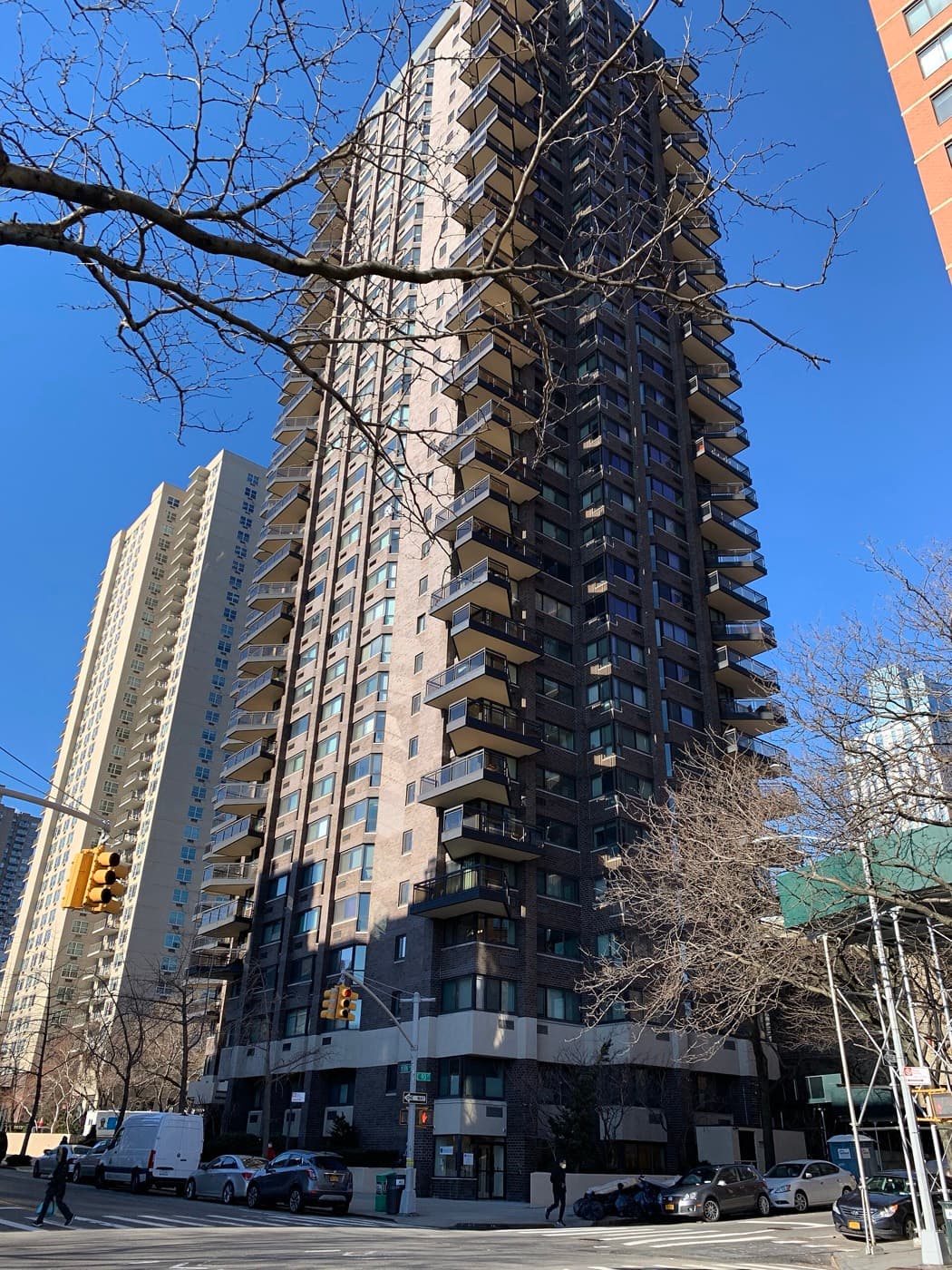
East River Tower (1725 York Avenue)
1725 York Avenue, New York, NY 10128
Yorkville, Upper East Side
BBL 1015690016 · BIN 1050634
- Year built
- 1971
- Type
- Cooperative
- Units
- 259
- Landmark
- No
- Pets
- Pet-friendly
- Flip tax
- 1.75%, paid by the buyer
Every recorded sale at this building, 2003–2026
Price-per-square-foot over time, the line- and floor-premium curves, and every recorded sale.
- Median $/sf
- $943
- Listing discount
- 3.0%
- Recorded sales
- 235
- On record
- 2003–2026
Own an apartment here? See what it would sell for.
A Private Pricing Opinion — what your apartment at East River Tower would likely sell for today, what it costs to sell, and what you’d walk away with — reviewed personally against condition, exposures, renovation quality, and the competition actually on the market.
1725 York Avenue — East River Tower — is one of the most visually distinctive towers in Yorkville. Built in 1971 and converted to a cooperative in 1984, the building is immediately identifiable by its zig-zag pattern of cantilevered corner balconies, which step diagonally up the facade and give the tower an aggressive, almost kinetic profile rarely seen in the era's otherwise plain masonry construction. Where most early-1970s York Avenue towers settled for utilitarian massing, East River Tower made its balcony geometry the architectural statement — and that geometry remains its signature on the Yorkville skyline.
The building sits at Yorkville's far eastern edge, the quiet residential band near Carl Schurz Park, Gracie Mansion, and the East River esplanade, with Asphalt Green's pool and athletic facilities a short walk north. This is the Upper East Side at its most neighborhood-scaled: low traffic, green space at the river, and a stock of post-war co-ops that have long offered Upper East Side living at more accessible pricing than the Park, Fifth, and Madison axis to the west. The 1984 conversion gave the building a genuine co-op governance structure and an established shareholder base.
For buyers, the proposition is specific: real cooperative ownership at post-war scale, a genuinely deep amenity set for the price tier — two tennis courts, a fitness center, and an attended garage — private outdoor space on the balconied lines, a pet-friendly policy, and a tranquil riverside Yorkville location.
Architecture and unit composition
The defining feature is the balcony program: cantilevered corner balconies arranged in a staggered, zig-zag rhythm that animates the facade and gives many apartments genuine private outdoor space — an amenity that commands a premium in any Manhattan co-op and is comparatively scarce in the Yorkville post-war stock. Corner lines on some floors carry wraparound balconies. Beyond the balconies, the building is an efficient early-1970s masonry high-rise: vertical massing, practical floor plates, and apartment volume across 33 stories.
The roughly 259 apartments span studios and one-bedrooms through larger two- and three-bedroom configurations. Post-war interior signatures run throughout: 8-to-9-foot ceilings, large operable windows, practical layouts (many renovated since conversion), and ample closets. Upper-floor and eastern-facing lines capture open East River, bridge, and Carl Schurz Park exposures; the balcony lines compound that view value with usable terrace space. Balcony presence varies by line, and the apartments with private outdoor space carry a clear premium in the building.
Building operations
East River Tower operates as a full-service post-war cooperative with a full-time doorman, two tennis courts, a fitness center, a 24-hour attended garage with a circular driveway and direct building access, a children's playroom, bike storage, and on-site laundry. The building is pet-friendly. The roughly 259-unit scale supports genuine full-time staffing and the operating budget a tower of this size requires.
Because the building converted to cooperative ownership in 1984, the substantive diligence items are the co-op's financials: reserve adequacy, recent and planned capital work — including balcony and facade maintenance, which is structurally important given the cantilevered balcony program, and Local Law 97 compliance planning common to towers of this vintage — and any current assessments. The building applies a 1.75% flip tax, paid by the buyer at closing.
Local Law 97
- 2024–2029 annual penalty
- $0 (under cap)
- 2030–2034 annual penalty
- $0 (under cap)
- Per unit / month range
- —
Source: NYC LL84 benchmarking and PLUTO · The Roebling Research Library. City record last verified September 2026.
See full Local Law 97 analysis — emissions history, scenarios, methodology →Facade safety — Local Law 11
The latest available filing classified the facade as SWARMP — Safe With A Repair and Maintenance Program: the engineer identified conditions requiring monitoring or repair before the next inspection cycle. The scope, timeline, and how the building funds the work are building-specific — we review the filings and board materials for you.
How to read this, and where it comes from
QEWI = Qualified Exterior Wall Inspector — the licensed engineer the city requires to sign the report (the independent expert, not the managing agent).
Source: NYC DOB facade filings (FISP) · The Roebling Research Library. City record last verified September 2026.
Management & transfer contacts
- Flip tax
- 1.75% of purchase price (buyer)
- Sublet policy
- 10% of annual rent per year of sublease; move-in/out $2,000
- Notable fees
- Move-in $1,000; transfer fee $750; NYS transfer tax stamps $0.05/share
Recent sales
Recent transfers at this building, curated by The Roebling Team research desk. Prices are the transfer amounts recorded with the NYC Department of Finance; apartment-level detail is checked against the building’s own file in The Roebling Research Library before publishing.
| Date | Unit | Apartment | Price | PPSF | vs. Ask |
|---|---|---|---|---|---|
| Jul 30, 2026 | 33H | 1 BR · 1.5 BA · 950 sf | $985,000 | $1,037/sf | +0.0% |
| Apr 28, 2026 | 26E | 2 BR · 2 BA · 1,350 sf | $1,350,000 | $1,000/sf | -1.8% |
| Feb 13, 2026 | 15D | 1 BR · 1.5 BA | $977,500 | -0.8% | |
| Nov 13, 2025 | 14A | 1 BR · 1 BA · 750 sf | $550,000 | $733/sf | -6.0% |
| Aug 4, 2025 | 33E | 2 BR · 2 BA · 1,300 sf | $1,275,000 | $981/sf | +0.0% |
| Jul 8, 2025 | 7D | 1 BR · 1.5 BA · 1,000 sf | $920,000 | $920/sf | -6.6% |
| Dec 17, 2024 | 7A | 1 BR · 1 BA · 750 sf | $610,000 | $813/sf | -5.4% |
| Dec 17, 2024 | 12G | 2 BR · 1 BA | $870,000 | -2.8% |
Market read. Most recent trades (2026) cleared a median $943/sf across 2 sales. Median listing discount 3.0% from the last ask — a recurring negotiation gap worth pricing into any offer or listing strategy.
The retrade record
Lines that have traded more than once in the public record — the building’s appreciation arc, apartment by apartment.
Full closing history with price-per-square-foot over time, the complete retrade record, and every line that has traded.
Sales sourced from NYC Department of Finance recorded transfers (BBL 1-01569-0016) and verified listing data. Apartment-level facts (line, condition, asking-price context) curated and cross-verified by The Roebling Team research desk. Not all transactions cross-verify with ACRIS records — sponsor and LLC purchases sometimes record at stipulated values rather than market price; square footage on co-ops is not officially recorded, figures shown are approximate.
What to know if you’re buying
This is a genuine post-war cooperative. Expect a board package, financial review, and co-op interview. Strong financials and primary-residence intent help.
Budget for the flip tax. The building applies a 1.75% flip tax paid by the buyer — factor it into your closing costs.
The amenity set is unusually deep for the tier. Two tennis courts, a fitness center, an attended garage, a playroom, and a pet-friendly policy come with the building — rare in this price band.
Balconies are the building's edge. Private outdoor space is the building's scarcest feature, present on the corner and staggered lines that carry the zig-zag program; the balconied high-floor river lines command the building's top prices.
Scrutinize the building's capital posture. The cantilevered balcony program and facade demand ongoing maintenance; review reserves, recent and planned capital work, and any assessments with your attorney.
The riverside Yorkville setting is the lifestyle. Carl Schurz Park, the East River esplanade, Asphalt Green, and a quiet residential pace are the location's draw.
What to know if you’re selling
Lead with the balconies, the views, and the amenities. Private outdoor space, open river/park exposures, and the tennis-courts-and-garage package are the building's marketing assets; high-floor balconied lines should be positioned accordingly.
Set expectations on the buyer-paid flip tax. The 1.75% flip tax is the buyer's cost here — useful to flag early in negotiation.
Apartment-level positioning drives price. Floor, exposure, balcony presence, layout, and renovation quality move value far more than building-wide averages.
Closing timelines are co-op standard. Plan for roughly 6–10 weeks from contract signing to closing, plus board package preparation and interview.
Comparable buildings
If you're considering East River Tower, also evaluate:
- 60 East End Avenue — eastern Upper East Side full-service co-op
- Ruppert Yorkville Towers — large Yorkville residential complex
- 1628 Second Avenue — a 14-unit boutique Yorkville condominium
- 425 East 86th Street — Yorkville full-service building
The neighborhood
For the full corridor — architecture, schools, transit, and pricing across Upper East Side — read The Roebling Team Guide to Upper East Side.
The full playbook — what goes in the package, how boards read your financials, the interview, and the timeline — plus sample cover, reference, and personal letters you can adapt.
How to read the facts on this page. Items attributed to an offering plan describe the building as it was offered at that filing — unit mix, square footage, the amenity program as planned. They are not a statement about how the building operates today. Tax and compliance figures are sourced separately to current City records and carry their own dates. House rules, staffing and fee policy can change by board resolution without any public filing: treat every policy line here as a starting point for diligence and confirm it with the managing agent. Where this page compares one building or neighborhood to another, that is our analysis of the recorded record — it names the measure, the period and the sample it rests on, and it is an observation about medians rather than a prediction about any particular apartment.
Considering a move at East River Tower?
Request a private building brief with the relevant comparable sales, current and off-market availability, and an apartment-specific view of value.