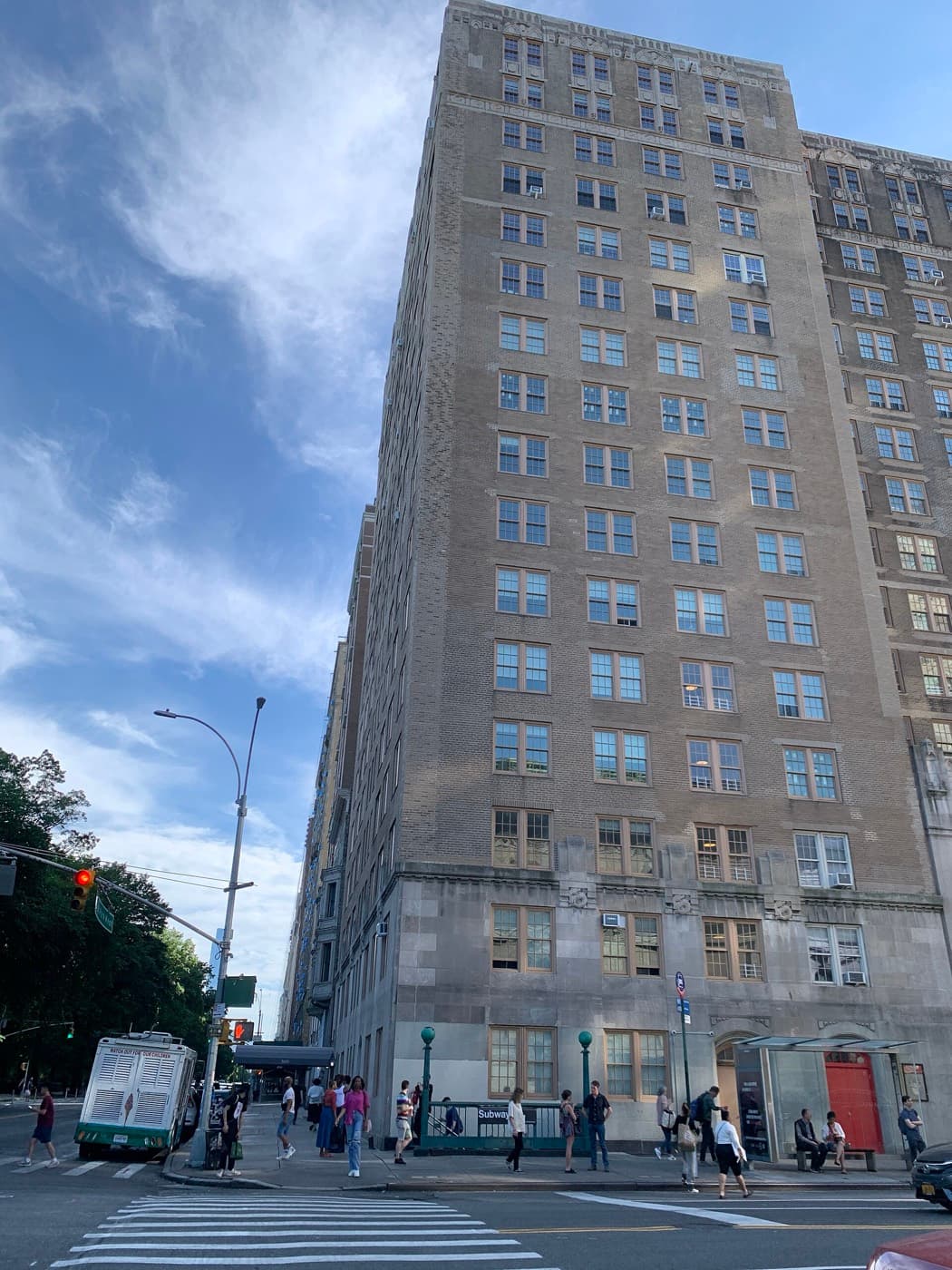
360 Central Park West
360 Central Park West, New York, NY 10025
Upper West Side
BBL 1012097502 · BIN 1031728
- Year built
- 1929
- Type
- Condominium
- Units
- 146
- Floors
- 16
- Landmark
- In a historic district
- Pets
- Permitted under condominium rules; a dedicated pet-grooming station is provided
- Subletting
- Permitted under the condominium declaration
- Pied-à-terre
- Allowed
Every recorded sale at this building, 2013–2026
Price-per-square-foot over time, the line- and floor-premium curves, and every recorded sale.
- Median $/sf (floor-adjusted)
- $1,889
- Listing discount
- 0.0%
- Recorded sales
- 73
- On record
- 2013–2026
Own an apartment here? See what it would sell for.
A Private Pricing Opinion — what your apartment at 360 Central Park West would likely sell for today, what it costs to sell, and what you’d walk away with — reviewed personally against condition, exposures, renovation quality, and the competition actually on the market.
360 Central Park West is the Candela condominium that shouldn't exist. Rosario Candela — the architect whose name is synonymous with the pre-war Manhattan cooperative, whose Fifth Avenue and Park Avenue towers define the ceiling of the co-op market — designed almost exclusively for buildings that would trade as cooperatives, with the board approvals, financing caps, and use restrictions that tenure implies. 360 Central Park West is the exception. Completed in 1929 and operated for most of its life as a stabilized rental building, it was reconstructed and converted to a 146-unit condominium in 2017. The result is the only pre-war Candela address on Central Park West that a buyer can acquire with condominium flexibility rather than co-op board approval.
That combination — Candela pedigree, Central Park West frontage, and condominium tenure — is genuinely scarce. Buyers who want the pre-war architectural language of the avenue's great cooperatives (The Beresford, The San Remo, The Eldorado) but who need the financing latitude, pied-à-terre allowance, and resale mechanics of a condominium have very few options on Central Park West. 360 is one of them.
The building's origin story is architecturally distinct. It sits on the former site of the Second Scotch Presbyterian Church, and Candela's design incorporated the church's chapel into the base — one of three "skyscraper church" apartment houses he executed with the builders Rothschild and Slattery in the late 1920s, a Depression-era financing model that paired a congregation's land value with a developer's apartment tower. The twin-tower massing rising above a shared masonry base is a direct product of that hybrid program.
The 2017 conversion, led by CetraRuddy Architects for sponsor Argo Real Estate, reconstructed the interiors to modern condominium standard while preserving the pre-war exterior and its position within the Upper West Side / Central Park West Historic District. Three roughly 4,000-square-foot penthouses with private setback terraces were created at the top of the building during the conversion.
For buyers, 360 Central Park West occupies a specific and defensible position: pre-war Candela architecture on the park-facing avenue, at the more residential northern end of the corridor around West 96th Street, with condominium tenure rather than the co-op board culture that governs almost every comparable pre-war address on Central Park West.
Architecture and unit composition
The building's 146 residences are distributed across a 16-story pre-war frame arranged as twin towers above a shared base. Candela's original 1929 plan and the 2017 CetraRuddy reconstruction together produce apartments with pre-war proportions — generous room dimensions, high ceilings, and hard-wall layouts — updated with modern systems, kitchens, and baths.
Unit composition spans studios and one-bedrooms through larger family layouts, with the three penthouse residences (each approximately 4,000 sf, with private setback terraces) at the top of the range. Park exposure is meaningful on the east-facing side of the building, which fronts Central Park West directly; the corner position at West 96th Street produces open sightlines to the north and toward the park.
Because the building is a true condominium, pricing is best read on a price-per-square-foot basis, in the pattern of the avenue's other condominium inventory rather than the price-per-room convention used at the surrounding cooperatives.
Building operations
360 Central Park West operates as a full-service condominium with an attended lobby, full-time door staff, and a resident manager. The amenity program — children's playroom, fitness center, pet-grooming station, private resident storage, and bicycle storage — is scaled to a family-oriented Upper West Side building rather than to the trophy-tower amenity arms race of the Billionaires' Row supertalls.
As a 2017 conversion of a 1929 building, 360 combines pre-war structure with recently reconstructed interiors and systems. Buyers should review the sponsor's offering plan, the reserve study, recent financial statements, and board minutes during due diligence — the standard diligence set for any recent conversion, where the interplay of original building age and conversion-era work warrants attention.
Facade safety — Local Law 11
The latest available FISP filing classified the facade as Safe — no repairs were required at that inspection. Facade inspections run on a fixed five-year cycle; future inspection, repair, and any assessment decisions remain building-specific.
How to read this, and where it comes from
QEWI = Qualified Exterior Wall Inspector — the licensed engineer the city requires to sign the report (the independent expert, not the managing agent).
Penalties shown are amounts DOB assessed against filings on record across 2005–10 to 2020–25. The FISP dataset does not record whether they were paid, contested or remain open, so treat the figure as history rather than a current balance and confirm the building’s standing with the managing agent.
Source: NYC DOB facade filings (FISP) · The Roebling Research Library. City record last verified September 2026.
Management & transfer contacts
Recent sales
Recent closings at this building, from The Roebling Research Library. Prices are the transfer amounts recorded with the NYC Department of Finance; apartment-level detail is checked against the building’s own file in The Roebling Research Library before publishing.
| Date | Unit | Apartment | Price | PPSF | vs. Ask |
|---|---|---|---|---|---|
| Jul 23, 2026 | 12E | 3 BR · 2.5 BA · 1,923 sf | $3,500,000 | $1,820/sf | -2.1% |
| Jul 15, 2026 | 11C | 2 BR · 2 BA · 1,552 sf | $3,500,000 | $2,255/sf | -6.7% |
| Jul 13, 2026 | 11E | 3 BR · 2.5 BA · 1,923 sf | $3,595,000 | $1,869/sf | +0.0% |
| May 15, 2026 | 2B | 3 BR · 3 BA · 2,077 sf | $3,600,000 | $1,733/sf | -5.1% |
| Mar 18, 2026 | 8A | 4 BR · 2.5 BA · 2,508 sf | $6,850,000 | $2,731/sf | -2.1% |
| Mar 18, 2026 | 11E | 3 BR · 2.5 BA · 1,923 sf | $3,200,000 | $1,664/sf | off-mkt |
| Oct 2, 2025 | 9B | 3 BR · 3.5 BA · 2,324 sf | $5,575,000 | $2,399/sf | off-mkt |
| Jul 2, 2025 | 16K | 2 BR · 2 BA · 1,210 sf | $2,840,000 | $2,347/sf | -1.9% |
Market read. Most recent trades (2026) cleared a median $1,889/sf (floor-adjusted) across 6 sales. Floor-adjusted means each sale is restated to a constant mix of floors, so the figure can differ from the plain median of the sales listed above. Median listing discount 0.0% from the last ask.
The retrade record
Lines that have traded more than once in the public record — the building’s appreciation arc, apartment by apartment.
Full closing history with price-per-square-foot over time, the complete retrade record, and every line that has traded.
Sales sourced from NYC Department of Finance recorded transfers (BBL 1-01209-7502). Apartment-level facts (line, condition, asking-price context) curated and cross-verified in The Roebling Research Library. Not all transactions cross-verify with ACRIS records — sponsor and LLC purchases sometimes record at stipulated values rather than market price; square footage from recorded condo declarations and offering plans.
Closed rents at 360 Central Park West, last 36 months
| Size | Leases | Median / month |
|---|---|---|
| 1 bedroom | 3 | $6,350 |
| 3 bedroom | 2 | $19,250 |
6 closed leases, October 2023 to September 2026. Most recent lease May 2026. Sizes with fewer than 2 leases are not shown. Compiled by The Roebling Team at Compass from closed leases.
At the recent median sale of $3.5M (12 sales since 2024), a buyer putting 25% down would pay about $146,931 to close, or 4.2% of the price.
- Mansion tax: $52,500
- Mortgage recording tax: $50,531
- Title insurance: $15,750
- Attorneys, lender, building fees, reserves and filings: $28,150
Assumes a resale (the seller pays transfer taxes), a $4,500 attorney fee and a mortgage on the rest.
Keep up with 360 Central Park West and its market
The Roebling Report, monthly: Manhattan sales data and analysis, including buildings like 360 Central Park West. Unsubscribe anytime.
We’ll use your email for The Roebling Report and note your interest in this building. See our privacy policy.
What to know if you’re buying
The Candela-condominium combination is the whole point. You are buying pre-war Candela architecture on Central Park West with condominium mechanics — a genuinely scarce pairing. Confirm the details that make the tenure valuable to you (financing latitude, pied-à-terre allowance, subletting) against the current declaration and house rules.
Condo flexibility is real. 30–45 day closings; foreign buyers welcome; pied-à-terre and investment use permitted under the declaration; subletting allowed.
Diligence the conversion. A 1929 building reconstructed in 2017 warrants review of the offering plan, reserve study, financial statements, and board minutes. Confirm the scope and warranty status of the conversion-era work.
Position within the corridor. The building sits at the northern, more residential end of Central Park West around West 96th Street — closer in character to a family Upper West Side building than to the trophy tier further south. Evaluate the location against your priorities.
Run the mansion-tax math on the larger units. Penthouse and larger-layout pricing can cross the $2M, $3M, and higher mansion-tax cliffs. Run pricing through the Mansion Tax Calculator.
What to know if you’re selling
Lead with scarcity. The pitch is specific: the only pre-war Candela condominium on Central Park West. That is a defensible, marketable position that separates the building from both the avenue's cooperatives and the newer condominium product.
Pricing requires apartment-level comparable analysis. Exposure, floor, park sightlines, and configuration drive pricing variation; the narrow condominium comparable set on Central Park West makes apartment-level analysis essential.
Closing timelines are condo-fast. 30–45 days from contract to closing.
Comparable buildings
If you're considering 360 Central Park West, also evaluate:
- The Eldorado (300 Central Park West) — Emery Roth twin-tower pre-war cooperative on Central Park West
- The Beresford (211 Central Park West) — Emery Roth pre-war cooperative, the CPW trophy tier
- The San Remo (145 Central Park West) — Emery Roth twin-tower pre-war cooperative
- The St. Urban (285 Central Park West) — pre-war cooperative on the avenue
- 15 Central Park West — Robert A.M. Stern's pre-war-styled condominium; the benchmark for park-facing condominium tenure
- 215 West 84th Street — modern Upper West Side new-construction condominium alternative
More Central Park West buildings
- The Turin (333 Central Park West) — 1909 co-op by Albert Joseph Bodker
- 336 Central Park West — 1929 co-op by Schwartz & Gross
- 353 Central Park West — 1992 condominium
- 370 Central Park West — 1917 co-op by Fred F. French Company
- 372 Central Park West (The Vaux) — 1961 condominium by Skidmore, Owings & Merrill
- 382 Central Park West (The Olmsted) — 1961 condominium by Skidmore, Owings & Merrill
The neighborhood
For the full corridor — architecture, transit, and pricing across Central Park West — read The Roebling Team Guide to Central Park West.
How to read the facts on this page. Items attributed to an offering plan describe the building as it was offered at that filing — unit mix, square footage, the amenity program as planned. They are not a statement about how the building operates today. Tax and compliance figures are sourced separately to current City records and carry their own dates. House rules, staffing and fee policy can change by board resolution without any public filing: treat every policy line here as a starting point for diligence and confirm it with the managing agent. Where this page compares one building or neighborhood to another, that is our analysis of the recorded record — it names the measure, the period and the sample it rests on, and it is an observation about medians rather than a prediction about any particular apartment.
Considering a move at 360 Central Park West?
Request a private building brief with the relevant comparable sales, current and off-market availability, and an apartment-specific view of value.