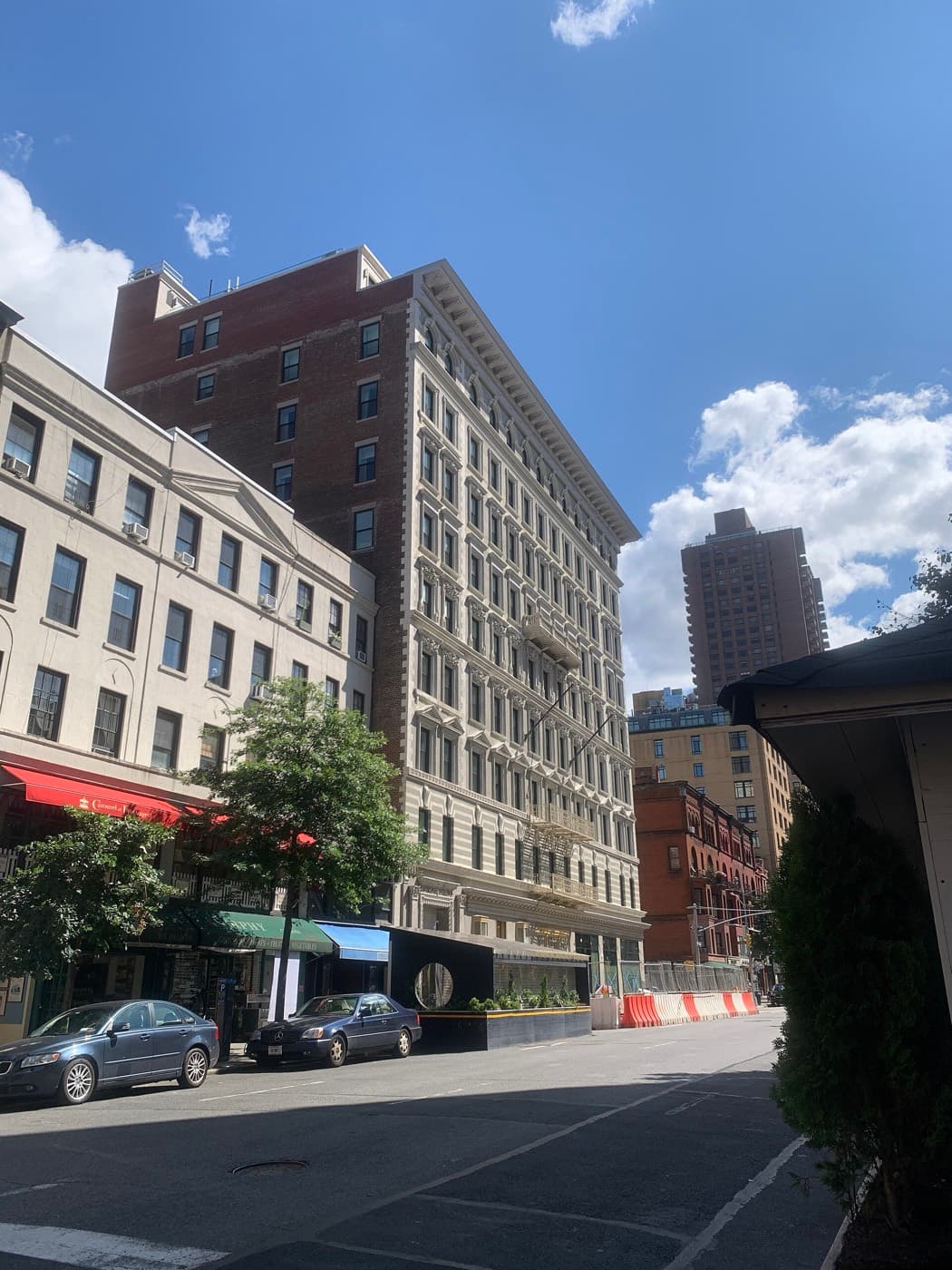
1295 Madison Avenue
1295 Madison Avenue, New York, NY 10128
Carnegie Hill, Upper East Side
BBL 1015047501 · BIN 1047067
- Year built
- 1900
- Type
- Condominium
- Units
- 21
- Floors
- 11
- Landmark
- In a historic district
- Pets
- Pet-friendly (dedicated pet spa on site); confirm specifics at offer stage
- Subletting
- Permitted under the condominium bylaws
- Pied-à-terre
- Allowed
Every recorded sale at this building, 2023–2026
Price-per-square-foot over time, the line- and floor-premium curves, and every recorded sale.
- Median $/sf
- $2,690
- Listing discount
- 2.9%
- Recorded sales
- 24
- On record
- 2023–2026
Own an apartment here? See what it would sell for.
A Private Pricing Opinion — what your apartment at The Wales would likely sell for today, what it costs to sell, and what you’d walk away with — reviewed personally against condition, exposures, renovation quality, and the competition actually on the market.
1295 Madison Avenue — The Wales — is one of Carnegie Hill's most distinctive recent condominium offerings: a landmarked, turn-of-the-century building, long known as a hotel, gut-converted into 21 condominium residences and completed in 2023. Standing eleven stories at the northwest corner of Madison and East 92nd, its ornate Neo-Renaissance terracotta-and-limestone façade is a familiar Carnegie Hill landmark, and the conversion married that historic exterior to a fully contemporary residential interior designed under the direction of the Paris-based studio PINTO.
For buyers, The Wales offers something rare in the neighborhood — brand-new, high-design condominium interiors inside a genuinely historic, landmarked building, on one of Carnegie Hill's best corners. The residences are large — half-floor and full-floor homes, plus a duplex penthouse — and the building trades at the top of the Carnegie Hill market. It appeals to buyers who want the character and permanence of a landmarked address without sacrificing new-construction finishes, mechanical systems, and amenities.
Building operations
The Wales operates as a full-service condominium with a 24-hour attended lobby, a doorman/concierge, a live-in superintendent, a fitness center, a dedicated pet spa, bike storage, and private and cold storage available to residents, alongside in-unit laundry — an amenity package calibrated to the upper tier of the Carnegie Hill market despite the building's boutique 21-unit size.
Because the residences are deeded condominium units, ownership carries the flexibility the form implies: no cooperative board interview, purchaser financing through the buyer's own lender, and pied-à-terre use, investment ownership, and subletting permitted under the condominium bylaws. The building is pet-friendly, with a pet spa on site. As with any recently converted condominium, confirm the pet-policy specifics, any transfer or working-capital contribution, the current sublet terms, and the building's financial profile against the offering plan and current house rules at offer stage.
Architecture and residences
The building dates to around 1900–1902 and was designed by architect Louis Korn in a Neo-Renaissance/Beaux-Arts idiom, with an ornate terracotta and limestone façade that is a protected feature of the Carnegie Hill streetscape. Its most recent life as a hotel ended around 2020, and developer Adellco undertook a comprehensive residential conversion, retaining and restoring the landmarked exterior — a process that required Landmarks Preservation Commission approval — while rebuilding the interior. The 21 residences, with interiors directed by PINTO, feature roughly 10-foot ceilings, white-oak herringbone floors, custom kitchens, and in-unit laundry, configured largely as half-floor and full-floor homes topped by a duplex penthouse. The conversion format means the character comes from the shell while the finishes and systems are new — a combination that requires apartment-specific evaluation, since layouts vary by line within the historic envelope.
Carnegie Hill and the Madison corner
The Wales sits at the northwest corner of Madison and East 92nd, in the heart of Carnegie Hill — the northern, low-key precinct of the Upper East Side known for its private schools, Central Park and Museum Mile proximity, and quiet, dignified residential blocks. The building anchors a stretch of Madison Avenue rich in neighborhood retail and dining, a short walk from Central Park and the 4/5/6 and Q trains. As a contributing building in the Carnegie Hill Historic District, its façade is protected and its exterior alterations are subject to LPC review — a mark of the neighborhood's preservation character.
Facade safety — Local Law 11
The latest available FISP filing classified the facade as Safe — no repairs were required at that inspection. Facade inspections run on a fixed five-year cycle; future inspection, repair, and any assessment decisions remain building-specific.
How to read this, and where it comes from
QEWI = Qualified Exterior Wall Inspector — the licensed engineer the city requires to sign the report (the independent expert, not the managing agent).
Penalties shown are amounts DOB assessed against filings on record across 2005–10 to 2020–25. The FISP dataset does not record whether they were paid, contested or remain open, so treat the figure as history rather than a current balance and confirm the building’s standing with the managing agent.
Source: NYC DOB facade filings (FISP) · The Roebling Research Library. City record last verified September 2026.
Recent sales
The Wales is read on a per-square-foot basis, as all Manhattan condominiums are. Sponsor sales launched in 2023 with pricing that ran from roughly $3.6 million into eight figures, and closings have spanned a wide band, from the lower-floor homes up to the top-floor penthouse, which trades on a different plane from the rest of the building. As a boutique conversion — 21 residences — resale inventory will be thin, and early sponsor and resale closings carry outsized weight in the comparable set. Underwriting should be per-unit and floor-specific, weighing floor, exposure, and the historic-versus-new character of each line.
Unit-level transaction history is maintained in The Roebling Research Library and shared with clients during diligence.
Recent closings at this building, from The Roebling Research Library. Prices are the transfer amounts recorded with the NYC Department of Finance; apartment-level detail is checked against the building’s own file in The Roebling Research Library before publishing.
| Date | Unit | Apartment | Price | PPSF | vs. Ask |
|---|---|---|---|---|---|
| Sep 17, 2026 | NRU1 | 1,621 sf | $1,750,000 | $1,080/sf | off-mkt |
| Jun 11, 2026 | NRU2 | 3,024 sf | $13,000,000 | $4,299/sf | off-mkt |
| Nov 21, 2024 | 4C | 2 BR · 2.5 BA · 1,393 sf | $2,350,000 | $1,687/sf | -29.9% |
| Jun 10, 2024 | 6A | 4 BR · 4.5 BA · 2,936 sf | $7,762,000 | $2,644/sf | -2.9% |
| Apr 15, 2024 | 5A | 3 BR · 3.5 BA · 2,184 sf | $4,850,000 | $2,221/sf | -2.9% |
| Mar 12, 2024 | 7A | 4 BR · 4.5 BA · 2,936 sf | $7,811,987 | $2,661/sf | -17.7% |
| Feb 27, 2024 | 2C | 1 BA · 466 sf | $875,000 | $1,878/sf | off-mkt |
| Nov 22, 2023 | 8A | 4 BR · 4.5 BA · 2,936 sf | $8,200,000 | $2,793/sf | -8.8% |
Market read. Most recent trades (2026) cleared a median $2,690/sf (recorded) across 2 sales. Median listing discount 2.9% from the last ask — a recurring negotiation gap worth pricing into any offer or listing strategy.
The retrade record
Lines that have traded more than once in the public record — the building’s appreciation arc, apartment by apartment.
Full closing history with price-per-square-foot over time, the complete retrade record, and every line that has traded.
Sales sourced from NYC Department of Finance recorded transfers (BBL 1-01504-7501). Apartment-level facts (line, condition, asking-price context) curated and cross-verified in The Roebling Research Library. Not all transactions cross-verify with ACRIS records — sponsor and LLC purchases sometimes record at stipulated values rather than market price; square footage from recorded condo declarations and offering plans.
At the recent median sale of $2.35M (3 sales since 2024), a buyer putting 25% down would pay about $97,888 to close, or 4.2% of the price.
- Mansion tax: $29,375
- Mortgage recording tax: $33,928
- Title insurance: $10,575
- Attorneys, lender, building fees, reserves and filings: $24,010
Assumes a resale (the seller pays transfer taxes), a $4,500 attorney fee and a mortgage on the rest.
Keep up with The Wales and its market
The Roebling Report, monthly: Manhattan sales data and analysis, including buildings like The Wales. Unsubscribe anytime.
We’ll use your email for The Roebling Report and note your interest in this building. See our privacy policy.
What to know if you’re buying
Buying here is a condominium path: your own financing, no substantive board approval, and full use flexibility under the bylaws. The reasons to buy are specific — new, high-design interiors inside a landmarked Carnegie Hill building, large half- and full-floor layouts, a full-service amenity and staffing package, and one of the neighborhood's best corners. Because the building is a recent conversion and small, review the offering plan carefully, confirm the sponsor's remaining inventory and any incentives, and underwrite the specific residence by floor and exposure. Note that as a landmarked building, exterior alterations are LPC-regulated.
What to know if you’re selling
The story is a landmarked Carnegie Hill address with brand-new, designer-led interiors — historic permanence with new-construction finishes. Pricing should be apartment-specific: floor level, exposure, and the scale of the residence drive value, and the penthouse trades on a different plane entirely. Positioning should lead with the landmark façade, the PINTO-directed interiors, the full-service amenity package, and the Carnegie Hill corner location, framing the historic-plus-new combination as the building's core differentiator.
Comparable buildings
If you're considering 1295 Madison Avenue, also look at these Carnegie Hill / Upper East Side buildings:
- 1217 Madison Avenue — Madison Avenue Carnegie Hill building serving an overlapping buyer pool
- 1225 Madison Avenue — nearby Madison Avenue building, comparable neighborhood context
- 1254 Madison Avenue — Carnegie Hill Madison Avenue comparable
- 1261 Madison Avenue — nearby Madison Avenue building serving similar buyers
- 1327 Madison Avenue — Carnegie Hill Madison Avenue building for scale and price context
- 1361 Madison Avenue — nearby Madison Avenue comparable in Carnegie Hill
More Upper East Side buildings
- 1270 Third Avenue — 1958 co-op
- 1280 Third Avenue — 1966 co-op
- The Hayworth (1289 Lexington Avenue) — 2019 condominium
- 1296 Third Avenue (196 East 75th Street) — 1959 co-op
- Carnegie Hill Tower (1327 Madison Avenue / 40 East 94th Street) — 1983 condominium
- The Theso (1328 Second Avenue) — 1961 co-op
The neighborhood
For the full corridor — architecture, transit, and pricing across Upper East Side — read The Roebling Team Guide to Upper East Side.
How to read the facts on this page. Items attributed to an offering plan describe the building as it was offered at that filing — unit mix, square footage, the amenity program as planned. They are not a statement about how the building operates today. Tax and compliance figures are sourced separately to current City records and carry their own dates. House rules, staffing and fee policy can change by board resolution without any public filing: treat every policy line here as a starting point for diligence and confirm it with the managing agent. Where this page compares one building or neighborhood to another, that is our analysis of the recorded record — it names the measure, the period and the sample it rests on, and it is an observation about medians rather than a prediction about any particular apartment.
Considering a move at The Wales?
Request a private building brief with the relevant comparable sales, current and off-market availability, and an apartment-specific view of value.