Sugarman & Berger was a New York architectural firm active across the 1920s and 1930s, working principally in the apartment cooperative and the urban hotel. On Lower Fifth Avenue the firm produced two consequential commissions within a three-year window: 45 Fifth Avenue (1925), a conservative seventeen-story prewar cooperative completed solo, and One Fifth Avenue (1927), the defining Art Deco tower at the corridor's southern terminus designed in association with Helmle & Corbett, with Harvey Wiley Corbett as chief designer. Period reputation placed the firm's strength in interiors over exteriors — a characterization the restrained-facade, substantively-equipped 45 Fifth commission tends to confirm.
The firm
Sugarman & Berger was a New York architectural firm active across the 1920s and 1930s, working principally in the period's two structurally distinct building types: the multi-story apartment cooperative and the urban hotel. The firm is less storied than the prolific prewar apartment-building partnerships — Schwartz & Gross, Emery Roth, Rosario Candela, J.E.R. Carpenter — but its commissions on Lower Fifth Avenue place the firm meaningfully within the corridor's prewar cooperative inventory still in service today.
The firm's documented Manhattan residential portfolio is small: two buildings on Lower Fifth Avenue, both completed within a three-year window during the corridor's most active 1920s development cycle. Both buildings remain consequential addresses on the Greenwich Village Gold Coast.
The Lower Fifth Avenue work
The two Sugarman & Berger commissions on Lower Fifth Avenue sit at structurally different positions in the corridor — one a solo apartment-house commission, one a collaborative tower with one of the more architecturally consequential New York firms of the period.
45 Fifth Avenue (1925)
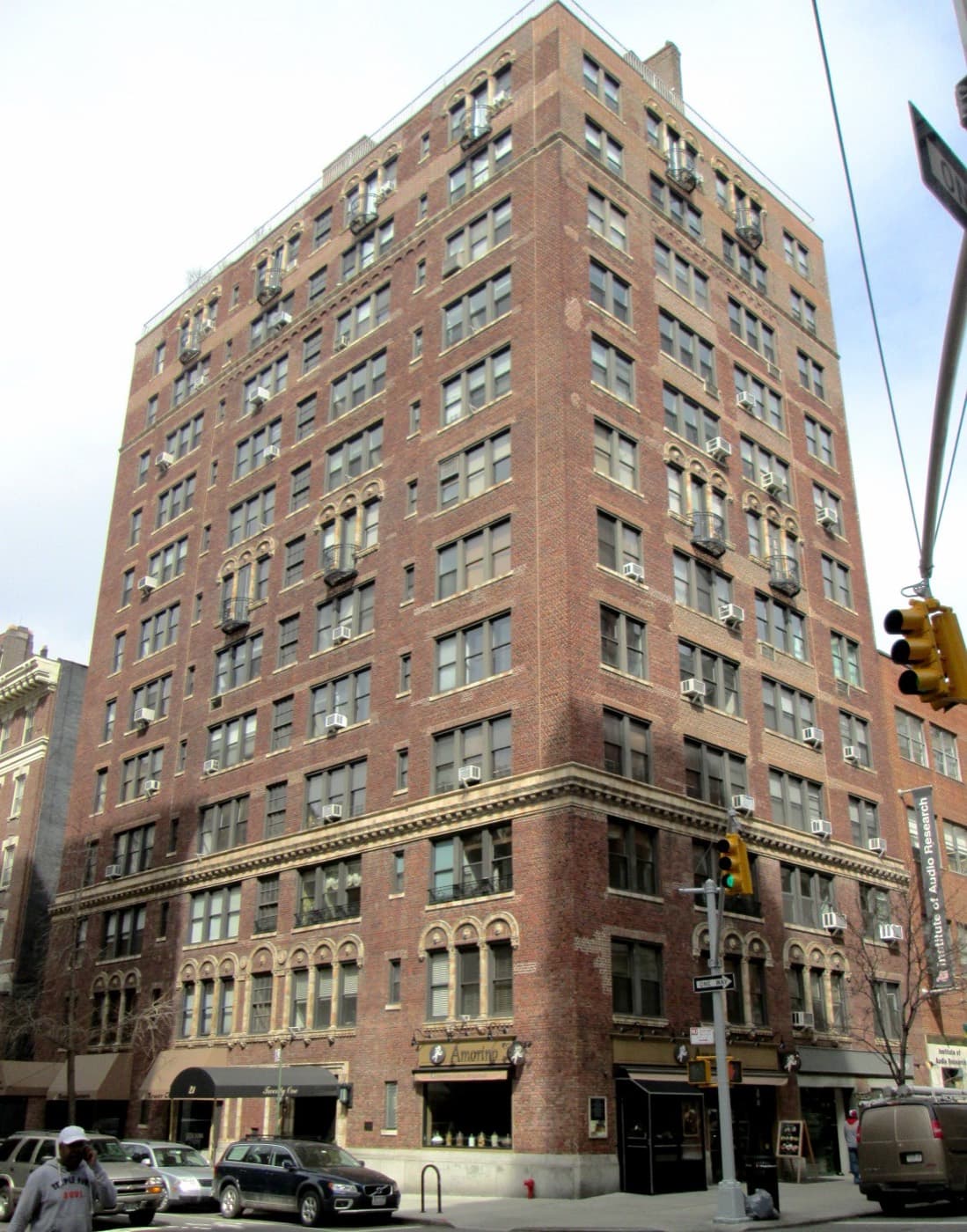
45 Fifth Avenue is the firm's solo Manhattan apartment-house commission. Completed in 1925 for the Forty-five Fifth Avenue Corporation, the building is a seventeen-story conservative prewar cooperative: limestone-clad ground level transitioning to red brick at the third floor, classical window detailing, and a canopied entrance with marble lobby staircases. Sixty-five original apartments — approximately sixty-three today after subsequent unit combinations — at four apartments per floor, with the penthouse level configured as a single larger residence.
The 45 Fifth facade is, by the firm's own period reputation, "a conservative facade" by a firm "better known for their interiors" — a characterization that the building's intimate four-per-floor scale and substantial interior infrastructure tends to confirm. Apartments retain prewar interior signatures: substantial beamed ceilings, oak-strip flooring, large double-hung windows, and the art-deco-style windowed bathrooms characteristic of the 1925-vintage building cycle. The building is among the most architecturally restrained of the Lower Fifth Avenue Gold Coast prewars, and its position in the corridor's pricing band — materially below the larger full-service buildings like One Fifth Avenue, the Brevoort, and 24 Fifth Avenue — reflects that restraint as a feature, not a deficit. Buyers at 45 Fifth choose the smaller, less amenitized, less institutional prewar in exchange for the Greenwich Village Historic District streetscape and materially more accessible pricing.
The building converted to cooperative ownership in 1983. The cooperative entity is 45 Fifth Avenue Owners Corp., managed by Caspi Development. The building is within the Greenwich Village Historic District, designated April 29, 1969.
One Fifth Avenue (1927)
One Fifth Avenue is the firm's collaborative commission with Helmle & Corbett, with Harvey Wiley Corbett as chief designer. Completed in 1927, originally constructed and operated as an apartment hotel before its 1976 conversion to cooperative ownership, One Fifth is among the defining Art Deco towers of downtown Manhattan: a twenty-seven-story massing with telescoping setbacks, chamfered corners, angled Jazz Age window heads, and a brick-and-stone tower body with a single central crown.
The architectural register at One Fifth is principally Corbett's rather than Sugarman & Berger's — Corbett carried the design direction, and the building's specific Art Deco vocabulary belongs to his hand. But the firm's association with the One Fifth commission, on the southern entry to Lower Fifth Avenue immediately above Washington Mews and within four blocks of Washington Square Park, establishes Sugarman & Berger within the corridor's most architecturally consequential addresses. The 27-story tower rises above the surrounding 19th-century rowhouse fabric in a way that produced sustained period architectural criticism — period critics described it as "a modern skyscraper in a neighborhood of brownstones" — and that defined the corridor's southern terminus.
After cooperative conversion in 1976, One Fifth Avenue carries approximately 180-plus residential apartments, 24-hour doorman and concierge service, a live-in superintendent, and the two-story lobby that survives from the apartment-hotel original. The building is within the Greenwich Village Historic District.
The broader portfolio
Beyond the two Lower Fifth Avenue residential commissions, Sugarman & Berger worked widely in 1920s-era New York hotel and commercial architecture. The firm is associated with several midtown hotel projects of the period — work that, alongside the contemporaneous activity of Schultze & Weaver, Emery Roth, and the other 1920s hotel-and-apartment hybrid practices, defined the period's mixed urban-hospitality vocabulary.
The hotel and commercial work falls outside our Manhattan apartment-cooperative coverage and is not catalogued in detail on this page. But it is the broader professional context within which the firm's apartment-house commissions should be read: Sugarman & Berger's residential work is the work of a firm experienced in mixed-use and hospitality-program design, applied to apartment commissions where the program demanded the same kind of carefully calibrated interior infrastructure that defined the firm's broader 1920s output.
Period reputation
The most informative characterization of Sugarman & Berger in the period architectural record is the line that the firm was "better known for their interiors than their exteriors." It is a backhanded compliment with substantive content: the firm's facades tend to be restrained and competent rather than architecturally inventive, but the interior program — apartment plan, finish, and infrastructure — was where the firm's professional reputation actually rested.
This characterization holds particularly for 45 Fifth Avenue, where the facade is among the most architecturally restrained of the Lower Fifth Avenue Gold Coast prewars but where the apartment interiors retain the substantive prewar signatures (beamed ceilings, oak-strip flooring, double-hung windows, windowed bathrooms) that the period interior program was built around. A buyer evaluating a Sugarman & Berger commission should expect the building's architectural argument to run through the interior rather than the exterior — and should weight the apartment-level program disproportionately in the diligence process.
Buying a Sugarman & Berger building today
Three practical considerations for buyers approaching the firm's inventory.
The architectural credit is not the prestige driver. Sugarman & Berger is not a brand-name credit in the way that Candela, Carpenter, or McKim Mead & White is. A Sugarman & Berger building does not trade at a prestige premium for the firm name alone, and buyers should not expect the credit to do market work that it cannot do. The building should be evaluated on its specific architectural and operational merits — the corridor positioning, the apartment-level program, the building's policy framework — rather than on the firm name.
The interior infrastructure is where the value sits. Consistent with the firm's period reputation, the apartment-level program at a Sugarman & Berger building tends to be where the substantive architectural value lives. Buyers should pay particular attention during diligence to the apartment plan, the finish quality, the ceiling heights, the window configurations, and the original built-in infrastructure. The facade tells you less than the apartment does.
The collaboration context matters. At One Fifth Avenue, the architectural register is principally Harvey Wiley Corbett's rather than Sugarman & Berger's; at 45 Fifth, the firm worked solo. Buyers evaluating an attribution should verify whether the commission was a solo Sugarman & Berger project or a collaboration, because the design direction varies meaningfully between the two contexts. The firm credit on a Lower Fifth Avenue building is informative; the lead-designer credit is informative in a different way.
Comparable architects
If you're researching Sugarman & Berger's body of work, also consider:
- Schwartz & Gross — the most prolific prewar Manhattan apartment-building firm, with a portfolio across Park Avenue, Central Park West, and the Upper West Side; a useful frame for the volume side of the prewar partnership cohort
- Emery Roth — the firm whose 1920s and 1930s Manhattan apartment work most directly defined the corridor inventory Sugarman & Berger worked alongside; a different stylistic register at substantially higher volume
- J.E.R. Carpenter — the Fifth Avenue and Park Avenue limestone classicist; the upper-tier prewar reference point against which Lower Fifth Avenue's more accessible inventory positions itself
The Roebling Team on Sugarman & Berger buildings
The Roebling Team at Compass works the Lower Fifth Avenue corridor — 45 Fifth Avenue, One Fifth Avenue, The Brevoort, 24 Fifth Avenue, 25 Fifth Avenue, 39 Fifth Avenue, 43 Fifth Avenue, 51 Fifth Avenue — as part of our broader Park-facing Manhattan practice. The firm's two Lower Fifth Avenue commissions sit within that coverage, and a buyer or seller engaging with us on either building is engaging with a team that has carried building-specific intelligence on those addresses through transaction work.
We publish architect profiles like this one because building-specific intelligence is the diligence layer that matters most for prewar Manhattan apartment buyers. The pre-war Manhattan apartment is a careful product. The architect-attribution conversation should be equally careful — particularly for firms like Sugarman & Berger, whose volume and stylistic register sit outside the brand-name prestige hierarchy but whose buildings remain consequential within their corridors.
If you're considering a purchase or sale at 45 Fifth Avenue or One Fifth Avenue, a 30-minute consultation is the right starting point. We'll bring the full context this page provides plus the transactional specifics your situation requires — building-specific board culture, comparable analysis at the apartment level, pricing-band positioning, and the pacing strategy that fits your timeline.
Run the numbers
Related guides
- Manhattan Co-op Buying Guide — board approval mechanics
- Greenwich Village corridor guide — the broader Lower Fifth Avenue Gold Coast context
- NYC Real Estate Tax & Closing Cost Guide — closing economics
Considering a Sugarman & Berger building?
Corey Cohen, Principal The Roebling Team at Compass 646.939.7375 · c.cohen@compass.com
This page reflects publicly available information, the LPC Greenwich Village Historic District designation report, the building-specific historical records for 45 Fifth Avenue and One Fifth Avenue, and The Roebling Team transaction experience. The Roebling Team at Compass does not represent any Sugarman & Berger building's management, board, or sponsor. © 2026 The Roebling Team at Compass.
Buildings designed by Sugarman & Berger



The drawings are public. The rest isn't.
How these buildings have actually traded, which lines deliver what the plans promise, and how each board handles financing and approvals.
646.939.7375 · c.cohen@compass.com