- Type
- Condominium
- Landmark
- In a historic district
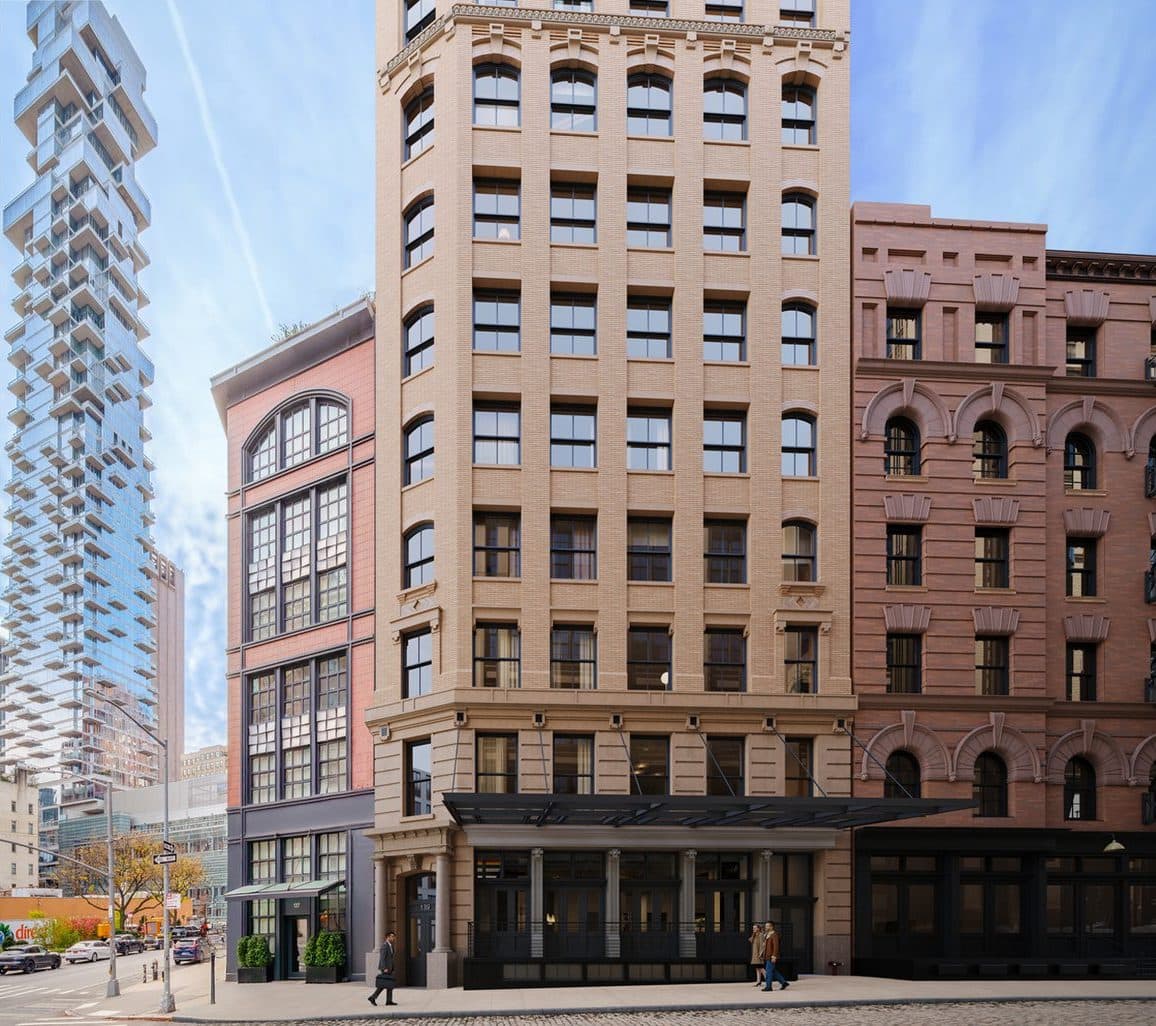
139 Franklin Street is a 10-story former self-storage building in the Tribeca West Historic District, built as a warehouse for the importers Strohmeyer & Arpe; the Landmarks Preservation Commission dates it to 1909 and credits Maynicke & Franke, while city tax records use 1915. It stands near the intersection of Franklin Street, Varick Street and West Broadway. Broad Street Development and TPG Angelo Gordon bought it in 2025 for $43.5 million and are converting it to a boutique condominium.
Published reporting describes up to 18 residences, in three- to five-bedroom layouts with private outdoor space and wellness-style amenities. In July 2026 Apollo affiliates provided a $71 million construction loan. For a buyer, the draw is the scale: a small building of large homes on a Tribeca block, delivered as a conversion inside a historic district.
What's planned
Plans call for three- to five-bedroom residences with private outdoor space and wellness-style amenities. The architect of record on DOB filings is Rawlings Architects. A rendering was released with the financing announcement; no design details beyond the program have been published.
The residence count differs by source. Published reporting says up to 18; the DOB certificate-of-occupancy filing shows 13. Confirm the final count in the offering plan.
Timeline and filings
- 2025: Broad Street Development and TPG Angelo Gordon buy the building for $43.5 million (reported).
- March to June 2026: DOB alteration filings for the building are approved.
- July 13, 2026: $71 million Apollo construction financing is reported.
- September 3, 2026: An alteration filing for a new certificate of occupancy is made (DOB job M01400498), showing 13 dwelling units.
- Next: Offering plan and sales launch. Neither has been announced.
Offering and pricing
No condominium offering plan or pricing had been filed or reported as of October 2026.
Local Law 97
- 2024–2029 annual penalty
- $0 (under cap)
- 2030–2034 annual penalty
- $31,818/yr
- Per unit / month range
- $0 – $241
- Modeled exposure split equally across 11 units (the city's lot-record total, including commercial units). Not an assessed amount; condominium owners are typically charged by each unit's common-interest percentage.
Source: NYC LL84 benchmarking and PLUTO · The Roebling Research Library. City data last refreshed October 2026.
See full Local Law 97 analysis — emissions history, scenarios, methodology →Facade safety — Local Law 11
The latest available filing classified the facade as Unsafe — conditions requiring prompt corrective action. The owner must install any public protection the inspector specifies (a sidewalk shed, construction fence or structural netting, depending on the condition) and make the repairs. Review the subsequent filings, the repair status, and the building’s board and financial materials — we pull the repair scope and funding picture for you.
How to read this, and where it comes from
QEWI = Qualified Exterior Wall Inspector — a licensed professional engineer or registered architect who meets DOB’s FISP qualifications and signs the report (the independent expert, not the managing agent).
Penalties shown are amounts DOB assessed against filings on record across 2005–10 to 2025–30. The FISP dataset does not record whether they were paid, contested or remain open, so treat the figure as history rather than a current balance and confirm the building’s standing with the managing agent.
Source: NYC DOB facade filings (FISP) · The Roebling Research Library. City data last refreshed October 2026.
Be first to know when 139 Franklin Street launches
There are no sponsor sales yet. Register below and we’ll reach out the moment pricing and the offering plan are released — before the building is on the open market.
We’ll use your email to reach out about this building and closely related inventory, and to send The Roebling Report. See our privacy policy.
Buying here? Condo closing costs with a mortgage typically run 3 to 6% of the price. See NYC co-op and condo closing costs, line by line.
What to know if you’re buying
No reservations before the plan is accepted. Before the Attorney General accepts the offering plan for filing, a sponsor with an approved CPS-1 application may only collect expressions of interest. It may not take reservations or deposits, binding or non-binding; an interest list does not secure a unit, and no purchase contract can be signed. Verify the plan's filing status before proceeding.
Deposits are typically 10 to 20 percent, held in escrow. The exact deposit schedule, the sponsor's closing conditions and the outside closing date are set in the plan and the purchase agreement. Have counsel read both before signing.
Closing costs run to the buyer in sponsor sales. Buyers customarily pay the New York State and New York City transfer taxes that would otherwise fall on the seller, plus the mansion tax on purchases of $1 million and above. Use the calculators below to size them.
Closings may take place on a temporary certificate of occupancy. New-development sales can close on a valid temporary certificate when the offering plan, purchase agreement and lender requirements allow it. Confirm which certificate will cover the apartment, the plan's closing conditions, and the sponsor's obligation, and the security behind it, to obtain the permanent certificate.
The budget, common charges and any abatement come from the plan. Projected common charges, real estate taxes and any tax benefit are set in the plan's first-year budget. Confirm them in the filed plan rather than in marketing material.
Historic-district review applies. The building is in the Tribeca West Historic District, so exterior changes need LPC approval.
Conversions change the certificate-of-occupancy. DOB is processing a new certificate-of-occupancy filing; the plan should state the final residential unit count and when a temporary certificate is expected.
Comparable buildings
- 140 Franklin Street — loft-conversion condominium on Franklin Street
- 155 Franklin Street — condominium conversion of a historic warehouse
- 67 Franklin Street — loft-conversion condominium on Franklin Street
- 50 Franklin Street — new-construction condominium on Franklin Street
More Tribeca buildings
- 134 Duane Street (Main Duane) — 1859 co-op
- 137 Duane Street — 1864 condominium
- 138 Reade Street — 2005 condominium
- 140 Franklin Street (One40 Franklin) — 1887 condominium
- 140 West Street / One Hundred Barclay — 1927 condominium
- 142 Duane Street — 1859 co-op
The neighborhood
For the full corridor — architecture, transit, and pricing across Tribeca — read The Roebling Team Guide to Tribeca.
How to read the facts on this page. Items attributed to an offering plan describe the building as it was offered at that filing — unit mix, square footage, the amenity program as planned. They are not a statement about how the building operates today. Tax and compliance figures are sourced separately to current City records and carry their own dates. House rules, staffing and fee policy can change by board resolution without any public filing: treat every policy line here as a starting point for diligence and confirm it with the managing agent. Where this page compares one building or neighborhood to another, that is our analysis of the recorded record — it names the measure, the period and the sample it rests on, and it is an observation about medians rather than a prediction about any particular apartment.
Considering a move at 139 Franklin Street?
Request a private building brief with the relevant comparable sales, current and off-market availability, and an apartment-specific view of value.
646.939.7375 · c.cohen@compass.com