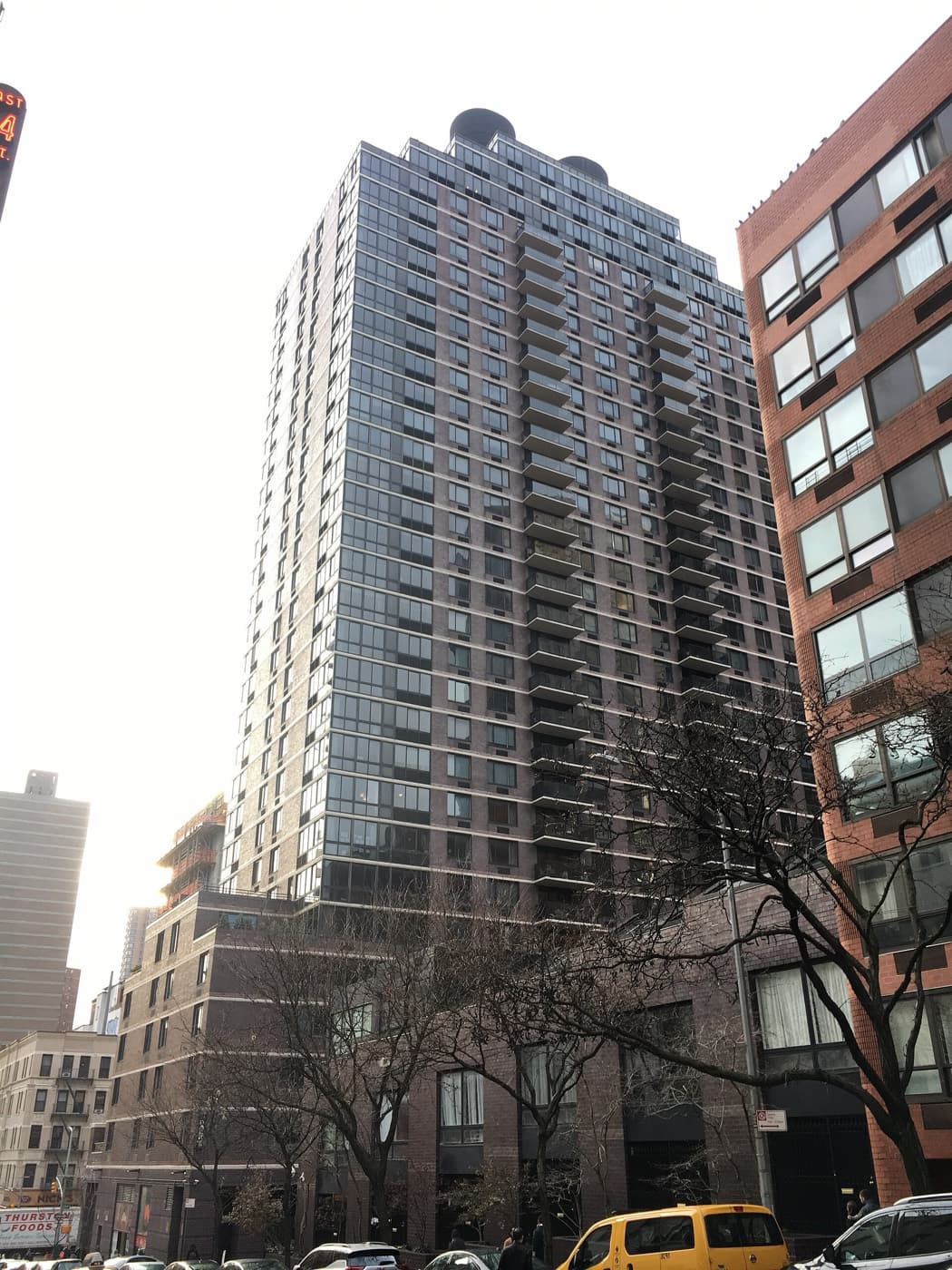
Astor Terrace (245 East 93rd Street)
245 East 93rd Street, New York, NY 10128
Yorkville, Upper East Side
BBL 1015397501 · BIN 1048918
- Year built
- 1985
- Type
- Condominium
- Units
- 290
- Floors
- 33
- Landmark
- No
- Pets
- Permitted under condominium rules
- Financing
- Condominium — low minimum down payment; no co-op-style financing cap
- Flip tax
- None documented as a condominium; confirm any current transfer fee at offer stage
Every recorded sale at this building, 2003–2026
Price-per-square-foot over time, the line- and floor-premium curves, and every recorded sale.
- Median $/sf (floor-adjusted)
- $1,028
- Listing discount
- 2.1%
- Recorded sales
- 274
- On record
- 2003–2026
Own an apartment here? See what it would sell for.
A Private Pricing Opinion — what your apartment at Astor Terrace would likely sell for today, what it costs to sell, and what you’d walk away with — reviewed personally against condition, exposures, renovation quality, and the competition actually on the market.
Astor Terrace is the SOM-pedigree condominium of upper Carnegie Hill — a 33-story dark-brick tower built in 1985 to a design by Skidmore, Owings & Merrill, with the residential specialists at Schuman, Lichtenstein, Claman & Efron, and developed by the Solomons with the Equitable Life Assurance Society. It is one of the relatively few purpose-built condominiums of the 1980s on the far Upper East Side that carries a genuine architectural signature, and it pairs that pedigree with a rare amenity: a private, gated park across the street for which residents receive keys.
The building's positioning is what makes it durable. It sits at the Carnegie Hill / Yorkville seam on upper Second Avenue, which for decades traded at a discount to the Fifth and Park spine — and which the Second Avenue Subway has since transformed. Direct access to the Q at 96th Street put the far Upper East Side one stop from Lexington and repriced the entire corridor. Astor Terrace, already a full-service condominium with a distinctive facade and a private park, was among the clearest beneficiaries: it offers the ownership flexibility of a condominium, the staffing of a Park Avenue building, and a transit position that no longer requires the long crosstown walk that once defined the neighborhood.
Architecturally, the building rewards a second look. SOM's massing steps the tower back three times at the crown and grounds it in a low, townhouse-scaled base with a balustrade along the side streets — a deliberate gesture toward the brownstone context of Carnegie Hill rather than a raw glass slab. The dark red brick and corner windows read as considered, not generic, which separates Astor Terrace from the beige-brick 1980s stock nearby.
Architecture and unit composition
The tower is a dark red-brick composition with corner windows that pull light from two directions on the strongest lines, three stepped setbacks near the top that create terraced upper units, and a low base scaled to the surrounding townhouse blocks. The circular driveway — accessible from both 93rd and 94th Streets — is an unusual amenity for a mid-block Upper East Side building, giving the entrance a porte-cochère quality.
The 290 residences run from studios and one-bedrooms through two- and three-bedroom homes, with the larger apartments and the setback lines commanding the terraces and the widest exposures. Many units convey with private storage. Layouts are efficient postwar-condominium plans — separated kitchens, defined entries, and generous closets — that renovate well, and a number of units carry in-unit washer/dryers.
Building operations
Astor Terrace operates as a full-service condominium: 24-hour doorman and concierge, a resident manager, the circular driveway, a windowed fitness center, a children's playroom, a residents' lounge with a fireplace and private dining room, a bike room, an on-site parking garage, and private storage. The private gated park across the street — to which residents hold keys — is the signature amenity and a genuine differentiator on the block. Common charges reflect the full-service staffing and the amenity roster; buyers should confirm the specific unit's carry and review the building's reserve position and any assessment during diligence.
Facade safety — Local Law 11
The latest available FISP filing classified the facade as Safe — no repairs were required at that inspection. Facade inspections run on a fixed five-year cycle; future inspection, repair, and any assessment decisions remain building-specific.
How to read this, and where it comes from
QEWI = Qualified Exterior Wall Inspector — the licensed engineer the city requires to sign the report (the independent expert, not the managing agent).
Penalties shown are amounts DOB assessed against filings on record across 2005–10 to 2025–30. The FISP dataset does not record whether they were paid, contested or remain open, so treat the figure as history rather than a current balance and confirm the building’s standing with the managing agent.
Source: NYC DOB facade filings (FISP) · The Roebling Research Library. City record last verified September 2026.
Management & transfer contacts
- Notable fees
- Buyer application fee $700 ($750 without broker); background report $125/applicant (+$75 criminal if required); move-in fee $1,000 + $1,000 refundable deposit ($2,500 DIY); seller move-out fee $1,000 + deposit; electric deposit $400
Recent sales
Astor Terrace trades as a full-service Carnegie Hill condominium that has benefited materially from the Second Avenue Subway's repricing of the corridor. Pricing runs unit-by-unit: setback and terraced lines and the higher floors carry premiums, and the condominium's ownership flexibility widens the buyer pool relative to the co-ops nearby. Recorded sales auto-populate from public records; unit-level history and current same-line comparables are maintained in The Roebling Research Library and shared with clients during diligence. Because the stock spans studios through three-bedrooms, same-line comparables — not blended building averages — are the correct analytical unit.
Recent closings at this building, from The Roebling Research Library. Prices are the transfer amounts recorded with the NYC Department of Finance; apartment-level detail is checked against the building’s own file in The Roebling Research Library before publishing.
| Date | Unit | Apartment | Price | PPSF | vs. Ask |
|---|---|---|---|---|---|
| Jul 1, 2026 | 20C | 2 BR · 1.5 BA · 1,056 sf | $1,188,000 | $1,125/sf | -8.3% |
| Jun 3, 2026 | 26G | 3 BR · 3 BA · 1,654 sf | $1,950,000 | $1,179/sf | +0.0% |
| Apr 28, 2026 | 9H | 3 BR · 2.5 BA · 1,357 sf | $1,780,000 | $1,312/sf | -3.8% |
| Apr 28, 2026 | 18A | 2 BR · 1.5 BA · 967 sf | $980,000 | $1,013/sf | -2.0% |
| Apr 24, 2026 | 6F | 2 BR · 2.5 BA · 1,230 sf | $1,625,000 | $1,321/sf | -1.5% |
| Apr 17, 2026 | 22C | 2 BR · 1.5 BA · 1,056 sf | $1,050,000 | $994/sf | -4.5% |
| Dec 17, 2025 | 2E | 1 BR · 1 BA · 772 sf | $850,000 | $1,101/sf | +0.0% |
| Dec 1, 2025 | 29F | 1 BR · 1 BA · 787 sf | $925,000 | $1,175/sf | +0.0% |
Market read. Most recent trades (2026) cleared a median $1,028/sf (floor-adjusted) across 6 sales. Floor-adjusted means each sale is restated to a constant mix of floors, so the figure can differ from the plain median of the sales listed above. Median listing discount 2.1% from the last ask — a recurring negotiation gap worth pricing into any offer or listing strategy.
The retrade record
Lines that have traded more than once in the public record — the building’s appreciation arc, apartment by apartment.
Full closing history with price-per-square-foot over time, the complete retrade record, and every line that has traded.
Sales sourced from NYC Department of Finance recorded transfers (BBL 1-01539-7501). Apartment-level facts (line, condition, asking-price context) curated and cross-verified in The Roebling Research Library. Not all transactions cross-verify with ACRIS records — sponsor and LLC purchases sometimes record at stipulated values rather than market price; square footage from recorded condo declarations and offering plans.
Closed rents at Astor Terrace, last 36 months
| Size | Leases | Median / month |
|---|---|---|
| 1 bedroom | 13 | $4,550 |
| 2 bedroom | 17 | $6,395 |
| 3 bedroom | 2 | $9,750 |
32 closed leases, October 2023 to September 2026. Most recent lease September 2026. Sizes with fewer than 2 leases are not shown. Compiled by The Roebling Team at Compass from closed leases.
At the recent median sale of $1.63M (22 sales since 2024), a buyer putting 25% down would pay about $68,423 to close, or 4.2% of the price.
- Mansion tax: $16,250
- Mortgage recording tax: $23,461
- Title insurance: $7,312
- Attorneys, lender, building fees, reserves and filings: $21,400
Assumes a resale (the seller pays transfer taxes), a $4,500 attorney fee and a mortgage on the rest.
Keep up with Astor Terrace and its market
The Roebling Report, monthly: Manhattan sales data and analysis, including buildings like Astor Terrace. Unsubscribe anytime.
We’ll use your email for The Roebling Report and note your interest in this building. See our privacy policy.
What to know if you’re buying
The condominium structure is the advantage. Pied-à-terre and investment use, subletting, and financing without a co-op board's thresholds all widen your options relative to the Carnegie Hill co-ops. Confirm the current common charge and any assessment on the specific unit.
The Second Avenue Subway is priced in — but it is real. Direct Q access at 96th Street repositioned this corridor permanently. Underwrite the location as a transit-connected one, not the old long-walk far Upper East Side.
The private park is a genuine amenity. Residents hold keys to a gated park across the street — an unusual feature that supports value and daily livability. Confirm current access terms.
Use same-line comparables. The stock ranges from studios to three-bedrooms with terraced setback lines at a premium. Price the specific line, not the building average. Run the True Monthly Carrying Cost Calculator on the unit.
What to know if you’re selling
Lead with the pedigree and the park. The SOM design and the private gated park are marketing assets that the generic 1980s stock nearby cannot claim. Use them.
Sell the transit story. The Q at 96th Street is the fact that changed this corridor. Buyers moving from other neighborhoods need it stated plainly.
Price the setback lines on their own. Terraced upper units trade on a distinct comparable set. Don't blend them into the building average.
Closing timelines are condo-fast. 30–45 days from contract to closing; foreign and investor buyers are welcome under the declaration.
Comparable buildings
If you're considering Astor Terrace, also evaluate:
- The Kent (200 East 95th) — the new-development condominium benchmark two blocks north; the price ceiling for the corridor
- 180 East 88th Street — the slim new-development condominium tower nearby; the architectural-statement alternative
- The Lucida (151 East 85th) — full-service Carnegie Hill condominium to the south; comparable amenity depth
- 1250 Third Avenue — full-service Third Avenue condominium; the corridor peer
- 400 East 84th Street — Yorkville condominium; the southern alternative
- The Kent and the broader upper-Second-Avenue condominium set define the current comparable universe
More Upper East Side buildings
- 241 East 76th Street — 1959 co-op
- 243 East 77th Street — 1910 co-op
- 245 East 72nd Street — 1930 co-op by Emery Roth
- 248 East 65th Street — 1961 condominium
- 249 East 62nd Street (The Treadwell) — 2021 condominium by SLCE Architects
- 255 East 74th Street (Casa 74) — 2008 condominium by SLCE Architects
The neighborhood
For the full corridor — architecture, transit, and pricing across Upper East Side — read The Roebling Team Guide to Upper East Side.
How to read the facts on this page. Items attributed to an offering plan describe the building as it was offered at that filing — unit mix, square footage, the amenity program as planned. They are not a statement about how the building operates today. Tax and compliance figures are sourced separately to current City records and carry their own dates. House rules, staffing and fee policy can change by board resolution without any public filing: treat every policy line here as a starting point for diligence and confirm it with the managing agent. Where this page compares one building or neighborhood to another, that is our analysis of the recorded record — it names the measure, the period and the sample it rests on, and it is an observation about medians rather than a prediction about any particular apartment.
Considering a move at Astor Terrace?
Request a private building brief with the relevant comparable sales, current and off-market availability, and an apartment-specific view of value.