Midtown South
Midtown South runs between NoMad and the Garment District, a district of early-twentieth-century commercial buildings where residential use arrived through conversion rather than by design. The inventory is loft-scaled and irregular, and street life stays predominantly commercial outside business hours. Buyers are typically choosing central location and unusual floor plates. This is the part of Manhattan where office-to-residential conversion is most active, so expect the inventory mix to keep changing. Closings run further below ask than the borough norm, and above-ask sales are rare.
What the index shows for Midtown South
Median condominium price per square foot and cooperative price per room, with the change over the past year and since 2022 and 2016. Condos are measured by the foot, co-ops by the room.
Medians of recorded, index-eligible sales, measured to the last complete year — each figure carries the mix of what happened to trade, not the like-for-like change of a single apartment. The count beside each change is the sample backing that comparison, which is smaller than the scope’s all-time total. New-development-heavy; thinner resale base. Compiled by The Roebling Team at Compass from public records. Figures are indicative, not an appraisal.
How Midtown South clears
What closings across Midtown South look like at the table, shown against the Manhattan baseline so each figure reads as a comparison.
- Typical closing vs asking price
- −4.5%
- Share selling above ask
- 6%
- Monthly charges
- $2,511
- Median rooms
- 3.0
At a glance
Where it is: the blocks in the 30s between Madison and Sixth Avenues, with NoMad below, the Fashion District west of Sixth and Murray Hill east of Madison Share of recorded sales: condominium 73 percent · cooperative 21 percent · commercial 6 percent Market character: 64.1 percent arm's-length across 2,626 recorded sales at just 78 addresses, with sponsor-flagged activity at 24.4 percent Published with a caveat: the Index flags this series new-development-heavy with a thinner resale base, and the record bears it out — five addresses carry 63 percent of every sale on file Defining control: M1-6 manufacturing zoning, mapped across the midblocks by the 1961 Zoning Resolution and prohibiting residential use, until the Midtown South Mixed-Use Plan was approved by the City Council on August 14, 2025 Transit: B, D, F, M, N, Q, R and W at 34th Street–Herald Square; 6 at 33rd Street; 7, B, D, F and M at 42nd Street–Bryant Park; 1, 2, 3, A, C and E at Penn Station Watch for: the avenue frontage line. Fifth and Madison sat outside the manufacturing districts; the midblocks behind them did not, and the two sides have different origins, ages and comparable sets
Daily life and getting around
The streets read commercial first, at every hour a viewing is unlikely to be scheduled. Fifth Avenue through the 30s is a near-continuous wall of early-twentieth-century loft and office buildings — limestone and terra-cotta at the base, deep floor plates above, freight entrances still in use — with glass residential towers pushed up between them at intervals. The register changes block by block: West 32nd Street between Fifth and Sixth is Koreatown, busy past midnight and the most reliably alive stretch here; two blocks north, 34th Street at Herald Square carries one of the heaviest pedestrian loads in the city, almost none of it residents. What a person walking it notices is how little of the small-scale retail that carries an evening in a residential neighborhood exists at all.
The retail spine is regional rather than local: Herald Square and the 34th Street corridor draw from the whole metropolitan area, while Madison and the side streets east of Fifth carry the delis and lunch counters that serve office tenants and, incidentally, residents. Green space is the weakest part of the case — Bryant Park at the north edge, anything larger a walk south to Madison Square Park.
Transit is the strongest argument the neighborhood makes. Herald Square puts eight lines under one station at the southwest corner; the 6 stops at 33rd Street, the 7, B, D, F and M at 42nd Street–Bryant Park, and Penn Station three blocks west adds the 1, 2, 3, A, C and E with the Long Island Rail Road, New Jersey Transit and Amtrak. Almost no address in Manhattan has more rail within ten minutes on foot.
Why Midtown South trades the way it does
Start with the address count, because it explains most of the rest. The recorded sale history for this leaf is 2,626 transactions across 78 addresses — closer to a single large complex than to a neighborhood; Lenox Hill spreads its record across more than 1,300. 325 Fifth Avenue alone carries 706 sales, twenty-seven percent of everything on file, and the five most-traded addresses together carry sixty-three percent. Look at this neighborhood's price history and you are largely looking at five buildings.
That is why the Index publishes the series with a caveat — new-development-heavy, thinner resale base — and the caveat is an instruction rather than a disclaimer. Arm's-length sales run at 64.1 percent, so roughly one recorded transaction in three is not a household selling to another household, and sponsor-flagged activity accounts for 24.4 percent, the highest share of any adjoining leaf. A comparable set assembled without separating sponsor closings from resales describes a sellout schedule rather than a market.
The thinness shows again in the annual samples. The 2025 condominium reading rests on twenty-six observations; the cooperative series has no complete 2025 reading at all, and its most recent stands on twenty. Both are lower in nominal terms than in 2016 and materially lower after inflation. Indexed to 2025 the direction is down, but treat any single year's move as provisional until a second confirms it.
The stock
Three products, and the first two do not comp against each other.
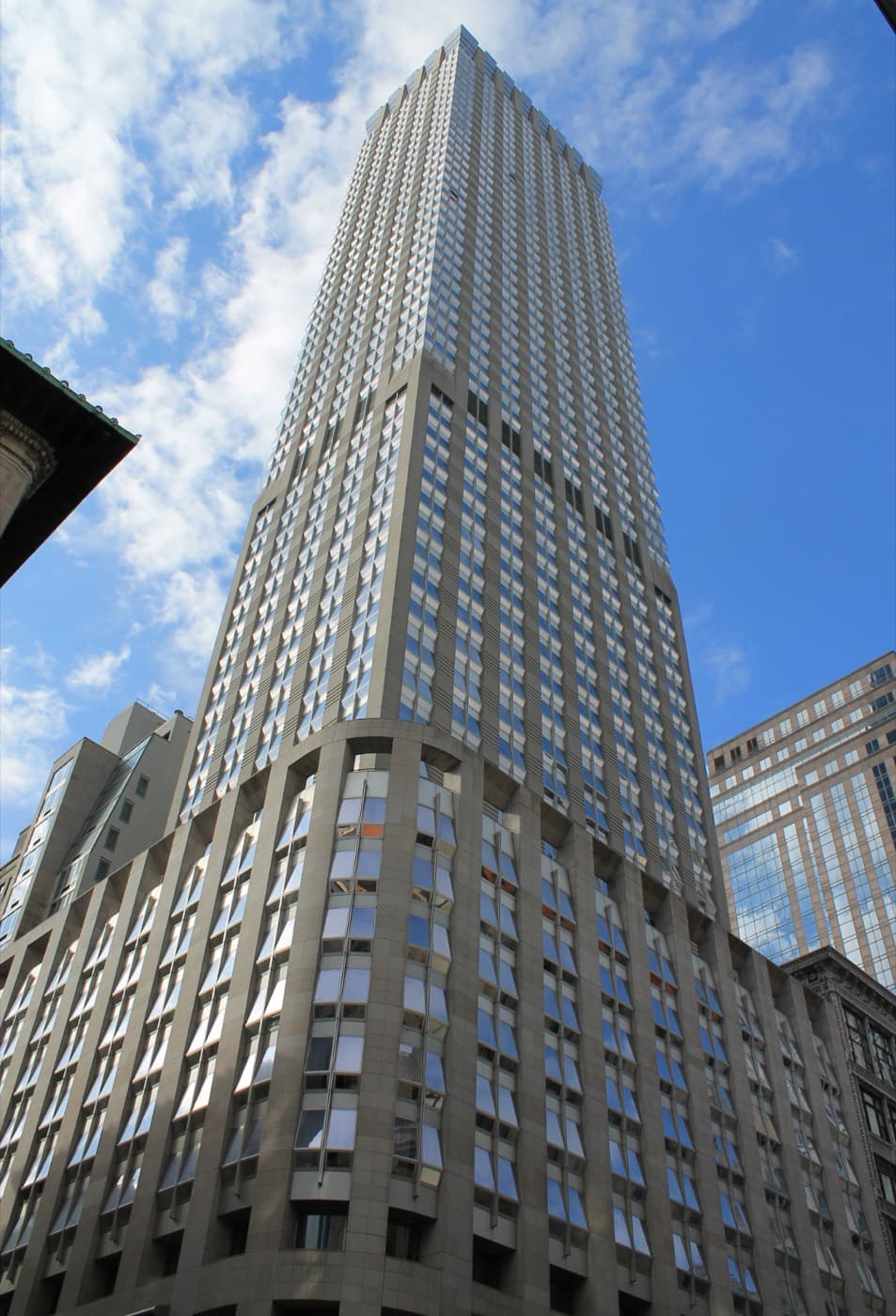
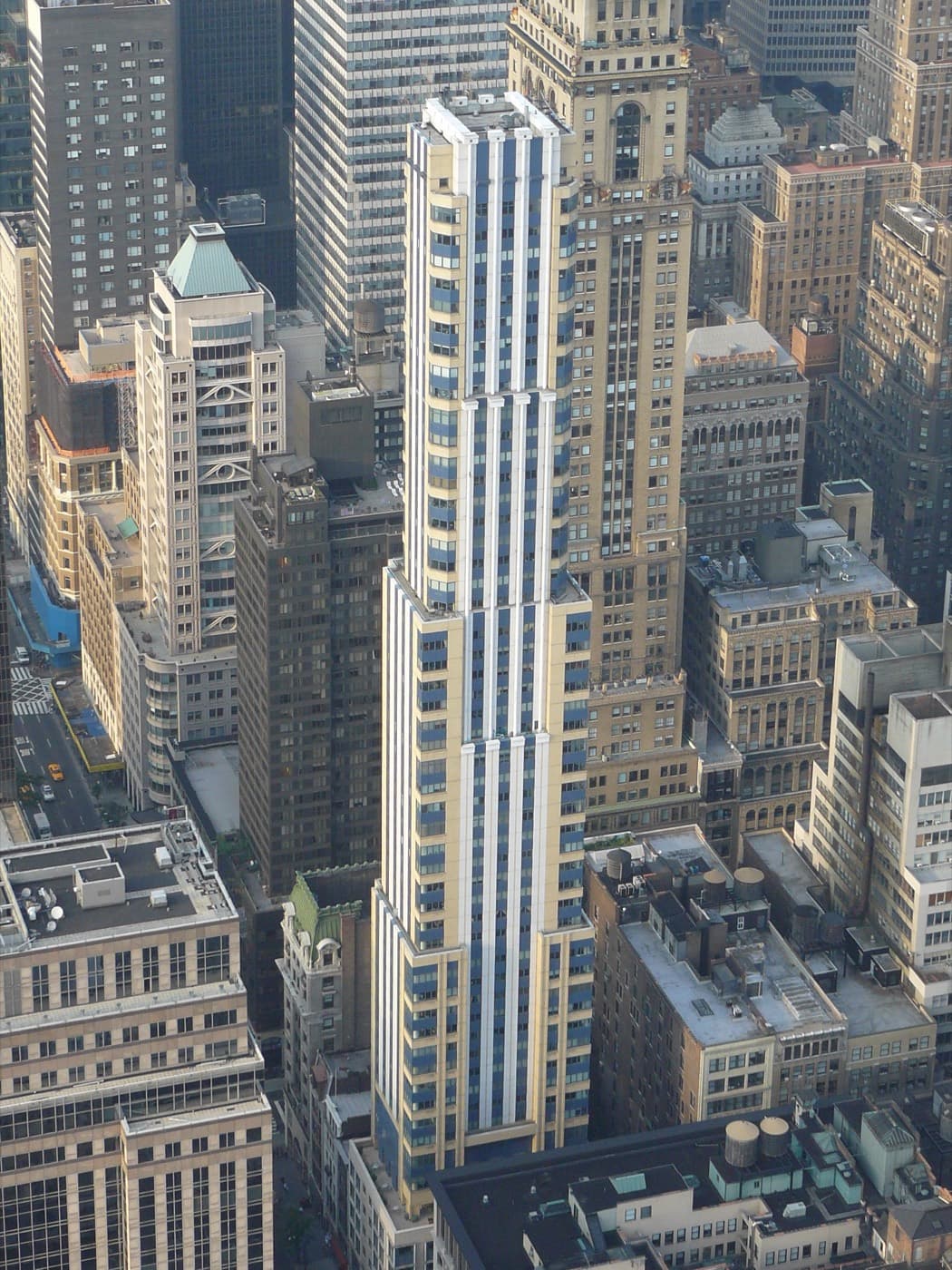
The Fifth Avenue frontage towers are purpose-built residential construction of the 2000s, and they dominate the record because a sellout of two hundred apartments generates two hundred recorded sales in a compressed period. 425 Fifth Avenue at 38th Street is the type specimen — fifty-five floors and 197 apartments to a Michael Graves design, topped out in April 2002. 400 Fifth Avenue, completed in 2010 to a Gwathmey Siegel design, combines residential and hotel use in one building, a materially different ownership structure and one to underwrite as such.
The midblock and side-street conversions are the older half, and the reason residential use here arrived by conversion rather than by design. 372 Fifth Avenue, 445 Fifth Avenue, 172 Madison Avenue and 28 West 38th Street are representative, with 159 Madison Avenue fourth by trade count. These are commercial buildings adapted to residential use, and the adaptation shows in the plans: interior columns, apartments running deep from a single exposure, ceiling heights a new tower cannot match.
The cooperative tier is 21 percent of the record and small in absolute terms, rarely enough to build a confident comparable set inside one building. A further six percent is commercial — office and retail condominium units trading in the same buildings, which is itself a fair description of the district. Price condominiums per square foot and cooperatives per room with the board terms attached, and never carry a per-square-foot figure from an avenue tower to a midblock conversion or back.
The zoning that kept housing out, and the plan that ended it
This neighborhood has so few residential addresses because for six decades most of it was not permitted any. M1-6 manufacturing zoning, which does not permit residential development, was mapped across these midblocks by the 1961 Zoning Resolution. City Planning's 1981 report described the manufacturing zoning east of Sixth Avenue as protecting some 2.4 million square feet of apparel-related industrial space from residential conversion. West of Sixth, the Special Garment Center District, created in 1987 across roughly thirteen blocks between West 35th and West 40th Streets, went further: an owner converting space to office use had to preserve an equivalent amount for manufacturing in perpetuity by restrictive declaration, a requirement the city eliminated in a 2018 rezoning. Housing arrived where it could, on the Fifth and Madison frontages outside the manufacturing districts. That is the frontage line.
On August 14, 2025 the City Council approved the Midtown South Mixed-Use Plan, rezoning roughly forty-two blocks across four non-contiguous quadrants between West 23rd and West 40th Streets and Fifth and Ninth Avenues. The quadrant covering this neighborhood is bounded, in the plan's own terms, by a line 150 feet west of Fifth Avenue on the east, 150 feet east of Sixth Avenue on the west, West 35th Street on the south and the centerline of the block between West 39th and West 40th Streets on the north — the midblocks precisely, not the avenue frontages already built out. New R11 and R12 districts permit 15 and 18 FAR of residential floor area, with Mandatory Inclusionary Housing at 20 to 30 percent of it averaging 40 to 80 percent of area median income, and the environmental review projected a net increase of roughly 9,676 dwelling units, between about 1,940 and 2,890 of them permanently income-restricted. The Council did not treat every midblock alike: it rezoned the central midblocks of the Garment Center quadrant to M1-9A, which permits no residential development, to protect garment jobs.
The conversion pipeline, and the 467-m clock
The other force reshaping the district is the conversion of obsolete commercial buildings to housing, and it runs on a dated incentive. Real Property Tax Law 467-m exempts qualifying conversions of non-residential buildings on condition that at least 25 percent of the dwelling units are rental affordable housing, at least 5 percent of them restricted at 40 percent of area median income and permanently rent-stabilized. A project must commence after December 31, 2022 and on or before June 30, 2031, and complete by December 31, 2039. In the Manhattan Prime Development Area the exemption runs at 90 percent, but the full-benefit period steps down by commencement date — thirty years through June 2026, twenty-five from July 2026, twenty from July 2028.
Two things follow. The volume is real: the Comptroller's office counts forty-four completed, ongoing and potential conversions citywide, roughly 17,400 apartments, some 14,500 of them in Manhattan south of 59th Street. And the affordability condition attaches to rental units, so a building taking the benefit is not delivering a condominium sellout. Much of what conversion adds around you will be rental — changing the block, the evening population and the retail, but not enlarging the resale comparable set the caveat on this series already calls thin.
What to know if you're buying here
Separate the sponsor closings before you conclude anything. At 24.4 percent sponsor-flagged and 64.1 percent arm's-length, a third of the recorded history at these addresses is something other than a resale. Pull the building's own record, strip out the sellout period and count what remains. In several buildings here the answer is a handful of resales, and a handful is what your price is built on.
Establish which side of the frontage line the building sits on. A 2000s avenue tower and a midblock conversion of a 1910s commercial building are different assets with different cost structures, efficiencies and buyers. Comping across that line is the most common analytical error made here.
Underwrite the commercial half of the building. These are buildings with office units, retail condominium units and, at 400 Fifth Avenue, a hotel operation. Get the common-charge allocation between residential and commercial units, the voting control, whether reserves are shared and what the commercial units owe. Lenders look hard at a heavy commercial component, and a constraint that surfaces only in your buyer's underwriting constrains your resale too.
Check the tax position, and price the rezoning as a construction horizon. Carrying cost here can be scheduled to change on a known date: confirm the exemption code, start year and term against the Department of Finance record, and underwrite the number after it steps up. The rezoning applies to the midblocks around you, not to your apartment, and its projections run over a decade — what it delivers near term is sites, scaffolding and sightline risk.
What to know if you're selling here
Your building's sponsor history is public, and the buyer's agent will find it. Where five addresses carry sixty-three percent of the record, no scarcity argument is available. Build your price from your own line, exposure and floor, and be ready to explain why the sellout prices are not the comparable set.
The buyer pool is narrow and knows what it wants. People buy here for central location, transit and an unusual floor plate, not for schools, parks or evening street life. Price for that pool, and plan a longer marketing period rather than treating a slow start as a pricing failure.
Bring the carrying cost and the building's structure forward. Common charges, assessments, the residential-to-commercial allocation, any abatement schedule and the capital plan are what re-trade deals here. A seller with those documents to hand on day one removes the most common cause of a renegotiation.
Where it sits in the Index
Midtown South publishes with 2,147 index-eligible sales across 78 addresses under the publish_with_caveat flag — new-development-heavy, thinner resale base — one of three Midtown leaves carrying it. Read its condominium and cooperative lines as indicative rather than settled, and set them beside the deeper resale records in NoMad and Murray Hill. See the Roebling Index for the current read.
Run the numbers
Related guides
- NoMad — A Buyer's Guide — the sibling south, same building type on a deeper record
- Murray Hill — A Buyer's Guide — east of Madison, the resale market to comp against
- Manhattan Apartment Buying Guide — Pillar 2
- NYC Real Estate Tax & Closing Cost Guide
Buildings in Midtown South
Get the neighborhood read on your building.
See how your apartment compares with the rest of Midtown South, or get a market update tuned to this neighborhood — sent to you directly.