Robert A.M. Stern Architects (founded 1969) has produced the dominant traditionalist trophy condominium portfolio of the 21st-century Manhattan market. The firm's limestone-clad work — 15 Central Park West (2008), 220 Central Park South (2018), and 520 Park Avenue (2018) — has repeatedly set per-square-foot records, with 220 CPS's $238M penthouse and 15 CPW's full-floor inventory anchoring the broader ultra-luxury market. Stern buildings consistently command premium pricing within their respective corridors because the firm's program (pre-war-styled floor plans, classical detailing, mature amenity stacks) reads as a continuation of the Candela / Carpenter canon at modern construction standards — a structural advantage over peer contemporary glass-and-steel condominium inventory.
The argument that won
For roughly four decades, an argument ran through the back rooms of American architectural practice about whether contemporary luxury residential design should be modernist or traditionalist. The modernists held the academy and the prize circuits; the traditionalists held a substantial portion of the actual paying clientele. Throughout the 1980s and 1990s the dispute felt unresolved. By 2008 it was effectively over. The building that ended it was 15 Central Park West, and the architect was Robert A.M. Stern.
The argument was not really about taste. It was about whether buyers paying tier-one Manhattan prices for new construction would accept buildings that drew their architectural language from the pre-war Carpenter / Candela / Cross & Cross tradition — limestone-clad facades, classical proportioning, formal entry galleries, restrained but generous fenestration — or whether they expected the glass-and-steel vocabulary that had dominated postwar luxury construction. 15 CPW answered the question commercially. Its initial sales between 2007 and 2010 generated north of $2 billion in transactions and produced a price-per-square-foot premium over comparable contemporary supertalls that has persisted across nearly two decades and multiple market cycles. The lesson developers extracted from the result was structural: buyers would pay supertall premiums for buildings that looked pre-war, executed at modern construction scale and engineering, on Park-facing Manhattan land. Every subsequent serious trophy condominium has been calibrated against that finding.
Stern did not invent the pre-war revival posture. Other contemporary architects — Allan Greenberg, Peter Pennoyer, Richard Cameron, Andres Duany — have built distinguished practices in similar territory. But Stern is the only contemporary architect who has executed the revival argument at supertall residential scale, in the most expensive Manhattan submarkets, repeatedly, with the development partners who actually built the most consequential trophy condominiums of the 2010s. The result is a body of work that is genuinely consequential to how Manhattan luxury real estate looks, prices, and operates today.
This piece is a long-form look at Stern's biography, the architectural argument he won, the Manhattan residential corpus that demonstrated it, and how to think about a Stern building as a buyer in 2026. The Roebling Team at Compass maintains individual building pages for nine RAMSA commissions in our research library — the three Park-facing trophies that anchor this piece (15 Central Park West, 220 Central Park South, and 520 Park Avenue), plus the broader Manhattan portfolio at 30 Park Place, 70 Vestry Street, 200 East 83rd Street, 205 East 85th Street, 215 West 84th Street, and The Bellemont at 1165 Madison; this is the architect-level companion piece. Where credible sources disagree on attribution or detail, the dispute is flagged in the body of the piece rather than resolved.
Who he is
Robert Arthur Morton Stern was born May 23, 1939 in Brooklyn. He attended Columbia University as an undergraduate (BA, 1960) before entering the Yale School of Architecture, where he received his Master of Architecture in 1965. His Yale education placed him inside two faculties that shaped a generation of American architects: he studied design under Paul Rudolph, then chair of the architecture school and one of the most prominent late-modernist practitioners in the country, and architectural history under Vincent Scully, the long-tenured Yale professor whose lectures on American architecture were among the most influential of the postwar period. Scully's work in particular — his readings of shingle-style domestic architecture and his sustained argument for the seriousness of historical reference in contemporary practice — is the clearest single intellectual influence on Stern's mature career.
Stern began his independent practice in 1969, initially under the name Stern & Hagmann with partner John S. Hagmann. The firm reorganized in 1977 and was renamed Robert A.M. Stern Architects (RAMSA); the firm has operated under that name continuously since. Early commissions were predominantly residential — single-family houses in the East Coast suburbs, vacation houses in the Hamptons and Connecticut, and small-scale renovations and additions for a clientele that valued classical and shingle-style detailing at a moment when most contemporary architects were producing late-modernist work. The early portfolio is now widely cited as one of the foundational bodies of American postmodernist domestic architecture, though Stern himself has at times rejected the postmodernist label in favor of the broader designation of "traditional" or "contextual."
Two parallel careers ran through the firm's first three decades. The first was architectural — RAMSA grew through the 1980s and 1990s into a substantial New York-based practice with portfolios across institutional, commercial, and residential work, expanding well beyond the single-family commissions that had defined its early years. The second was academic. Stern taught at Columbia and Yale for decades; in 1998 he was appointed Dean of the Yale School of Architecture, a position he held for eighteen years until 2016. The deanship is structurally significant to his legacy and is treated below in its own section.
By 2026, RAMSA operates as one of the largest classically-oriented architecture firms in the world, with hundreds of staff across a New York headquarters and additional offices. The portfolio includes campus master planning for major universities (including substantial work at Yale, Harvard, the University of Virginia, and others), institutional buildings (most prominently the George W. Bush Presidential Library in Dallas, completed 2013), commercial towers, and the residential work that is the subject of this piece. Stern himself, in his ninth decade, remains active in the firm's senior design leadership.
The academic and written legacy
It is difficult to discuss Stern's reach in American architecture without first taking the academic and written work seriously. The deanship and the books are the substrate on which the residential commissions rest.
The Yale deanship, from 1998 to 2016, reshaped American architectural education in measurable ways. When Stern took over, Yale's architecture program was — like most elite American architecture schools — predominantly oriented toward late-modernist and deconstructivist practice; the curriculum reflected the prevailing assumption that contemporary design culture had moved past historical reference. Stern's tenure brought traditional, classical, and contextual practice back into the school as a legitimate intellectual position. He hired faculty across the stylistic spectrum, including practitioners who would have been excluded from Yale a decade earlier; he expanded the school's preservation and history program; and he treated traditional design as an equal seat at the curricular table rather than a marginalized counter-position. The Yale program under Stern produced graduates working seriously in classical and traditional practice in a way that no other top-tier American architecture school did during the same period. The effect was disproportionate: Yale's graduates populated a substantial share of the senior leadership of New York architectural firms, and the legitimacy that Stern gave traditional practice at Yale has been part of the broader rehabilitation of the vocabulary across the profession.
The written work is the other half. Stern has been a working architectural historian throughout his career, and his most consequential authorship is the New York series — a multi-volume documentary history of New York City architecture and urbanism that he has co-authored with various collaborators over four decades. The volumes published to date include New York 1880 (1999), New York 1900 (1983), New York 1930 (1987), New York 1960 (1995), and New York 2000 (2006). Each volume documents the architectural and urban development of New York across a thirty-year period; collectively the series runs to several thousand pages of text, photographs, plans, and primary-source documentation. The series is widely treated as the canonical reference for modern New York architectural history. Working brokers, architectural historians, preservationists, and serious students of the city's built environment routinely keep one or more volumes on the shelf. The New York series is, in a meaningful sense, the architectural-historical complement to Stern's residential practice: the volumes document with rigor the pre-war Manhattan apartment-house tradition that his RAMSA commissions explicitly extend.
The combined effect — the deanship, the books, the residential corpus — is that Stern is not simply a luxury-developer collaborator who happens to design pre-war-styled buildings. He is an architectural historian and educator who has spent six decades arguing, in writing and in practice, that the New York pre-war tradition is a serious contemporary design vocabulary. The residential commissions are the operational expression of an intellectual position that has been documented in libraries and taught in classrooms for forty years.
The residential breakthrough: 15 Central Park West
In 2003, the Zeckendorf brothers — Arthur W. Zeckendorf and William L. Zeckendorf, third-generation Manhattan developers from a family with a multi-decade real-estate development practice — acquired the Mayflower Hotel site at the southwest corner of Central Park West and 61st Street and began assembling the air-rights envelope necessary for the building they wanted to construct. Their initial plan was the modern Manhattan luxury-condominium default of the early 2000s: a glass-curtainwall supertall, optimized for view altitude, scaled to the speculative-condominium economics of the moment. The Zeckendorfs spent several months in development before reaching the architectural conclusion that defined the rest of their careers: the building should not be a glass supertall. It should look pre-war. They commissioned Robert A.M. Stern.
The reasoning was strategic. The Zeckendorfs had read the Manhattan luxury buyer pool carefully. Their finding was that the apex of the contemporary buyer set — the international wealth pool that would set the pricing curve on the project — placed structural value on architectural seriousness. A glass supertall would compete on view altitude and amenity package with One57 (then in development one block north) and the broader 57th Street supertall cohort. A pre-war-styled building, on the other hand, would compete on a different axis entirely: it would offer the architectural prestige of pre-war Central Park West, executed at modern construction scale, with the condominium flexibility (foreign ownership, pied-à-terre intent, financing latitude, lighter board scrutiny) that pre-war cooperatives explicitly prohibited. The bet was that a meaningful segment of buyers would pay a substantial premium for that combination — and that the building, by virtue of its architectural posture, would also pull in the broader supertall pool as a more architecturally serious alternative to the glass-curtainwall set.
15 Central Park West, completed in 2008, executed the argument. The 202-unit building is configured as two connected structures: a 19-story "House" facing 61st Street, with larger floor plates and the building's more architecturally substantial apartments, and a 35-story "Tower" facing 62nd Street, with higher altitudes and a wider range of unit configurations. The facade is clad in Indiana limestone, with proportions and detailing that explicitly reference early-twentieth-century McKim, Mead & White work, particularly the firm's 998 Fifth Avenue across the Park. The two-tower configuration is, on Stern's own account, a deliberate echo of the Art Deco twin-towers tradition on Central Park West — the San Remo, the Eldorado, the Majestic — though Stern's silhouette is more classical and less Deco than its CPW neighbors. The building's interior treatment carries the same vocabulary: 11-to-13-foot ceilings in primary rooms, formal entry galleries, library-living-room sequences, primary suites configured for substantial closet and dressing infrastructure, materials and finishes scaled for the price points the building serves.
The commercial result vindicated the architectural argument with unusual clarity. Initial sales generated over $2 billion in aggregate transactions across the 2007-2010 sales window. The most prominent early transactions — Lloyd Blankfein, Sting, Denzel Washington, Goldman Sachs senior leadership — were treated as cultural reference points in the architectural and real-estate press throughout the late 2000s. Pricing held remarkably stable through the 2008-2010 financial crisis, which collapsed pricing at many peer supertalls, and the building's price-per-square-foot has continued to outperform broader Manhattan ultra-luxury through subsequent cycles. As of 2026, 15 CPW remains one of the most reliably-pricing condominium buildings in the city, and apartments routinely transact at premiums over comparable inventory in newer supertalls.
The architectural lesson that the development industry extracted was specific. Buyers were not merely willing to accept the pre-war revival posture; they would pay structural premiums for it, on a sustained basis, across cycles. The implication was that the next generation of Manhattan trophy condominiums should be designed with pre-war classical reference — and the architect with the most credible portfolio in that vocabulary was Stern. 15 Central Park West building profile →
The apex commission: 220 Central Park South
If 15 CPW established the typology, 220 Central Park South demonstrated its scale ceiling. Stern's commission for Vornado Realty Trust, completed in 2018, is the apex of the residential corpus and the building that defines the modern Manhattan ultra-luxury tier.
Vornado, under the development leadership of Steven Roth, acquired the 220 CPS site through a multi-year assembly process across the late 2000s and early 2010s. The site sits on Central Park South between Broadway and Seventh Avenue — a location with unobstructed northern views directly up Central Park, a position that no comparable contemporary supertall could match. Roth's strategic decision was to invest in architectural seriousness rather than in pure view altitude. The 57th Street supertalls — One57 (Christian de Portzamparc, 2014), Central Park Tower (AS+GG / Adrian Smith and Gordon Gill, 2020), 111 West 57th (SHoP, 2021), and 432 Park Avenue (Rafael Viñoly, 2015) — were pursuing the view-altitude / glass-curtainwall / amenity-package strategy. Roth's contrarian bet was that 220 CPS could outprice all of them by being the architecturally substantial supertall in the cohort. He commissioned Stern.
The result is configured as two connected structures: a 16-story "Villa" on the south side, with larger floor plates and the building's most architecturally generous apartments, and a taller "Tower" on the north side with higher view altitudes and a wider range of unit sizes. Source attribution note: published descriptions of the tower height vary. The building's primary-source sales materials and certain trade-press accounts describe the Tower as a 65-story structure; other published references describe it as approximately 70 stories; certain reporting places the building at 79 floors or roughly 950 feet at the architectural top. The variance appears to reflect different conventions for counting mechanical floors, the elevation of the topmost occupied floor, and the distinction between Tower and Villa portions. (Reported floor count varies across sources.) The facade is clad in limestone with classical proportioning. The amenity program is substantial — fitness center, pool, spa, residents' lounge, private dining, screening room, library — and explicitly more institutional in posture than the larger amenity packages at Central Park Tower or 111 West 57th. The architectural and operational design favors the building over the apartment, in a way that distinguishes 220 CPS from its 57th Street peers.
The commercial result has anchored the modern trophy market. The building's primary sales window (2017–2019) generated over $3 billion in aggregate transactions — by reported figures, the highest-grossing residential condominium sales total in New York City history at completion. The most prominent transaction — hedge-fund founder Ken Griffin's $238 million purchase of the multi-floor penthouse, recorded in 2019 — set a U.S. residential record that, as of 2026, has not been exceeded. Secondary-market transactions in the building have continued to anchor the trophy tier; multiple resales have exceeded $50 million; the building's overall pricing curve has materially outperformed peer 57th Street supertalls across the seven years since its initial sales window. Stern's architectural argument, executed at 220 CPS scale, produced a building that has out-priced its more architecturally adventurous neighbors on a sustained basis. 220 Central Park South building profile →
The Park Avenue corollary: 520 Park Avenue
While 220 CPS was rising on Central Park South, Stern and the Zeckendorf development team were executing the Park Avenue corollary. 520 Park Avenue, completed 2018, applies the same architectural premise to Park Avenue itself — the corridor that the pre-war Candela, Cross & Cross, and Delano & Aldrich tradition originally defined and that, until 520 Park, had received no comparable contemporary supertall commission.
The Zeckendorfs assembled the 520 Park site through a multi-year air-rights consolidation involving adjacent tenement properties. The completed building rises to 781 feet across 54 stories and contains thirty-three condominium residences — an unusually low unit count for a modern supertall, scaled closer to the smallest pre-war Gold Coast cooperatives (740 Park's thirty-one apartments; 720 Park's twenty-nine) than to the typical modern condominium configuration of 100-to-180 residences. The average apartment size is approximately 5,400 square feet, with multi-floor penthouses exceeding 12,000 square feet.
The architectural argument at 520 Park is the most aggressive of the Stern residential corpus. The building is entirely clad in Indiana limestone — hand-set, full-height across all 781 feet — a material specification that distinguishes it from every peer modern supertall, all of which use precast concrete or glass curtainwall. The campanile-form tower, set 15 feet back from the entrance, joins the broader silhouette of slender Manhattan trophy towers including the Sherry-Netherland (Schultze & Weaver, 1927) and The Pierre (Schultze & Weaver, 1930) at the southeast corner of Central Park — a deliberate architectural conversation across nearly a century. The three-story base massing complements the immediately adjacent Grolier Club (Bertram Goodhue, 1917) and Christ Church (Cram & Ferguson, 1931), which establishes the building's contextual posture relative to the Lenox Hill streetscape.
Inside, the apartment-design vocabulary follows the same pre-war classical logic Stern deployed at 15 CPW and 220 CPS, scaled up: 11-to-12-foot ceilings, formal entry galleries with grand proportions reminiscent of Candela / Cross & Cross original detail, library-living-room combinations, primary suites with substantial closet and dressing infrastructure, formal dining rooms with butler's pantries, service wings. The premise is that 520 Park's apartments should function as full-scale Park Avenue pre-war apartments executed at modern engineering scale — and the floor-plate work delivers on that brief. The building's primary sales activity in 2018–2020 produced a series of substantial transactions, including a penthouse trade reported in late 2018 at $68 million and multiple full-floor configurations transacting in the $30 million–$60 million range. The top penthouse reached a $130 million marketing position.
520 Park is, structurally, the Park Avenue equivalent of 15 CPW: the same Zeckendorf development team, the same Stern architectural firm, the same architectural premise that pre-war classical vocabulary executed at modern engineering scale can extend the Manhattan trophy tradition. Where 15 CPW opened the modern pre-war-styled condominium era on Central Park West, 520 Park anchored the same posture on Park Avenue. 520 Park Avenue building profile →
The broader RAMSA Manhattan residential portfolio
Beyond the three primary commissions covered above, RAMSA's contemporary Manhattan residential portfolio includes several other buildings that warrant note for buyers thinking about the broader Stern corpus.
30 Park Place / Four Seasons Private Residences New York (2016) — the Silverstein Properties development at the corner of Park Place and Church Street in Tribeca, combining a Four Seasons Hotel on the lower floors with condominium residences above. The building is a 926-foot tower with 157 residential units. Stern's design language pulls from the classical Manhattan high-rise vocabulary — limestone-and-precast lower stories, ornamented setbacks, restrained classical detailing — applied to the Lower Manhattan / Tribeca context rather than the Park-facing corridor. Trade-press treatment of the building has positioned it as the most architecturally serious contemporary trophy commission in Lower Manhattan.
20 East End Avenue (2017) — a smaller-scale RAMSA condominium on East End Avenue between 80th and 81st Streets, developed by Corigin Real Estate Services. The building is a 19-story, 43-unit limestone-clad residence in the Carl Schurz Park / Yorkville Gold Coast neighborhood. The scale is closer to a pre-war cooperative than a modern supertall, and the architectural posture is correspondingly restrained — the building is treated in published commentary as one of the most successful contemporary executions of the small-scale Manhattan luxury cooperative vocabulary, despite operating as a condominium.
70 Vestry Street (2018) — a Related Companies commission in Tribeca's West Street corridor. The building is more contemporary in palette than the Park-facing Stern commissions — the facade incorporates more glazing and a less explicitly classical vocabulary — though the floor-plate work and interior planning remain recognizably Stern. The 47-unit building has produced a series of substantial transactions in the Tribeca market.
The broader RAMSA Manhattan residential corpus extends further, with additional condominium and mixed-use commissions across Midtown, Upper East Side, and various neighborhoods. The firm has also designed substantial multi-family residential work outside Manhattan — Brooklyn, Long Island City, Westchester, and major projects across other American cities — but the Park-facing Manhattan corpus is the part of the portfolio most relevant to the trophy-condominium buyer pool that the Stern brand most directly serves.
What Stern authorship means for value
Several practical considerations follow from Stern authorship that buyers and sellers should weigh at the building level.
The pre-war revival argument resonated with the trophy buyer pool. The commercial premise behind these buildings — pre-war architectural presence at modern construction scale, without the board constraints of a pre-war cooperative — is the same one that has drawn the international trophy-condominium buyer to 15 CPW, 220 CPS, and 520 Park. Each building's pricing history is a matter of public record and closely tracked in the trade press. Whether the Stern credit itself carries a measurable price premium — as distinct from location, floor, view, and finish — is not something a recorded-sales model can isolate cleanly, so we describe the demand rationale rather than assert a firm-name premium: a meaningful segment of this buyer set places value on architectural seriousness, and Stern's work is among the most recognized expressions of it in the contemporary supertall category.
Construction quality and material specification tend to be unusually substantial. Limestone cladding (hand-set Indiana limestone, in the case of 15 CPW, 520 Park, and substantial portions of 220 CPS) is a meaningfully more expensive facade specification than the precast concrete or glass curtainwall used at most peer modern supertalls. Interior materials — oak floors, marble, custom millwork, high-grade hardware and fixtures from the original sponsor specification — are scaled to the price points the buildings serve. The construction quality contributes to the buildings' value retention: apartments built with these materials age better than peer condominium inventory and require less remedial capital across long holding periods.
Floor plates favor the apartment-as-experience over maximum-bedroom-count efficiency. Stern's residential planning carries the pre-war Candela / Cross & Cross / Carpenter discipline: formal entry galleries, library-living-room sequences, primary-suite separation, generous closet and dressing infrastructure. Buyers comparing dollar-per-bedroom against newer glass-curtainwall supertalls sometimes find Stern buildings less competitive on raw bedroom count — the same apartment, redesigned with modern open-plan vocabulary, would hold an additional bedroom. The trade-off is intentional. Stern buildings are designed for buyers who value the daily-life-versus-entertaining geometry of the pre-war floor plate, and the pricing curve reflects that buyer preference.
The amenity package is institutional rather than maximalist. Compared to Central Park Tower's roughly 50,000-square-foot amenity program or 53 West 53rd's elaborate wellness center, the Stern supertalls are deliberately quieter in amenity posture. The buildings include the standard fitness / pool / spa / residents' lounge / private dining infrastructure but stop short of the maximalist offerings at the largest competing supertalls. The architectural argument is that the building itself is the amenity; the operational result is that common charges, while still substantial, run modestly below peer supertall levels.
The buyer pool is the most heterogeneous in the modern condominium tier. Where many supertalls draw primarily international demand and where pre-war cooperatives draw primarily domestic demand, Stern buildings draw both pools meaningfully. The architectural seriousness pulls buyers who would otherwise have purchased into pre-war cooperatives (and chose the condo route specifically for the financial flexibility — foreign citizenship, complex finances, pied-à-terre intent, lighter board scrutiny). The supertall scale pulls the international wealth pool that anchors the modern condominium market generally. The combination — pre-war architectural credibility plus condo flexibility — is unusual in either category and unique in their combination, and is a substantial part of why the buildings price the way they do.
Renovation expectations are condominium-typical but architectural-character-aware. Stern buildings are not landmarked (most are too recent), but the building boards and sponsor management typically maintain expectations that renovation should respect the building's architectural character. Modern open-plan overhauls that erase the pre-war floor-plate discipline are technically permissible but receive friction from neighbors, brokers, and the broader buyer pool when the apartment is eventually resold. Buyers planning extensive renovation should weigh resale implications carefully.
Buying a Stern today
If you are evaluating a Stern building in 2026, several practical considerations follow.
Confirm the building's specific Stern attribution. RAMSA is a substantial firm that has executed many buildings; not all of them are operating at the architectural register of 15 CPW or 220 CPS. The peak-tier Manhattan Stern residential commissions are a narrow set; the broader portfolio includes work at different price points and architectural ambitions. Confirm the specific commission's design history before paying a Stern-tier premium.
Compare against the pre-war alternatives explicitly. A buyer considering a Stern condominium typically also has the option of a comparable pre-war cooperative — at 15 CPW, the alternative is the Beresford or the San Remo; at 520 Park, the alternative is 740 Park or 720 Park. The comparison is structural. The Stern condominium offers the financial flexibility (foreign ownership, pied-à-terre intent, financing latitude, faster closing, lighter board scrutiny); the pre-war cooperative offers a longer architectural pedigree, a different cultural register, and typically a lower carrying cost on a comparable-priced apartment. The right choice depends on the buyer's specific posture — and a serious comparative evaluation across both options, at the apartment level, is the right starting point.
Pricing tiers within the Stern Manhattan residential corpus are wider than buyers often assume. At the apex — full-floor or multi-floor configurations at 220 CPS, 15 CPW, or 520 Park — apartments routinely transact between $30 million and $100+ million, with trophy combinations transacting at three-digit-million figures. In the middle tier — smaller configurations at the same three buildings, or full apartments at 30 Park Place, 20 East End Avenue, or 70 Vestry — pricing typically ranges from approximately $5 million to $25 million for 2-3 bedroom configurations. The shared architect provides design quality across the portfolio; the price differential reflects building scale, address, view envelope, and the supertall premium where applicable.
Mansion tax cliff effects routinely matter. At Stern Manhattan condominium pricing, the $5M, $10M, $15M, $20M, and $25M cliff thresholds apply across most transactions. Buyers should run pricing through the Mansion Tax Calculator before structuring offers.
Carrying cost analysis is structurally important. Common charges and property taxes at the supertall Stern commissions can run $15,000–$30,000+/month on substantial apartments. Sophisticated buyers model the full carrying-cost stack and weigh it against the apartment. Sellers should expect detailed financial modeling from buyers and should be prepared with answers about future common-charge trajectory.
The international buyer pool is real and material. Marketing a Stern apartment for resale typically benefits from broker access to international networks — Compass's private exclusive program, REBNY's international broker outreach, and private network outreach to brokers serving Asian, Middle Eastern, and European buyer pools. The Stern brand is recognized globally to a degree that meaningfully exceeds most peer architects, and the marketing strategy for resale should reflect that buyer geography.
The cultural legacy
Beyond the residential corpus, Stern's broader effect on contemporary Manhattan trophy real estate is structural. The pre-war revival argument that he established at 15 CPW has shaped how every subsequent serious trophy developer thinks about facade design. The buildings that followed — 220 CPS, 520 Park, 30 Park Place, the broader pre-war-styled trophy cohort that emerged in the 2010s — were calibrated against the 15 CPW finding that buyers would pay supertall premiums for pre-war architectural seriousness. Even the buildings that did not follow the Stern argument — the glass-curtainwall supertalls along 57th Street — defined themselves explicitly against it, as the architectural alternative for buyers who preferred view altitude and contemporary vocabulary over pre-war classical reference. The argument is now load-bearing across the modern Manhattan trophy market; both sides reference it.
The academic legacy at Yale is the second-order effect. A generation of senior architects working in classical and traditional practice across New York firms passed through the Yale School of Architecture during Stern's deanship. The legitimacy that Stern gave traditional design within American architectural education has changed the supply of architects available to do this kind of work — which means the pre-war revival vocabulary is now available not only at the apex of the trophy market (the Stern commissions themselves) but at the next tier down, where Stern-trained alumni populate the senior design ranks at the firms that develop and design pre-war-styled buildings across Manhattan and beyond.
The written work — the New York series — is the third effect. The volumes have become the canonical reference for modern New York architectural history, used by architects, preservationists, developers, brokers, and historians as a documentary record of the city's architectural development. Stern is, by virtue of the New York series, a serious architectural historian; the residential commissions are the operational expression of the intellectual position the books document.
The combined result is unusually substantial for a contemporary architect. Most contemporary practitioners influence design culture through their built work. Stern has influenced design culture through built work, through architectural education, and through documentary history simultaneously, across six decades. The pre-war revival argument that ran through the back rooms of American architectural practice for forty years was won, in the end, by an architect who was operating on all three fronts at once.
Working with The Roebling Team
The Roebling Team at Compass specializes in Central Park West, the Upper East Side, and the broader Park-facing Manhattan market — which includes the three Stern commissions most relevant to our buyer and seller pool: 15 Central Park West, 220 Central Park South, and 520 Park Avenue. We publish individual building pages for each of these, and we maintain working transactional context on the broader Stern residential corpus. If you are considering a purchase or sale at a Stern building — at any tier of the portfolio — a thirty-minute consultation is the right starting point. We bring building-specific context (architecture, operational reality, transactional mechanics, pricing at the apartment level) plus the comparative perspective across the broader pre-war revival corpus and the pre-war cooperative alternatives that buyers and sellers need to make informed decisions in this tier of inventory.
Corey Cohen, Principal The Roebling Team at Compass 646.939.7375 · c.cohen@compass.com
Run the numbers
- Mansion Tax Calculator — at Stern-building pricing, multiple cliff thresholds routinely apply
- Buyer Closing Cost Calculator
- Seller Closing Cost Calculator
Related building profiles
- 15 Central Park West — Stern / Zeckendorf 2008
- 220 Central Park South — Stern / Vornado 2018
- 520 Park Avenue — Stern / Zeckendorf 2018
Related guides
- Park-Facing Apartments Guide — Pillar 5 — comparative analysis of CPW vs. Fifth Avenue vs. CPS submarkets
- Manhattan Apartment Buying Guide — Pillar 2
- Manhattan Co-op Buying Guide — Pillar 4 — for buyers weighing Stern condominiums against pre-war cooperative alternatives
- NYC Real Estate Tax & Closing Cost Guide — Pillar 3
Related architect spotlights
- Rosario Candela: The Architect Who Defined Manhattan's Luxury Apartment — the pre-war predecessor whose floor-plate discipline Stern's contemporary corpus explicitly extends
- J.E.R. Carpenter — the Fifth Avenue pre-war architect whose tradition Stern's Park-facing corpus references
- Emery Roth — the Central Park West pre-war architect whose twin-tower silhouette Stern echoes at 15 CPW
This page reflects publicly available information and The Roebling Team transaction experience. The Roebling Team at Compass does not represent any individual building's management, board, or sponsor. Sources triangulated across Robert A.M. Stern Architects (ramsa.com) firm portfolio documentation, Architectural Record, The Architect's Newspaper, The New York Times architectural coverage (notably Paul Goldberger and the late David Dunlap), and primary-source sales and offering materials from Zeckendorf Development and Vornado Realty Trust. Where credible sources disagree on attribution or detail, the dispute is flagged in the body of the piece rather than resolved. © 2026 The Roebling Team at Compass.
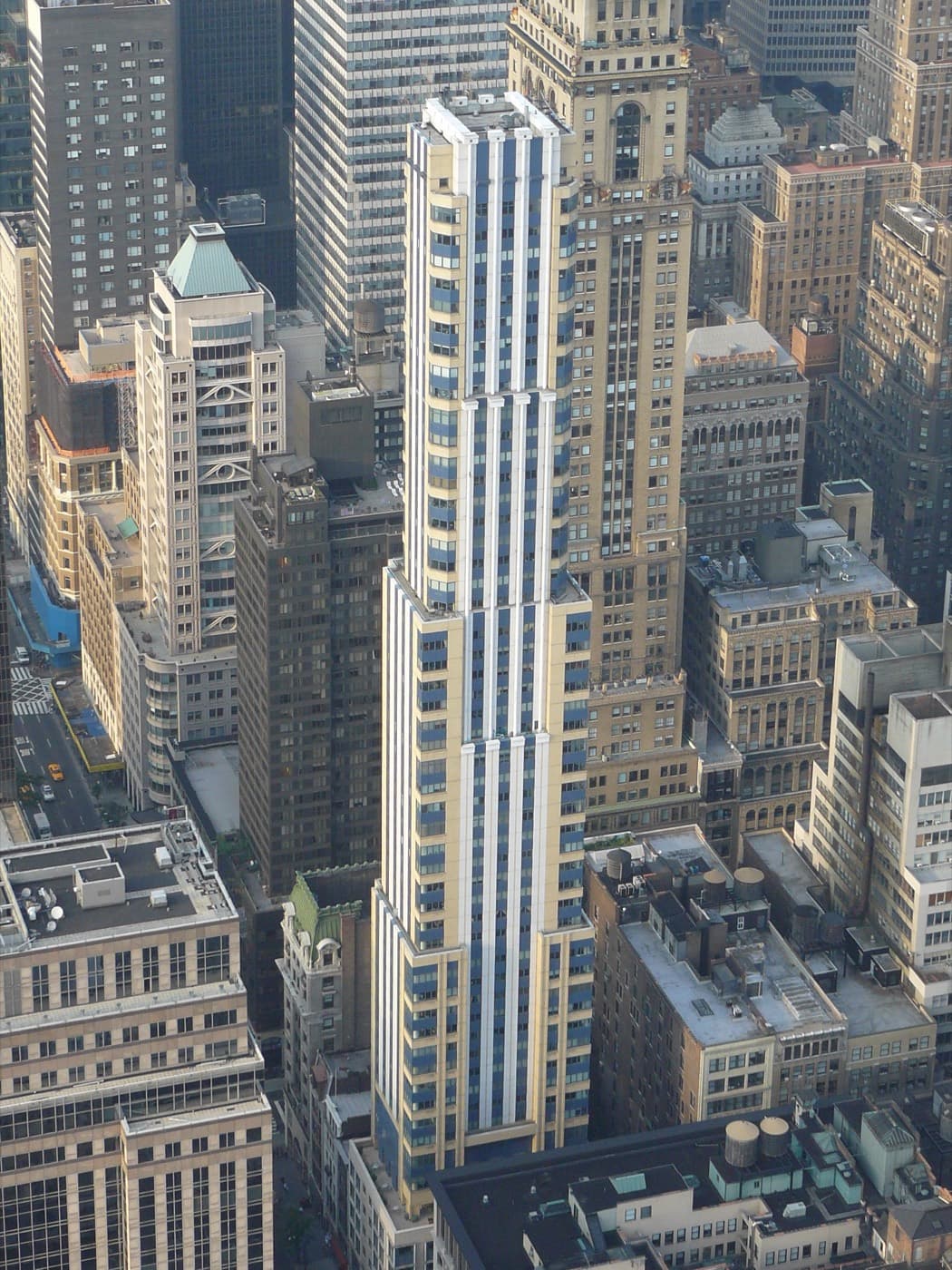
Buildings designed by Robert A.M. Stern Architects




The drawings are public. The rest isn't.
How these buildings have actually traded, which lines deliver what the plans promise, and how each board handles financing and approvals.